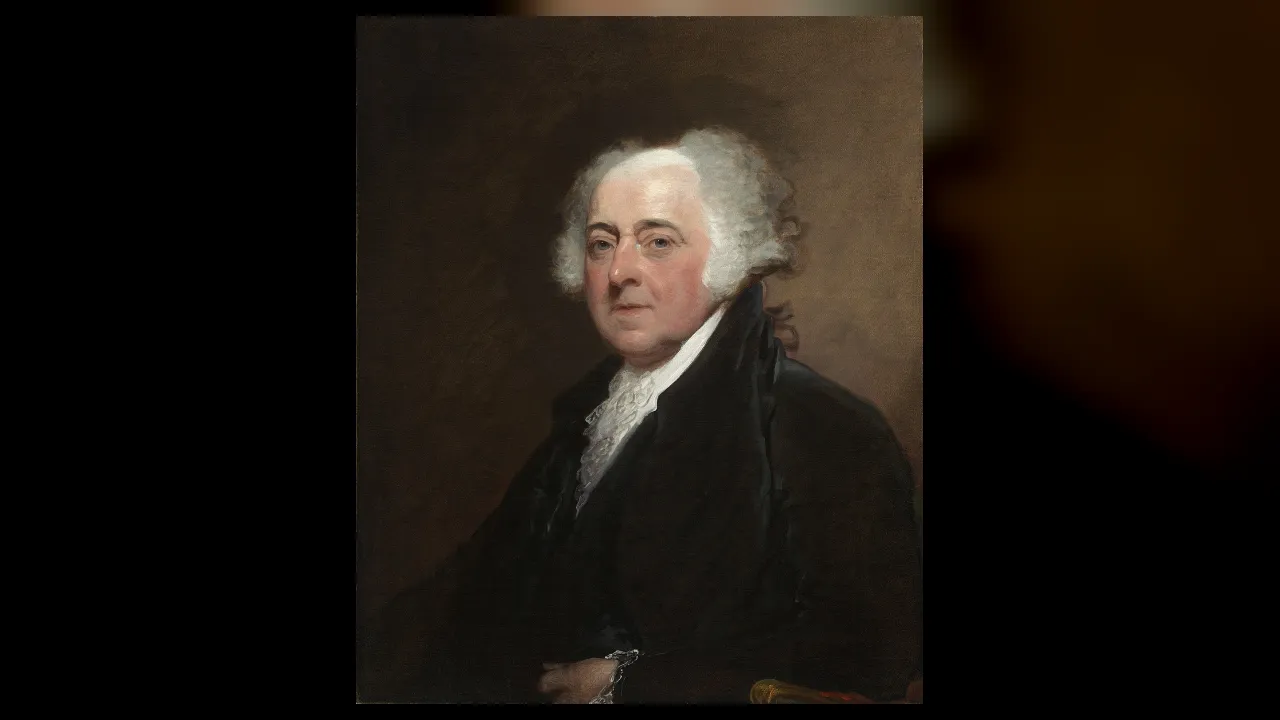
🇺🇸 U.S. HISTORY
🏛️ 2nd President of the United States (1797–1801) • Founding Father
VA History & Social Science SOL K.1, 1.2, 2.4, VS.1–VS.10, USI & USII
John Adams
Bold Voice for Independence and Fair Laws
Grade 3 • Fluent • 156 words
⏳ Era / StatehoodPresidency: March 4, 1797 – March 4, 1801 (1735–1826)
🗺️ Region / CapitalQuincy (Braintree), Massachusetts • Peacefield
📜 Key MilestoneChampion of the Declaration of Independence, U.S. Navy founder, and 1st White House resident
⚡ Historical SparkProved America is a nation of fair laws—not angry crowds—and kept the young republic at peace
🤯 Mind-Blowing Fact • Grade 1
When John and Abigail Adams first moved into the unfinished White House in November 1800, Abigail hung clean laundry to dry inside the giant East Room!
✨ Word Sparks (Grade 1 Glossary)
Tap 🔊 to hear
gavel
small wooden hammer tapped to call order
vice president
second-highest elected leader helping the president
fair
following honest rules equally for everyone
🪝
Who was the very first president to unpack boxes inside the brand-new White House?
1
Speaking Up for Freedom
Tap goes the in a busy hall! John Adams stood up bravely and urged leaders to vote for American freedom.
2
Our Second President
First he helped George Washington as . Next, voters chose John Adams as our second president!
3
Moving Into the White House
Wet paint still smelled fresh when John and Abigail Adams moved into the brand-new White House in 1800!
1. Which number president of the United States was John Adams?
2. What milestone did John and Abigail Adams set in Washington, D.C., in 1800?
🤯 Mind-Blowing Fact • Grade 2
John Adams and his son, John Quincy Adams (the sixth president), were the very first father and son to both serve as President of the United States!
✨ Word Sparks (Grade 2 Glossary)
Tap 🔊 to hear
quill
writing pen made from a bird feather
trial
court meeting that tests facts fairly
navy
branch of military ships guarding the seas
🪝
How did over a thousand handwritten letters tell us what America's founding felt like up close?
1
A Lawyer Who Loved Books and Fairness
Scratch, scratch went a goose-feather pen across crisp paper in Massachusetts! Growing up on a small farm near Boston, John Adams loved reading law books and believed everyone deserved a fair in court—even unpopular people.
2
Teamwork With Abigail and Jefferson
In 1776, Adams asked young Thomas Jefferson to write the Declaration of Independence while Adams argued passionately for every word in Congress! Whenever duty kept him far from home, he and his wise wife, Abigail Adams, traded over one thousand lively letters.
3
Ships and Peace as Second President
As America's second president, Adams built wooden ships for the new U.S. and bravely chose peace talks instead of a costly war with France.
1. How do historians know so many vivid details about John and Abigail Adams's ideas during the Revolution?
2. What military branch did President John Adams help organize with sturdy wooden ships to protect American sailors?
🤯 Mind-Blowing Fact • Grade 3
Unlike many other wealthy leaders of his era, John Adams never owned an enslaved person during his entire ninety years of life!
✨ Word Sparks (Grade 3 Glossary)
Tap 🔊 to hear
rule of law
principle that laws apply equally to everyone
diplomat
representative who negotiates peace with other nations
verdict
official decision reached by a courtroom jury
🪝
Why did Patriot lawyer John Adams agree to defend British soldiers in a Boston courtroom?
1
'Facts Are Stubborn Things'
Imagine angry crowds filling Boston streets in 1770 after British soldiers fired during the Boston Massacre! Almost no Patriot lawyer dared give those soldiers a legal defense. Yet John Adams stepped forward because he believed liberty means nothing without the —where evidence, not anger, decides guilt. Telling the jury 'Facts are stubborn things,' he won a fair .
2
Engine of Independence
At the Second Continental Congress in Philadelphia, Adams nominated Virginian George Washington to lead the army and persuaded Thomas Jefferson to draft the Declaration of Independence. When rain pounded outside on July 1, 1776, Adams spoke with such thunderous energy for independence that Jefferson called him the 'Colossus of that debate'!
3
Diplomat Across the Atlantic
Adams sailed through Atlantic storms to secure Dutch loans and help Benjamin Franklin and John Jay negotiate the 1783 Treaty of Paris ending the Revolutionary War.
4
Peaceful Transfer of Power
After serving one term as second president (1797–1801) and avoiding war with France, Adams peacefully handed the presidency to rival Thomas Jefferson.
1. Why did John Adams agree to represent British soldiers in court in 1770 even though he supported American rights?
2. Why did Thomas Jefferson call John Adams the 'Colossus of that debate' in July 1776?
🤯 Mind-Blowing Fact • Grade 4
The 1780 Constitution of the Commonwealth of Massachusetts, drafted almost single-handedly by John Adams, is the oldest continuously operating written constitution anywhere on Earth—even seven years older than the U.S. Constitution!
✨ Word Sparks (Grade 4 Glossary)
Tap 🔊 to hear
independent judiciary
judges free to decide fairly without pressure
envoy
messenger sent abroad on a peace mission
reconciliation
restoring warm friendship after a long disagreement
🪝
How did a Massachusetts constitution written by John Adams in 1780 become a model for the U.S. Constitution?
1
Architect of Written Constitutions
Long before delegates met in Philadelphia in 1787, John Adams sat in his Braintree, Massachusetts, study in the autumn of 1779 drafting a bold blueprint for self-government. His 1780 Massachusetts Constitution separated power into three distinct branches—a two-house legislature, an executive governor, and an independent court system—opened with a Declaration of Rights, and required the state to cherish public schools and science. Remarkably, that 1780 Massachusetts Constitution is the oldest functioning written constitution in the world today!
2
Forging Alliances Abroad
During and after the Revolution, Adams spent nearly a decade in Europe alongside his young son John Quincy Adams. He persuaded bankers in the Netherlands to recognize the United States and lend crucial funds, co-signed the 1783 Treaty of Paris confirming American independence, and served as America's first minister to Great Britain—standing face-to-face with King George III.
3
Testing the Young Presidency
Elected second president in 1796 with Abigail Adams as his closest political confidante, Adams faced an undeclared naval conflict—the Quasi-War—when French warships seized American merchant vessels. Although many in his own Federalist Party clamored for full-scale war, and controversial wartime Alien and Sedition Acts stirred fierce debate, Adams courageously dispatched peace in 1799–1800, establishing the Department of the Navy while sparing the young republic a ruinous war.
4
Reconciliation on the Fiftieth Fourth of July
After losing the 1800 election to Thomas Jefferson—marking America's first peaceful transfer of power between rival political parties—Adams retired to Peacefield farm. Years later, the two old friends resumed writing warm philosophical letters until both passed away on July 4, 1826—the exact fiftieth anniversary of the Declaration of Independence!
1. What record does the 1780 Massachusetts Constitution—written by John Adams—still hold today?
2. On what extraordinary date in 1826 did both John Adams and Thomas Jefferson pass away?
🤯 Mind-Blowing Fact • Grade 5
Carved into the marble fireplace mantel of the White House State Dining Room is a line from John Adams's second-night letter home to Abigail in November 1800: 'I pray Heaven to bestow the best of Blessings on this House and all that shall hereafter inhabit it. May none but honest and wise Men ever rule under this roof!'
✨ Word Sparks (Grade 5 Glossary)
Tap 🔊 to hear
due process
fair legal rules protecting citizens in court
bicameral
legislature divided into two lawmaking chambers
epistolary
shared through thoughtful written letters over time
🪝
Why did John Adams ask that his tombstone remember not battles won, but the war with France he prevented?
1
Harvard Scholar and Principled Advocate of Law
Descended from Massachusetts farmers and educated at Harvard College (1735–1826), John Adams built his reputation across colonial New England circuits through exhaustive legal scholarship. While writing vigorous essays opposing Parliament's 1765 Stamp Act as taxation without representation, Adams simultaneously insisted that liberty collapses into tyranny without impartial courts. Defending Captain Thomas Preston and eight British soldiers after the March 1770 Boston Massacre—winning six acquittals on self-defense grounds—demonstrated to Europe and the colonies alike that Massachusetts Patriots honored ('a government of laws, and not of men').
2
Continental Strategist and Constitutional Theorist
Inside Independence Hall from 1774 to 1777, Adams chaired twenty-five congressional committees—including the Board of War and Ordnance—forged cross-regional unity by nominating Virginian George Washington for supreme command, and partnered on the Committee of Five with Thomas Jefferson and Benjamin Franklin to produce the Declaration of Independence. Equally influential were his constitutional writings: 'Thoughts on Government' (1776) and the 1780 Massachusetts Constitution established legislatures, an executive veto, an independent judiciary, and an explicit public duty to support schools and arts.
3
Transatlantic Diplomacy and First Vice President
Across perilous wartime voyages to France, the Dutch Republic—where he secured vital sovereign credit in 1782—and London, Adams helped clinch the 1783 Treaty of Paris recognizing American boundaries to the Mississippi River. Returning home in 1788, he served two terms as America's first Vice President under George Washington, presiding over the Senate before winning the closely contested 1796 presidential election.
4
Presidential Restraint, Naval Defense, and the Election of 1800
During Adams's presidency (1797–1801), French privateering and the XYZ Affair ignited furious public calls for war. Adams strengthened maritime defense—commissioning frigates such as the USS Constitution ('Old Ironsides') and creating the Department of the Navy—while regrettably signing the controversial 1798 Alien and Sedition Acts amid wartime alarm. Yet defying hawks inside his own party at the cost of his reelection, Adams sent envoys to conclude the Convention of 1800, preserving peace and paving the way for the Louisiana Purchase three years later. After moving into the unfinished White House in November 1800—where he composed the prayer carved on the State Dining Room mantel ('May none but honest and wise Men ever rule under this roof')—he honored the voters' choice in 1801, accomplishing history's landmark peaceful transfer of power between opposing parties.
5
Abigail's Partnership, Abolitionist Conviction, and Peacefield
Lifelong opponents of slavery who hired only free labor on their Quincy farm, John and Abigail Adams left over 1,100 letters illuminating early American civic thought—culminating in Adams's famous fifteen-year reconciliation with Thomas Jefferson before both died on July 4, 1826.
1. What famous constitutional phrase did John Adams write into the 1780 Massachusetts Constitution to explain why fair courts and written rules matter?
2. How did President John Adams's courageous decision to negotiate peace with France in 1800 help the United States just three years later?