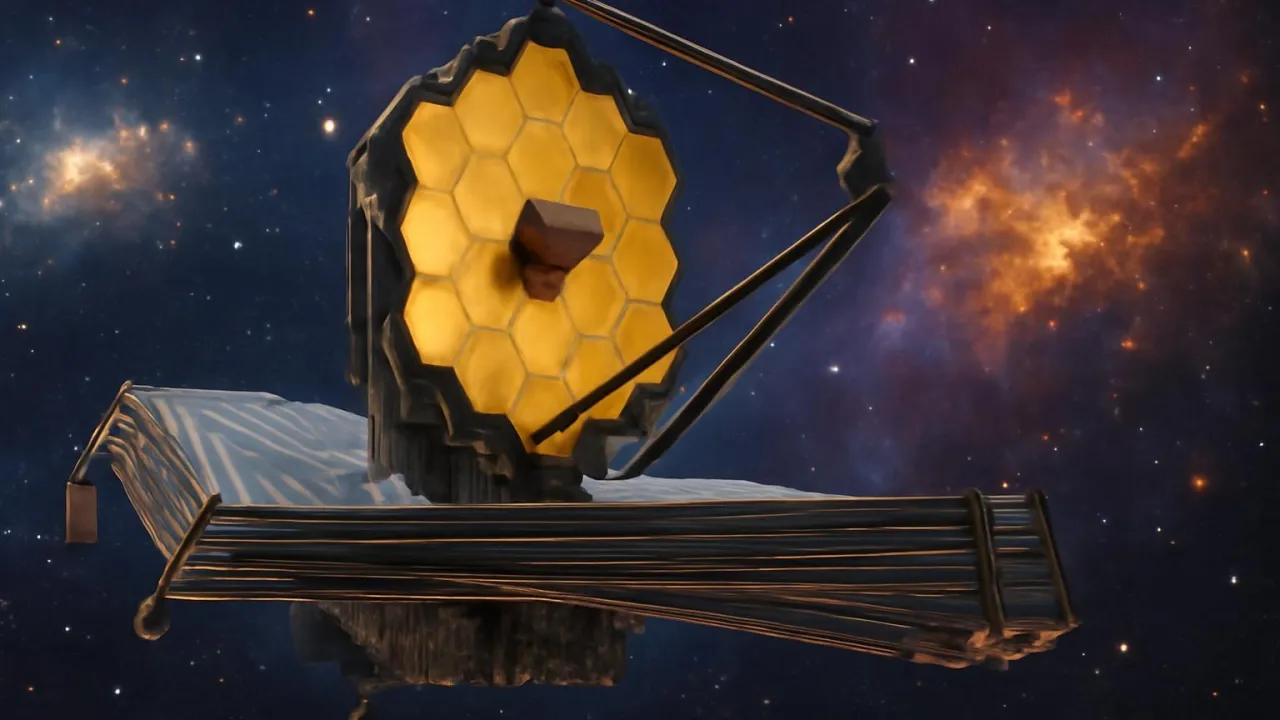
The telescope can see light that is invisible to our eyes!
✨ Word Sparks (Grade 2 Glossary)
Tap 🔊 to hear
galaxy
A huge group of stars
launch
To send something into space
universe
Everything in space and time
🪝
Can you imagine a telescope floating far above Earth?
1
Golden Mirrors in Space
The James Webb Space Telescope has big golden mirrors. The mirrors are shaped like a honeycomb, and they help catch light from far away. These special mirrors let scientists see things we could never see before.
2
How It Travels and Works
The telescope was launched into space by a rocket. It floats far from Earth, where it can see deep into the . It sends back amazing pictures of stars and galaxies.
3
Discovering the Universe’s Past
The telescope looks at very old light from space. This helps scientists learn about how stars and planets began. Every new picture teaches us something exciting about space.
Webb’s sunshield is as long as a tennis court and keeps it colder than ice!
✨ Word Sparks (Grade 3 Glossary)
Tap 🔊 to hear
infrared
Light we cannot see, but can feel as heat
orbit
To travel around something in space
galaxy
A giant group of stars and planets
🪝
What secrets could a giant golden telescope find in the darkness of space?
1
A Telescope Like No Other
The James Webb Space Telescope is the largest space telescope ever built. Its huge gold-coated mirrors are arranged in a honeycomb pattern to gather faint light. Webb’s mirrors are made of beryllium and coated with gold to reflect light. This special design helps scientists study stars and galaxies too far for other telescopes to see.
2
Journey Beyond Earth
Webb was launched into space by a powerful rocket. It now the sun, far beyond the moon, at a place called L2. This distant spot keeps the telescope cold and stable, which is important for detecting faint signals. The telescope’s cameras and instruments must stay extremely cold to see ancient starlight.
3
Seeing the Invisible
Unlike most telescopes, Webb looks in the spectrum. Infrared light is a kind of energy we cannot see with our eyes. By detecting these invisible waves, Webb can peer through dust clouds and see where stars are born. This lets scientists study the universe’s earliest galaxies and even search for planets around other stars.
4
Unlocking Cosmic Mysteries
Every picture Webb sends back is a window into the past. The light it catches left distant galaxies billions of years ago. By studying this ancient light, scientists learn how the universe grew and changed. Webb’s discoveries help us understand where we come from and what else might be out there.
Webb can detect the heat of a bumblebee on the Moon from Earth’s distance!
✨ Word Sparks (Grade 4 Glossary)
Tap 🔊 to hear
infrared spectrum
A type of light we feel as heat
Lagrange point
A spot in space where gravity balances
exoplanet
A planet outside our solar system
🪝
Imagine unfolding a golden mirror in deep space to glimpse the universe’s first stars—what might you see?
1
Engineering a Golden Eye
The James Webb Space Telescope’s main mirror is made of 18 hexagonal segments, each coated with a thin layer of real gold. This honeycomb design allows the telescope to collect more infrared light than any previous space observatory. The mirrors are crafted from beryllium, a metal chosen for its strength and ability to withstand extreme cold. Webb’s engineering lets it capture faint light from the earliest galaxies.
2
A Chilly Home Far from Earth
Webb orbits the sun at a special place called the second , or L2, about a million miles from Earth. Its giant tennis-court-sized sunshield blocks heat and light from the sun and Earth, keeping the telescope at -370°F. Staying this cold is essential for detecting the faint infrared signals from distant stars and planets. The sunshield’s five layers protect Webb’s sensitive instruments from warming up.
3
Peering Through Cosmic Dust
Unlike visible light telescopes, Webb observes the universe in infrared wavelengths, which can pass through thick clouds of dust and gas. This ability allows scientists to study how stars and planets form in hidden regions of space. By analyzing the infrared spectra, Webb can even identify the chemical makeup of distant atmospheres. Its discoveries help answer questions about how galaxies, stars, and planets are born.
4
Changing Our View of the Universe
Webb’s images and data are already transforming our understanding of the cosmos. By looking back over 13 billion years, it reveals how the first galaxies took shape after the Big Bang. Its findings inspire new questions about the origins of life and our place in the universe. Scientists all over the world use Webb’s discoveries to make new theories and plan future missions.
Webb can detect the heat signature of a single candle on one of Jupiter’s moons from nearly a billion kilometers away.
✨ Word Sparks (Grade 5 Glossary)
Tap 🔊 to hear
spectra
Patterns of light that reveal what things are made of
Kelvin
A temperature scale used for very cold things in science
collaboration
Working together to achieve something big
🪝
What would you discover if you could unfold a golden telescope the size of a house and gaze back to the dawn of time?
1
A Marvel of Modern Engineering
The James Webb Space Telescope (JWST) represents the most ambitious space observatory ever constructed, with a segmented 6.5-meter primary mirror comprised of 18 hexagonal beryllium segments, each coated with a 100-nanometer layer of gold. This honeycomb structure maximizes Webb’s light-collecting area while minimizing its weight for launch. The mirror’s gold coating is crucial because gold reflects infrared wavelengths far more efficiently than other metals, enabling Webb to detect extremely faint heat signatures from the earliest galaxies. The telescope’s folding design allowed it to fit inside the Ariane 5 rocket, unfolding automatically after reaching its orbit.
2
Orbiting at the Edge of Earth’s Influence
Webb operates at the second Lagrange point (L2), approximately 1.5 million kilometers from Earth, where the gravitational forces of the Earth and Sun balance the telescope’s orbital motion. This stable location allows Webb to maintain a constant orientation with respect to the Sun and Earth, which is essential for its sensitive instruments. Its five-layer sunshield, about the size of a tennis court, blocks heat and light, keeping the telescope’s instruments below 50 (-370°F). This extreme cold prevents the telescope’s own heat from interfering with the faint infrared signals it is designed to detect.
3
Infrared Vision: Seeing the Unseen
Unlike the Hubble Space Telescope, which primarily observes visible and ultraviolet light, Webb is optimized for infrared astronomy. Infrared wavelengths allow Webb to peer through cosmic dust clouds that block visible light, revealing star-forming regions and the atmospheres of exoplanets. Webb’s instruments, including the Near Infrared Camera (NIRCam) and Mid-Infrared Instrument (MIRI), can analyze the of distant objects, identifying elements and molecules such as water, methane, and carbon dioxide. This capability enables the study of planetary systems’ formation and the search for potentially habitable worlds.
4
Rewinding Cosmic History
Webb’s unprecedented sensitivity allows it to detect light that has traveled over 13.5 billion years, essentially looking back in time to the universe’s first few hundred million years after the Big Bang. By capturing this ancient light, Webb helps scientists investigate how the first galaxies formed, how stars and black holes evolved, and how chemical elements necessary for life were created. Its discoveries are already challenging existing theories and prompting new questions about the origins of the cosmos.
5
A Global Collaboration and Lasting Legacy
The JWST is a joint project led by NASA, with significant contributions from the European Space Agency (ESA) and the Canadian Space Agency (CSA), involving thousands of scientists and engineers worldwide. Its data is shared with researchers across the globe, fostering international and education. As Webb continues to send back breathtaking images and groundbreaking data, it inspires future missions and generations of scientists. Its legacy will shape our understanding of the universe for decades to come, opening new frontiers in astronomy and planetary science.