🇺🇸 U.S. HISTORY
🏛️ 5th President of the United States (1817–1825) • Founding Father
VA History & Social Science SOL K.1, 1.2, 2.4, VS.1–VS.10, USI & USII
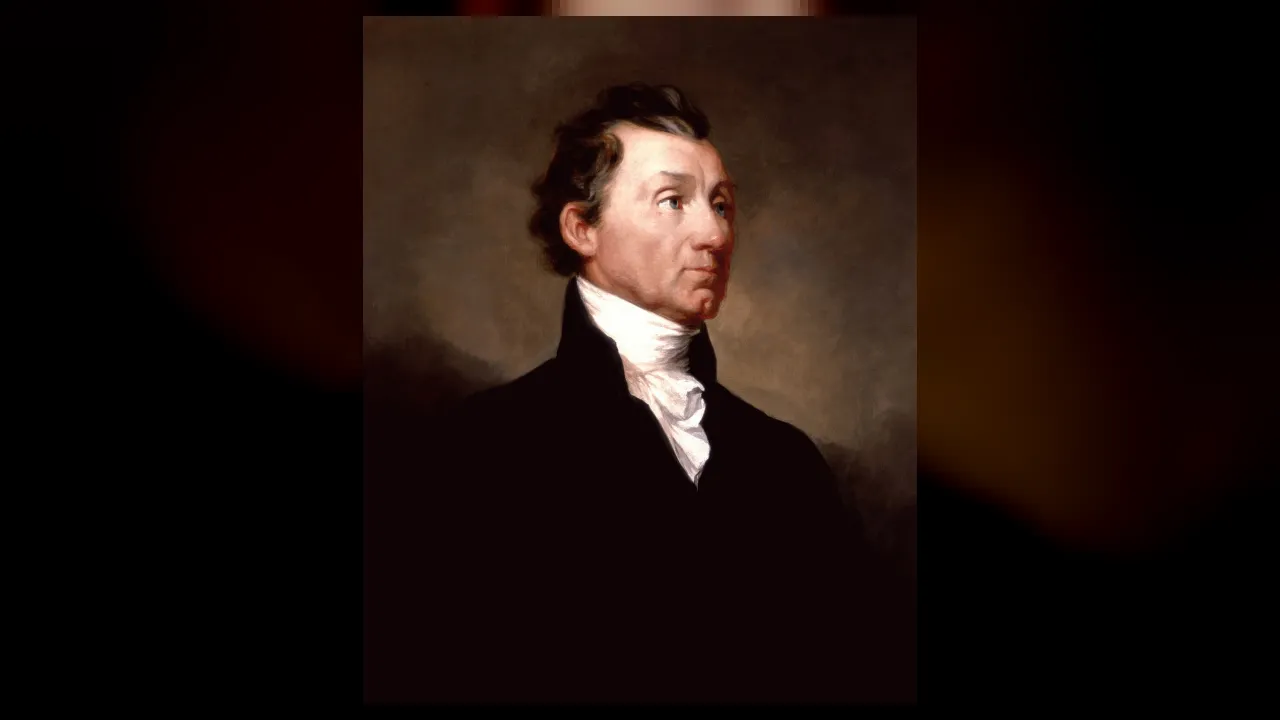
James Monroe
Revolutionary Hero and Era of Good Feelings
Grade 3 • Fluent • 146 words
⏳ Era / StatehoodPresidency: March 4, 1817 – March 4, 1825 (1758–1831)
🗺️ Region / CapitalWestmoreland County, Highland & Oak Hill • Commonwealth of Virginia
📜 Key MilestoneTrenton Revolutionary War hero, 1803 Louisiana Purchase negotiator, Era of Good Feelings, and Monroe Doctrine (1823)
⚡ Historical SparkLast Founding Father president—united a growing nation and warned empires not to recolonize the Americas
🤯 Mind-Blowing Fact • Grade 1
Look closely at the famous giant painting 'Washington Crossing the Delaware'—the young officer standing right behind George Washington holding the American flag is eighteen-year-old James Monroe!
✨ Word Sparks (Grade 1 Glossary)
Tap 🔊 to hear
tricorn
colonial hat folded up on three sides
peace
calm friendly time without war or fighting
continent
giant landmass such as North America
🪝
Who held the flag behind George Washington in the famous boat-crossing painting?
1
Brave Young Soldier
Icy waves splash a wooden boat! Eighteen-year-old James Monroe crossed the Delaware River right behind General George Washington.
2
Good Feelings Tour
Years later, Monroe became our fifth president! He traveled from town to town wearing an old-style three-cornered hat, cheering everyone up.
3
Keeping Neighbors Safe
He told distant kings across the ocean to leave free countries in North and South America in !
1. Which number president of the United States was Virginian James Monroe?
2. Where can you spot teenaged soldier James Monroe in a famous Revolutionary War painting?
🤯 Mind-Blowing Fact • Grade 2
When James Monroe ran for a second term as president in 1820, nobody even ran against him—he won every single Electoral College vote except one!
✨ Word Sparks (Grade 2 Glossary)
Tap 🔊 to hear
era
memorable period of years in history
doctrine
clear guiding policy announced by a government
colony
land ruled from afar by another country
🪝
Why did newspapers call James Monroe's presidency the 'Era of Good Feelings'?
1
Last of the Three-Cornered Hats
Cheers rang out along New England roads in the summer of 1817! President James Monroe—born in Westmoreland County, Virginia, just like George Washington—still wore knee-buckle pants and a three-cornered Revolutionary War hat. Seeing a real hero from 1776 visit towns North and South made Americans feel so united that a Boston newspaper called his time the ' of Good Feelings'!
2
Five New States and Sunny Florida
While Monroe was our fifth president, the country grew fast: Mississippi, Illinois, Alabama, Maine, and Missouri all became states, and Spain peacefully transferred Florida to the United States!
3
The Monroe Doctrine
In 1823, Monroe announced the Monroe , warning European rulers not to start new colonies in North or South America.
1. Why was James Monroe's presidency nicknamed the 'Era of Good Feelings'?
2. What clear message did the 1823 Monroe Doctrine send to European kings and empires?
🤯 Mind-Blowing Fact • Grade 3
More public offices did James Monroe hold than almost anyone in American history: Continental officer, U.S. Senator, Minister to France and Britain, Governor of Virginia, Secretary of State, Secretary of War, and fifth President!
✨ Word Sparks (Grade 3 Glossary)
Tap 🔊 to hear
Western Hemisphere
half of Earth holding North and South America
negotiate
talk calmly to reach a fair treaty
goodwill
friendly kindness and respect shared among neighbors
🪝
Did you know one man did two giant Cabinet jobs at once during the War of 1812—and helped buy Louisiana too?
1
From Student to Trenton Battlefield
Imagine leaving college classrooms at William & Mary in Williamsburg at age seventeen to march with the Continental Army! On Christmas night 1776, young Lieutenant James Monroe crossed the freezing Delaware River and charged forward at the Battle of Trenton, taking a musket-ball wound in his shoulder while helping capture enemy cannons that saved the day.
2
Sealing the Louisiana Deal in Paris
After studying law with Thomas Jefferson, Monroe served as senator, governor of Virginia, and diplomat. Sent to Paris in 1803 just to buy the port of New Orleans, Monroe and Robert Livingston seized a surprise offer from France to purchase the entire Louisiana Territory!
3
Double Duty in Wartime
During the toughest days of the War of 1812 under President James Madison, tireless Monroe served as both Secretary of State and Secretary of War at the same time!
4
Guarding the Western Hemisphere
As fifth president (1817–1825), Monroe acquired Florida in 1819 and proclaimed the 1823 Monroe Doctrine, declaring the closed to new European colonization.
1. Which two top Cabinet positions did James Monroe hold at the exact same time during the War of 1812?
2. Which sunny peninsula became part of the United States by treaty with Spain during James Monroe's presidency?
🤯 Mind-Blowing Fact • Grade 4
Just like John Adams and Thomas Jefferson five years earlier, James Monroe passed away on July 4, 1831—making three of America's first five presidents who died on Independence Day!
✨ Word Sparks (Grade 4 Glossary)
Tap 🔊 to hear
monarchy
government ruled by a king or queen
sectional
divided between different geographic regions of a nation
recolonize
take foreign imperial control over free lands again
🪝
How did the 'Last of the Cocked Hats' guide America from its Founding generation into a continental nation?
1
Virginia Dynasty's Final Revolutionary Hero
Born in Westmoreland County, Virginia, in 1758—just miles from George Washington's birthplace—James Monroe was the last U.S. president from the Revolutionary War generation and the fourth Virginian among America's first five presidents! Wounded leading an assault at Trenton in 1776, tested at Brandywine, Germantown, and Valley Forge, and mentored in law by Thomas Jefferson, Monroe built his Highland farm right next door to Jefferson's Monticello in Albemarle County before later building Oak Hill in Loudoun County.
2
Uniting the Nation After 1815
Inaugurated outdoors on March 4, 1817, while the Capitol was still being rebuilt from the War of 1812, Monroe embarked on a sixteen-week, 2,000-mile tour through Northern and Western states by horse, stagecoach, and early steamboat. Citizens cheered 'the last of the cocked hats,' prompting Boston's 'Columbian Centinel' newspaper to coin the phrase 'Era of Good Feelings.' Meanwhile, Secretary of State John Quincy Adams negotiated treaties setting the peaceful 49th-parallel border with British Canada (1818) and acquiring Florida from Spain via the Adams-Onís Treaty (1819).
3
The Missouri Compromise of 1820
Beneath national pride, debate erupted when Missouri applied for statehood. In 1820, Congress passed and Monroe signed the Missouri Compromise—admitting Maine as a free state and Missouri as a slaveholding state while drawing a 36°30' latitude line across the rest of the Louisiana Purchase, postponing national conflict for three decades.
4
The 1823 Monroe Doctrine
As Latin American republics from Mexico to Argentina won independence from Spain, European monarchies discussed helping Spain retake them. In his December 2, 1823 annual message to Congress—crafted with John Quincy Adams—Monroe declared that the United States would stay out of internal European wars, while any European attempt to colonize or control independent nations in the Americas would be viewed as unfriendly to U.S. peace and safety.
1. Why did Americans affectionately call President James Monroe 'the Last of the Cocked Hats'?
2. Which two states entered the Union together in 1820 under the Missouri Compromise signed by President Monroe?
🤯 Mind-Blowing Fact • Grade 5
Monrovia, the modern capital city of the West African nation of Liberia, is the only foreign national capital in the world named after a U.S. president—honoring James Monroe!
✨ Word Sparks (Grade 5 Glossary)
Tap 🔊 to hear
demilitarize
remove warships and weapons along a border
non-intervention
policy of staying out of foreign conflicts
vanguard
leading front group moving ahead first
🪝
How did a wounded teenaged lieutenant from Trenton shape half a continent's borders and two centuries of Western Hemisphere diplomacy?
1
Northern Neck Patriot and Jeffersonian Statesman
Born on Monroe Creek in Westmoreland County, Virginia (1758–1831), James Monroe left the College of William & Mary in 1776 to join the 3rd Virginia Regiment of the Continental Line. Crossing the ice-choked Delaware in Washington's on December 25, 1776, eighteen-year-old Lieutenant Monroe helped seize Hessian artillery on King Street in Trenton before a severed shoulder artery nearly ended his life—leaving a musket ball he carried for his remaining fifty-five years. Studying law afterward under Governor Thomas Jefferson, Monroe served in the Confederation Congress, initially critiqued the 1787 Constitution for lacking a direct Bill of Rights before embracing its ratification, and rose through the U.S. Senate, the Virginia governorship, and European embassies.
2
Continental Diplomacy From Paris (1803) to Wartime Washington
Dispatched by President Jefferson in 1803 as Envoy Extraordinary to assist Minister Robert Livingston in purchasing New Orleans, Monroe arrived in Paris just as Napoleon resolved to sell all of French Louisiana—co-signing the treaty that doubled the republic's territory. Called into James Madison's Cabinet in 1811 as Secretary of State, Monroe personally scouted invading British troops near Bladensburg in August 1814 and assumed concurrent leadership as Secretary of War, reorganizing defenses that protected Baltimore and New Orleans before winning the presidency overwhelmingly in 1816.
3
Era of Good Feelings, Transcontinental Treaties, and Internal Fault Lines
Monroe's two terms (1817–1825)—closing the thirty-two-year 'Virginia Dynasty' of Washington, Jefferson, Madison, and Monroe—ushered in temporary one-party national harmony dubbed the 'Era of Good Feelings,' underscored by his nearly unanimous 1820 reelection (231 of 232 electoral votes). Partnering with formidable Secretary of State John Quincy Adams, the administration achieved sweeping diplomatic landmarks: the Rush-Bagot Pact (1817) demilitarizing the Great Lakes, the Convention of 1818 fixing the 49th parallel to the Rockies, and the 1819 Adams-Onís (Transcontinental) Treaty ceding Spanish Florida while defining a boundary all the way to the Pacific Ocean! Domestically, the Panic of 1819 and the 1820 Missouri Compromise revealed the deepening sectional rift over slavery's westward expansion—a contradiction Monroe, himself a Virginia slaveholder who supported the American Colonization Society—for whom Monrovia, Liberia, was named—never resolved.
4
The Monroe Doctrine of December 2, 1823
When European powers of the Holy Alliance contemplated restoring Spanish rule over newly independent Latin American republics—and Czarist Russia claimed Pacific Northwest trading rights—Britain suggested a joint Anglo-American warning. Following John Quincy Adams's counsel to speak independently rather than trail like 'a cock-boat in the wake of the British man-of-war,' Monroe delivered his seventh annual message to Congress on December 2, 1823. Its twin pillars—American in internal European affairs paired with firm opposition to any new European colonization or political interference in the Western Hemisphere—became a cornerstone of U.S. foreign policy.
5
Oak Hill Retirement and Independence Day Passing
Retiring to Jefferson-designed Oak Hill in Loudoun County, serving with Jefferson and Madison on the University of Virginia's Board of Visitors, and chairing Virginia's 1829–1830 Constitutional Convention, America's last Founding Father president died in New York City on July 4, 1831—later laid to rest in Richmond's Hollywood Cemetery.