💡 INVENTIONS
⚙️ 1804 CE • Programmable Mechanical Weaving & Binary Logic
VA Science, Engineering & History SOL
Jacquard Loom
Punched Cards That Taught Cloth Computers
Grade 3 • Fluent • 170 words
🧑🔬 Inventor & OriginJoseph Marie Jacquard • Lyon, France
⏳ Year InventedPatented in 1804 CE (Demonstrated 1801)
⚙️ How It WorksChains of hole-punched pasteboard cards guide spring rods to lift exact silk threads automatically
⚡ World-Changing SparkWove intricate pictures automatically and inspired the punch-card code of early computers
🤯 Mind-Blowing Fact • Grade 1
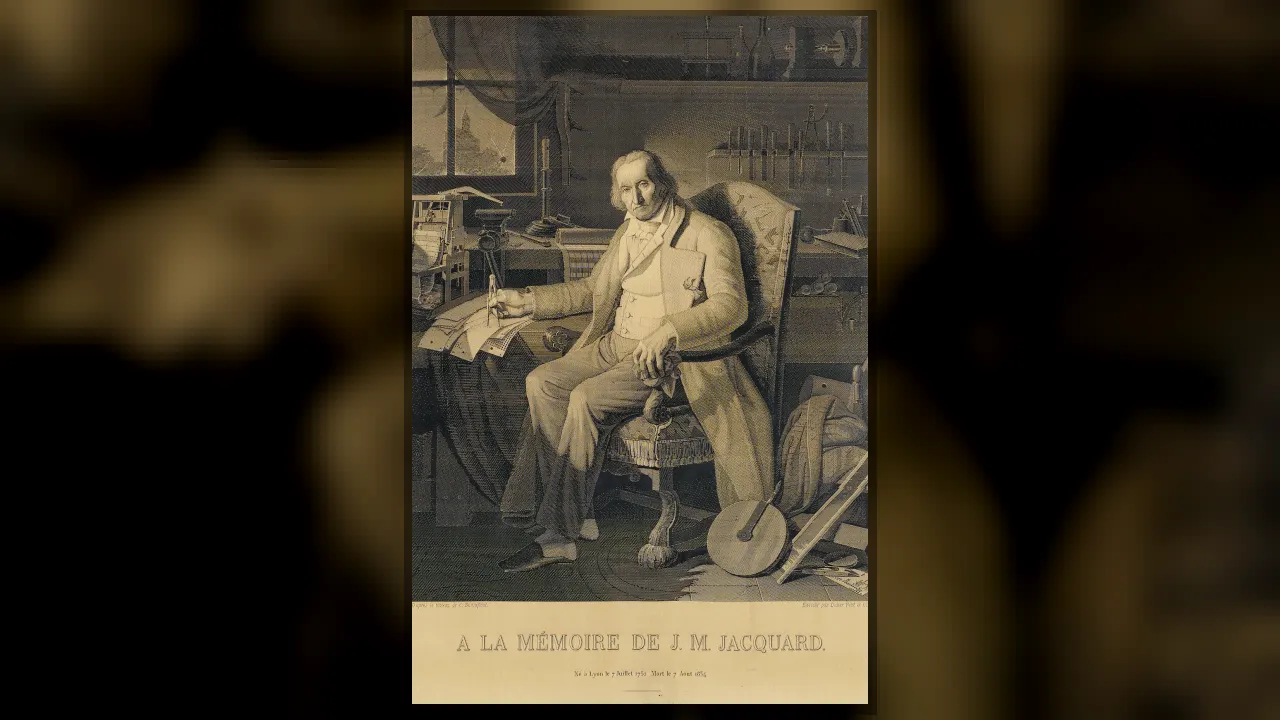
Inventor Joseph Marie Jacquard wove a detailed black-and-white silk portrait of himself using 24,000 punched cards—and it looked just like a photograph!
✨ Word Sparks (Grade 1 Glossary)
Tap 🔊 to hear
loom
A frame machine that weaves threads together
punch card
Stiff card with holes holding secret instructions
pattern
A repeated picture or design in cloth
🪝
How can tiny holes in stiff paper tell a machine what picture to weave?
1
Clack, Slide, Weave!
Clack, clack, whoosh! Bright silk threads dance up and down on a tall wooden frame. Slowly, shiny roses appear in the cloth!
2
Cards With Secret Holes
Long loops of stiff cards click past metal pins. Where a pin pokes through a hole, one thread lifts up. Solid spots keep threads down.
3
Grandparent of Computers
Changing the punched cards made brand-new right away. Years later, early computers copied this hole-and-card code!
1. What happens when a metal pin on a Jacquard loom meets a hole in the card?
2. Which modern machine got its early coding idea from Jacquard's punched cards?
🤯 Mind-Blowing Fact • Grade 2
Mathematician Ada Lovelace loved Jacquard's silk portrait so much that she wrote early computers would weave math formulas the exact way the loom wove flowers and leaves!
✨ Word Sparks (Grade 2 Glossary)
Tap 🔊 to hear
shuttle
Holder that carries crosswise thread across looms
silk
Smooth, shiny thread spun by silkworms
code
Set of symbols that give clear instructions
🪝
How could a weaver change a flower pattern into a castle pattern just by swapping paper cards?
1
Inside a Silk Workshop
Step into a busy French workshop in 1800. Before automatic helpers existed, young assistants sat perched atop tall looms all day, pulling hundreds of cords by hand so fancy flowers would appear in royal cloth.
2
Jacquard's Clever Card Chain
In 1804, Joseph Marie Jacquard built a smart mechanical head for the loom. He laced stiff pasteboard cards together into a long loop, and each card controlled one crosswise pass of the yarn .
3
Yes or No in Every Hole
Rows of spring-loaded needles pressed against each card: a hole meant lift the thread, while solid paper meant leave it down. That simple two-choice later inspired the zeros and ones inside every digital tablet and laptop!
1. Who patented the punch-card loom attachment in Lyon, France, in 1804?
2. How did a weaver make a Jacquard loom weave a brand-new design?
🤯 Mind-Blowing Fact • Grade 3
By 1812—just eight years after Jacquard received his patent—more than 11,000 Jacquard looms were already clacking away across France!
✨ Word Sparks (Grade 3 Glossary)
Tap 🔊 to hear
warp
Lengthwise threads held tight on a loom
weft
Crosswise thread woven over and under warp
binary
Two-choice system like hole or no hole
🪝
Why do computer historians call an 1804 French silk loom the world's first programmable machine?
1
Weaving Pixel by Pixel
Zoom in closely on a fancy woven tapestry or brocade jacket, and you will spot tiny grid squares where vertical threads cross horizontal threads. Long before glowing television pixels existed, French weavers created detailed images one thread crossing at a time!
2
Needles, Hooks, and Punched Cards
Building on earlier ideas from Frenchmen Basile Bouchon, Jean-Baptiste Falcon, and Jacques de Vaucanson, Joseph Marie Jacquard unveiled his perfected loom attachment in 1804. On every beat of the foot treadle, a four-sided prism rotated a fresh punched card against hundreds of horizontal spring needles.
3
Binary Logic Made of Wood and Iron
Whenever a needle slipped through a punched hole, its linked vertical hook caught a rising bar and lifted that exact thread so the shuttle passed underneath. Where solid card blocked a needle, its hook tilted away and that warp thread stayed down.
4
Inspiring Babbage, Lovelace, and Census Machines
English inventor Charles Babbage and mathematician Ada Lovelace adopted Jacquard's cards to program their proposed Analytical Engine in the 1830s. Decades later, Herman Hollerith used punch cards to count the 1890 U.S. Census, founding a company that became IBM!
1. In weaving, what is the difference between warp threads and weft threads?
2. How did Herman Hollerith adapt Jacquard's punch-card idea in 1890?
🤯 Mind-Blowing Fact • Grade 4
Napoleon Bonaparte was so amazed when he toured Jacquard's workshop in Lyon in 1805 that he awarded Jacquard a royal pension plus a 50-franc royalty on every loom built!
How did separating 'software' from 'hardware' in an 1804 French textile mill launch the Information Age?
1
Separating Pattern Memory from Metal Hardware
Run your fingers across raised floral damask fabric: every curve required lifting specific combinations out of thousands of warp threads at precise moments. Prior to 1804, complex drawlooms demanded human 'drawboys' who spent exhausting twelve-hour shifts tugging harness cords in memorized sequences—until Joseph Marie Jacquard stored the memory inside replaceable paper cards.
2
Inside the Jacquard Head Mechanism
Mounted high atop the loom frame, the Jacquard head pairs a grid of spring-backed horizontal feeler needles with vertical lifting hooks and a rising knife-bar frame called a griff. Each card in an endless laced chain represents one pick (one horizontal throw of the weft shuttle). Holes permit needles to advance, keeping their vertical hooks upright in the griff's path; unpunched cardstock pushes needles back, tilting hooks clear.
3
From Silk Guilds to Universal Computing
Although Lyon's weavers initially feared losing jobs and even protested the machine, French Emperor Napoleon Bonaparte recognized its brilliance, granted the city public rights to the patent, and awarded Jacquard a lifelong pension. Productivity soared as intricate became affordable.
4
The Direct Bridge to Digital Code
Jacquard proved that a single physical machine could perform limitless tasks simply by feeding it new symbolic data—the exact separation of hardware and software! Charles Babbage owned a 24,000-card woven silk portrait of Jacquard, which directly inspired Babbage and Ada Lovelace's and 20th-century mainframe computing.
1. Why is the Jacquard loom famous for separating 'software' from 'hardware' long before electronics existed?
2. What does a single punched card in a Jacquard chain control during weaving?
🤯 Mind-Blowing Fact • Grade 5
Stored on 24,000 punched cards, the famous 1839 woven silk portrait of Jacquard held roughly three megabytes of binary data—more memory than early 1980s home computers!
✨ Word Sparks (Grade 5 Glossary)
Tap 🔊 to hear
shed
Temporary tunnel formed between raised and lowered warps
halftone
Simulating smooth shading using tiny spaced dots
solenoid
Wire coil that moves metal pins magnetically
🪝
How did 18th-century French silk artisans invent binary read-only memory more than a century before the electronic transistor?
1
Cumulative Genius in Lyon's Silk Capital
Stand before an authentic 19th-century Jacquard loom as its overhead griff rises and falls in rhythmic cadence: thousands of linen harness cords fan downward like cathedral organ trackers, translating perforations in pasteboard into photorealistic silk shading. Far from an isolated flash of luck, Joseph Marie Jacquard's 1804 patent synthesized eight decades of French textile automation—combining Basile Bouchon's 1725 perforated paper roll, Jean-Baptiste Falcon's 1728 hinged card chain, and Jacques de Vaucanson's 1745 overhead cylinder.
2
Boolean Mechanics of the Spring-Needle Matrix
Mechanically, a Jacquard head acts as a parallel binary reader. Suppose a loom governs 1,200 independent warp ends. Before each weft insertion, a perforated four-sided cylinder presses one pasteboard card against a 1,200-needle array. A punched locus (binary 1) lets its spring needle remain extended so the coupled vertical hook engages the ascending griff blade, raising that warp thread to form the upper ; an unpunched locus (binary 0) deflects needle and hook clear of the blade.
3
Resolution, Grayscale Shading, and Storage Density
Just as modern printing simulates continuous grayscale from pure black dots, master card-punchers varied weave structures—satin, twill, and plain intersections of dark and light threads—to render subtle facial shadows. Jacquard's famous 1839 commemorative portrait required 24,000 cards punched with over a thousand hole positions each, storing roughly three megabytes of uncompressed binary pattern data!
4
Intellectual Lineage of Computer Architecture
Viewing that exact silk portrait in London, Charles Babbage adapted dual Jacquard card chains—operation cards and variable cards—to control arithmetic mills and memory columns in his Analytical Engine, prompting Ada Lovelace's immortal 1843 observation that the engine 'weaves algebraic patterns.' Herman Hollerith's 1890 electromechanical census tabulators and mid-20th-century IBM 80-column Fortran cards carried Jacquard's physical medium straight into the silicon era.
5
Modern Electronic Jacquard Actuators
Today, high-speed computerized air-jet and rapier Jacquard looms replace cardboard chains with electromagnetic firing over 1,000 picks per minute—weaving everything from custom athletic shoe uppers and automotive airbags to 3D carbon-fiber aerospace composites.