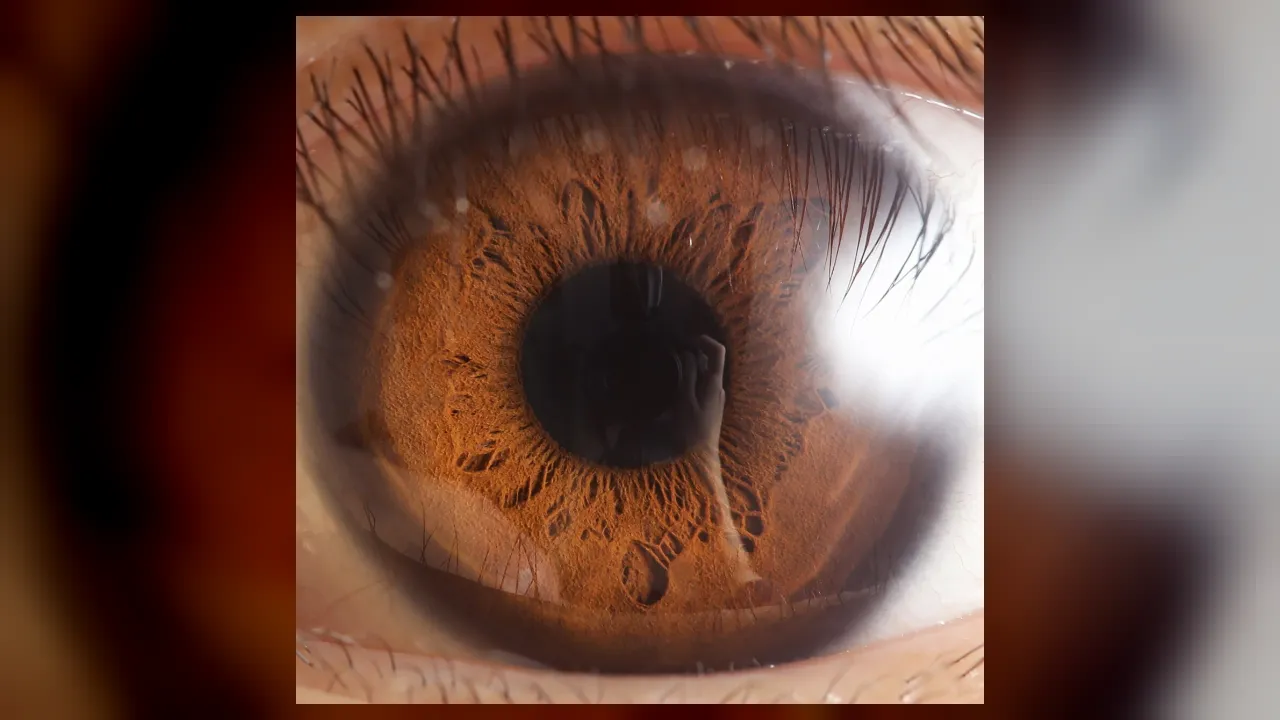
1. What actually is the dark pupil in the center of your eye?
2. What happens to your pupil when you walk into a cozy, dim movie theater?
🤯 Mind-Blowing Fact • Grade 2
Sailors moving from sunny ship decks down below into dark cargo holds could uncover a covered eye whose pupil was already wide open for the dark!
✨ Word Sparks (Grade 2 Glossary)
Tap 🔊 to hear
melanin
Natural pigment giving eyes and skin color
pigment
A natural coloring substance inside living cells
scatter
To bounce light rays in many directions
🪝
Why do pirate stories show captains wearing an eyepatch even with two healthy eyes?
1
Smart Camera Curtains
Step out of a bright hallway into a dark closet and wait a few seconds! Right behind your clear cornea, a colorful ring of muscle called the iris slides open your central pupil like round camera curtains so more light pours inside.
2
What Makes Eye Colors Different?
Every iris holds a natural called —the same helper that colors hair and freckles! Lots of melanin makes rich brown eyes, while tiny amounts light to look hazel, green, or sky blue.
3
One-of-a-Kind Swirls
Look closely and you will spot tiny lacy lines and speckles. Even identical twins have completely different iris patterns!
1. Which natural pigment decides whether your iris looks brown, hazel, green, or blue?
2. Do identical twins share the exact same lacy pattern in their irises?
🤯 Mind-Blowing Fact • Grade 3
House cats have vertical slit pupils that can change area more than one hundred thirty-five times between noon sun and midnight—nearly ten times wider a range than human round pupils!
✨ Word Sparks (Grade 3 Glossary)
Tap 🔊 to hear
radial
Spreading outward from center like wheel spokes
aperture
An adjustable opening controlling incoming light
wavelength
Distance between peaks of a light wave
🪝
How can blue eyes look bright blue when humans don't actually make any blue eye pigment?
1
Named After the Rainbow
Ancient Greeks named the colored ring of the eye 'iris' after their messenger of the rainbow! Floating in clear watery fluid between your front cornea and your inner lens, this twelve-millimeter muscular ring controls your pupil—the adjustable round window in its middle.
2
Two Tiny Muscle Teams
Inside each iris live two smooth-muscle teams pulling in different ways. A circular ring muscle squeezes inward like a drawstring bag to shrink your pupil in dazzling snow or sunshine. Moments later, spoke-like muscles pull outward like bicycle spokes to widen your pupil up to four times larger at dusk!
3
The Secret of Blue Eyes
Surprise: zero humans have blue ink or blue pigment in their eyes! Eyes with very little brown melanin scatter short blue light waves back out—using the exact same physics that makes daytime skies look blue.
4
Teamwork Between Left and Right
Shine a safe penlight near just your left eye, and watch a friend verify that BOTH pupils shrink together automatically!
1. Why do blue irises appear blue even though they hold zero blue pigment?
2. Which iris muscle shape squeezes inward like a drawstring to shrink your pupil in bright sun?
🤯 Mind-Blowing Fact • Grade 4
High-security airport scanners prefer iris recognition over fingerprints because a human iris packs over two hundred fifty measurable crypts, furrows, and rings that stay stable for decades!
✨ Word Sparks (Grade 4 Glossary)
Tap 🔊 to hear
sphincter
Circular muscle ring that narrows an opening
dilator
Spoke-like muscle pulling an opening wider
consensual
Both sides responding together at once
🪝
Why do old flash cameras sometimes turn people's dark pupils glowing red in family photos?
1
Tug-of-War Controlled by Your Brainstem
Think of your iris and pupil as a self-adjusting camera diaphragm wired straight to your autonomic nervous system! Surrounding the pupil edge, the circular pupillae muscle receives calming parasympathetic signals along the oculomotor nerve, constricting the pupil down to two millimeters so harsh glare never overwhelms delicate sensors inside. Radiating outward like sunbeams, the pupillae muscle answers sympathetic 'alert' signals, widening the aperture to eight millimeters in darkness—or whenever something thrilling catches your attention!
2
Why Both Eyes Move as Twins
Doctors check brainstem health using the pupillary light reflex. Because incoming light signals split equally to both the left and right midbrain nuclei, shining a gentle light into only one eye commands BOTH pupils to constrict simultaneously.
3
Solving the 'Red-Eye' Photo Mystery
Why does a dark pupil usually look pitch-black, yet glow cherry-red in a sudden nighttime camera flash? Normally, inner eye pigments absorb incoming light. In a dim room with wide-open eight-millimeter pupils, however, a millisecond flash bounces straight off oxygen-rich red blood vessels lining the back of the eye before your iris has time to blink it smaller!
4
Sharpening Close-Up Homework
Look away from a distant window down to pencil words on your desk, and your pupils automatically narrow slightly—increasing 'depth of field' so fine letters look razor-sharp!
1. Why do peoples' pupils sometimes glow red in a sudden nighttime flash photograph?
2. Why do your pupils automatically narrow slightly when you read tiny print up close?
🤯 Mind-Blowing Fact • Grade 5
Because circle area equals pi times radius squared, widening your pupil's width just four times—from two millimeters to eight millimeters—actually lets SIXTEEN times more starlight pour into your eye!
How do Tyndall light scattering, sixteen-fold light regulation, and cognitive pupil dilation reveal both physics and hidden mental effort?
1
Sixteen-Fold Area Control and Optical Quality
Floating inside aqueous humor between the cornea and crystalline lens, the iris serves as the anterior portion of the eye's vascular uveal tract. When its pupil diameter expands fourfold—from two millimeters on a sunlit snowfield to eight millimeters under starlight—geometry dictates via the circle-area formula ($\pi r^2$) that light admission actually changes sixteen-fold! Beyond brightness protection, pupil constriction trims spherical optical from the outer edges of the cornea and lens during precision reading.
2
Tyndall Scattering and Multi-Gene Eye Color
Early genetics charts once taught eye color as a simple one-gene trait, yet modern genomics shows at least sixteen genes—led by OCA2 and HERC2 on chromosome 15—tune melanocyte pigment inside the anterior iris stroma. Behind every healthy iris sits a dark two-cell-thick pigmented epithelium blocking stray light leaks. When the front stroma holds dense eumelanin, eyes appear rich brown; moderate melanin plus yellowish pheomelanin yields hazel or green; and low stromal melanin produces blue eyes via Tyndall scattering of short-wavelength light off collagen fibrils.
3
Neuroanatomy of the Pupillary Reflex
Unlike most vision, pupil control relies heavily on intrinsically photosensitive retinal ganglion cells expressing . Ambient brightness signals race via the optic nerve to the midbrain's pretectal nucleus, cross bilaterally to both Edinger-Westphal nuclei, and travel down cranial nerve III to release acetylcholine onto the sphincter pupillae—completing constriction in roughly two hundred milliseconds.
4
Pupillometry: Windows Into Mental Effort
Psychologists in the 1960s discovered something extraordinary: solve a tough multiplication problem such as $17 \times 24$ in your head under steady room lighting, and your pupils measurably dilate by half a millimeter! Driven by norepinephrine from the brainstem's locus coeruleus, pupil size subtly tracks mental focus and curiosity.
5
Mathematical Biometrics
In the 1990s, computer scientist John Daugman created 'IrisCode' wavelet algorithms converting those 250+ trabecular crypts and furrows into a mathematical signature whose false-match odds are less than one in a trillion!