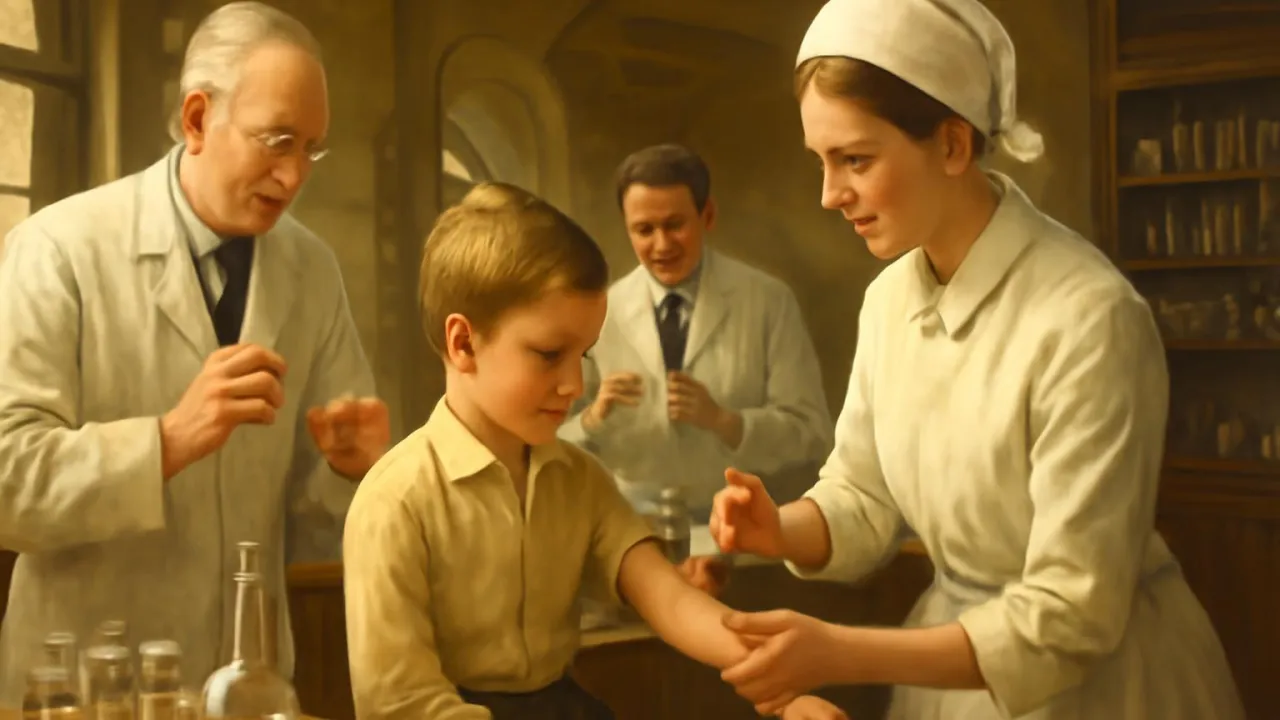
Before insulin, kids with diabetes could not eat sweet treats safely.
✨ Word Sparks (Grade 2 Glossary)
Tap 🔊 to hear
diabetes
A sickness when sugar is too high.
laboratory
A science room for making discoveries.
medicine
Something that helps people feel better.
🪝
Have you ever wondered how a tiny shot can save a life?
1
The Sugar Balancer
Some people’s bodies cannot control sugar well, so they need help. Insulin is a special that helps keep sugar balanced. Doctors give insulin with a small shot, and it helps people feel better.
2
A Big Discovery
Long ago, doctors Banting and Best worked in a lab. They found out how to make insulin from animal parts. Their discovery changed how people with could live and play.
3
Everyday Helpers
Today, many kids and adults get insulin every day. They can play sports, go to school, and have fun with friends. Insulin helps them stay strong and healthy.
The very first insulin patient was just 14 years old and lived because of the shot.
✨ Word Sparks (Grade 3 Glossary)
Tap 🔊 to hear
pancreas
An organ that makes insulin.
hormone
A chemical that controls body jobs.
syringe
A tool for giving shots.
🪝
Imagine needing a tiny shot to help your body use food—how does it work?
1
The Body’s Sugar Problem
People with diabetes cannot make enough insulin in their . Without insulin, sugar in the blood gets too high and causes problems. Insulin is a that helps move sugar into the body’s cells. When people get insulin shots, their bodies can use food for energy.
2
A Brilliant Discovery
In 1921, Dr. Banting and Charles Best worked in a laboratory in Canada. They took insulin from animal and purified it for humans. Their prototype insulin therapy saved a dying boy named Leonard Thompson. Soon, insulin therapy spread to hospitals everywhere.
3
How Insulin Therapy Works
Insulin is injected with a or pen under the skin. The medicine travels through the blood and helps cells absorb sugar. This stops dangerous symptoms like tiredness and thirst. With insulin, people with diabetes can live long, active lives.
4
Changing the World
Before insulin therapy, diabetes was often deadly for children and adults. Now, millions of people use insulin every day to stay healthy. Scientists keep working to make insulin even better and easier to use. Insulin therapy is a life-saving invention for the world.
2. Why do people with diabetes need insulin shots?
🤯 Mind-Blowing Fact • Grade 4
Synthetic insulin, made in labs today, is almost identical to natural human insulin.
✨ Word Sparks (Grade 4 Glossary)
Tap 🔊 to hear
glucose
A kind of sugar in your blood.
synthetic
Made by people, not by nature.
recombinant
Created by mixing genes in a lab.
🪝
What if a single discovery could turn a deadly illness into a treatable one for millions?
1
The Science of Sugar Control
When people have diabetes, their pancreas cannot produce enough insulin, a hormone essential for controlling blood sugar. Without insulin, builds up in the bloodstream, causing dangerous symptoms and long-term damage. Insulin therapy uses purified insulin injected under the skin to help cells absorb glucose. This therapy restores the body’s chemical balance and allows people to live healthier lives.
2
The Breakthrough Moment
In 1921, Dr. Frederick Banting and Charles Best made history in Toronto, Canada, by isolating insulin from animal pancreases. Their research involved creating a prototype therapy and testing it on patients who were gravely ill. The first successful treatment saved the life of a teenager named Leonard Thompson, proving insulin’s power. Their discovery was quickly shared with doctors around the world.
3
Engineering a Lifesaver
Early insulin was extracted from cows and pigs, but scientists later developed and forms. Insulin is delivered with syringes, pens, or pumps that control the dose and timing. The mechanics of insulin therapy rely on understanding how the hormone’s structure interacts with body cells. Today, new devices and types of insulin help people manage their blood sugar more precisely.
4
Global Impact and Ongoing Progress
Before insulin therapy, diabetes was often a fatal disease, especially for children. Now, millions of people worldwide rely on insulin to live normal, active lives. The invention of insulin therapy has inspired further medical research and innovation. Scientists continue to improve insulin’s effectiveness, making it easier and safer for everyone.
1. How does insulin therapy help people with diabetes?
2. What was the first source of insulin for therapy?
🤯 Mind-Blowing Fact • Grade 5
The Nobel Prize in Medicine was awarded to Banting and Macleod for the discovery of insulin in 1923.
✨ Word Sparks (Grade 5 Glossary)
Tap 🔊 to hear
homeostasis
Keeping the body’s systems balanced and steady.
recombinant DNA
Mixing genes to make new medicines in labs.
artificial pancreas
A machine that copies the pancreas’s insulin job.
🪝
Can you imagine a world where a single medical breakthrough could turn a deadly disease into a manageable condition for millions?
1
The Chemistry of Life and Insulin’s Role
Every time you eat, your digestive system breaks down food into glucose, a vital energy source for your cells. In a healthy body, the pancreas releases insulin, a protein hormone, to signal cells to absorb glucose from the bloodstream. When the pancreas fails to produce enough insulin, as in type 1 diabetes, glucose accumulates in the blood, leading to severe complications. Insulin therapy replaces the missing hormone, allowing the body to maintain and prevent dangerous spikes in blood sugar.
2
The Historic Breakthrough in Toronto
In 1921, Dr. Frederick Banting and Charles Best, working in Dr. John Macleod’s laboratory at the University of Toronto, achieved a medical milestone. By isolating insulin from dog and later cattle pancreases, they created a prototype therapy for diabetes. Their first patient, Leonard Thompson, was a 14-year-old boy near death from diabetes; after receiving insulin, his symptoms dramatically improved. This success led to rapid global adoption, with pharmaceutical companies soon producing insulin on a large scale.
3
Engineering and Evolution of Insulin Therapy
Early insulin was animal-derived and required careful purification to avoid allergic reactions. By the 1980s, scientists used technology to create synthetic human insulin, revolutionizing safety and availability. Modern insulin can be rapid-acting, long-acting, or delivered continuously via programmable pumps. These advances rely on biochemistry, mechanical engineering, and materials science to precisely mimic the body’s natural insulin delivery.
4
Global Impact and Social Transformation
Before insulin therapy, a diabetes diagnosis was almost always fatal, especially for children. Today, more than 30 million people worldwide use insulin to manage diabetes, enabling them to attend school, work, and participate fully in society. Insulin therapy has inspired countless innovations in medicine, from glucose monitoring devices to systems. The discovery’s ripple effect continues to shape medical research and public health policy.
5
The Future: Innovation and Access
Despite its life-saving power, access to insulin remains a challenge in some regions due to cost and supply issues. Scientists are developing new forms of insulin, including oral pills and smart insulins that release only when needed. Ongoing research aims to make insulin therapy even safer, more affordable, and accessible for everyone. The story of insulin therapy is a powerful example of how science and compassion can change the world.