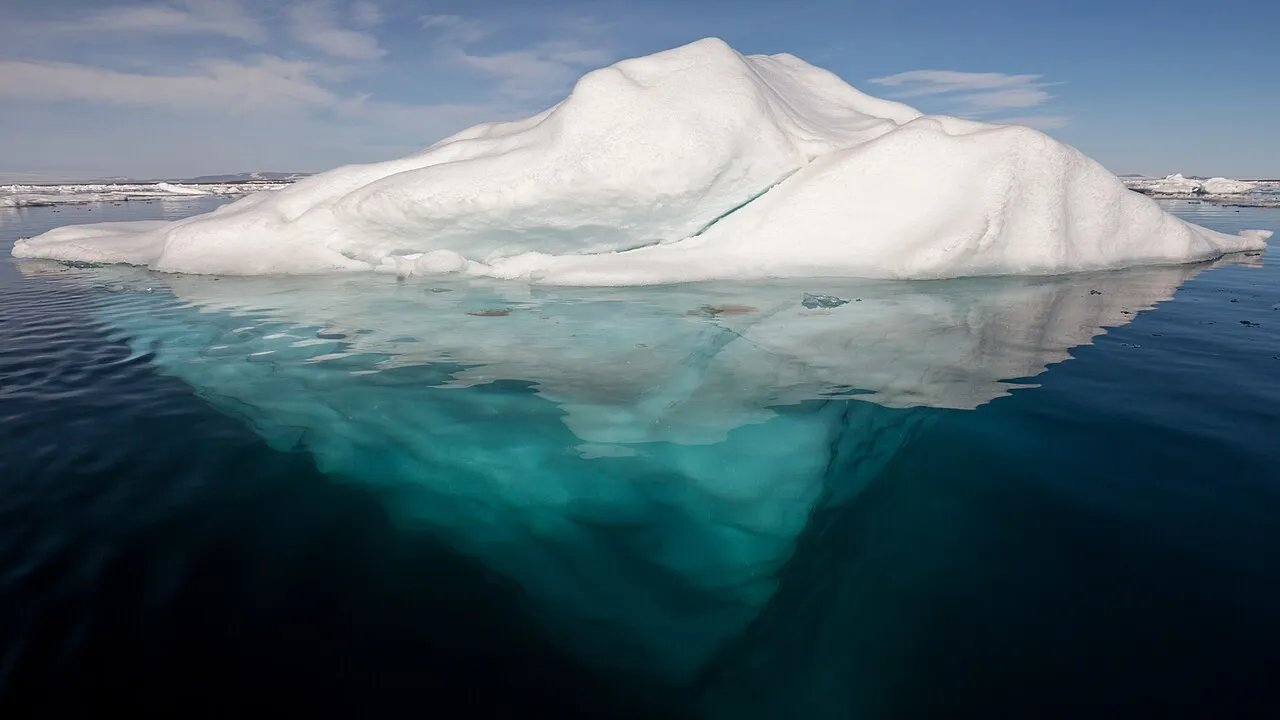
1. How much of an iceberg stays hidden under the ocean waves?
2. What kind of water is an iceberg made of?
🤯 Mind-Blowing Fact • Grade 2
Penguins in Antarctica and seabirds in the Arctic ride drifting icebergs like floating rest stops while hunting fish!
✨ Word Sparks (Grade 2 Glossary)
Tap 🔊 to hear
Calving
Breaking off of ice chunks from a glacier
Submerged
Sitting completely hidden underneath the water surface
Dense
Packed tightly together so something feels heavy
🪝
Why do some floating icebergs gleam bright blue like giant sapphires?
1
Calving at the Coast
Listen to thunder boom across an icy bay in Greenland when there isn't a cloud in the sky! That roar is —when a coastal glacier cracks and drops a mountain-sized block of ice into the sea.
2
Just the Tip of the Iceberg
Put an ice cube in a glass of water and watch most of it sink just below the rim! Because solid ice is only slightly lighter than seawater, about ninety percent of every iceberg floats hidden underwater.
3
White Snow to Sapphire Blue
Young icebergs look bright white because millions of tiny air bubbles scatter sunlight. Older, super-squeezed glacier ice has almost no bubbles, so it absorbs red light and glows vivid blue!
1. What do scientists call the loud cracking event that gives birth to a new iceberg?
2. Why does ancient, tightly squeezed iceberg ice look bright blue instead of white?
🤯 Mind-Blowing Fact • Grade 3
Iceberg B-15, which calved off Antarctica's Ross Ice Shelf in the year 2000, covered 4,200 square miles—larger than the entire island of Jamaica!
✨ Word Sparks (Grade 3 Glossary)
Tap 🔊 to hear
Tabular Iceberg
Flat-topped steep-sided iceberg shaped like a table
Sea Ice
Thin flat ice frozen directly from ocean seawater
Buoyancy
Upward push of water helping lighter objects float
🪝
How is a towering iceberg completely different from frozen sea ice?
1
Born on Land, Drifting at Sea
People often mix up and icebergs, yet they have totally different beginnings! Sea ice forms when salty ocean water freezes into thin flat sheets only a few meters thick. Icebergs begin on land as snowflakes stacking onto Greenland or Antarctic glaciers over thousands of years.
2
Tabular Giants vs. Jagged Pinnacles
Not all icebergs share the same shape. Antarctica's vast floating ice shelves calve flat-topped shaped like giant tabletops miles across. Greenland's steeper valley glaciers usually drop jagged dome, wedge, or spire-shaped icebergs.
3
Buoyancy and Sudden Flips
Freshwater glacier ice has a density near 0.92 grams per cubic centimeter, while salty cold seawater is denser at 1.025. That snug match keeps almost nine-tenths of the berg underwater! As warm water melts the bottom unevenly, top-heavy icebergs can suddenly flip upside down.
4
Iceberg Alley Patrols
Ocean currents carry thousands of Greenland icebergs southward past Newfoundland down 'Iceberg Alley,' where patrol planes and satellites track them to keep ships safe.
1. How does an iceberg differ in origin from polar sea ice?
2. Where do most huge, flat-topped tabular icebergs come from?
🤯 Mind-Blowing Fact • Grade 4
Sailors call small, low-floating chunks of glacier ice 'growlers' because escaping pressurized air bubbles make a rumbling animal growl as the ice melts!
✨ Word Sparks (Grade 4 Glossary)
Tap 🔊 to hear
Growler
Small car-sized iceberg piece floating low in waves
Bergy Bit
Medium house-sized piece of floating glacier ice
Phytoplankton
Microscopic ocean plants that feed marine food webs
🪝
How did one famous Atlantic iceberg launch an international ocean safety patrol that has protected ships for over a century?
1
Official Size Rules on the High Seas
Watch coast guard spotters scanning foggy North Atlantic waves! To earn the official title of iceberg, a chunk of floating glacier ice must rise at least five meters (sixteen feet) above sea level and stretch more than fifteen meters across. Smaller drifting pieces get fun sailor nicknames: house-sized chunks are called ',' while car-sized blocks bobbing low in the swell are called '' because trapped air hisses and growls as they melt!
2
Iceberg Alley and the International Ice Patrol
Every spring, Greenland's fast-moving Jakobshavn and northern fjords calve tens of thousands of icebergs. Carried south by the cold Labrador Current toward busy shipping lanes near the Grand Banks of Newfoundland, one of those bergs sank the RMS Titanic in April 1912. In response, nations created the International Ice Patrol in 1913; using radar aircraft and satellites, not a single vessel heeding its warnings has been lost to an iceberg since!
3
Striped Bergs and Floating Fertilizer
Flipping Antarctic icebergs sometimes reveal dramatic emerald-green, black, or brown stripes—frozen layers of mineral-rich seawater, dark volcanic ash, or ground-up rock flour scraped from the continent below.
4
Feeding Ocean Food Webs
As drifting icebergs melt across open seas, they release iron-rich rock dust trapped inside the ice. That natural iron fertilizes blooms of microscopic , feeding krill, fish, penguins, and baleen whales for miles around!
1. How do melting icebergs support whales, krill, and seabirds far out in the open ocean?
2. Which cold ocean current carries Greenland icebergs southward into North Atlantic shipping lanes?
🤯 Mind-Blowing Fact • Grade 5
Iceberg A23a—nearly three times the area of New York City—calved from Antarctica in 1986, sat stuck on an underwater mudbank for more than three decades, and finally broke free to drift north in the 2020s!
✨ Word Sparks (Grade 5 Glossary)
Tap 🔊 to hear
Archimedes' Principle
Physics law explaining buoyant force on floating objects
Grounding Line
Boundary where land glacier ice begins floating
Dropstone
Rock dropped into deep-sea mud by melting icebergs
🪝
Why doesn't a melting floating iceberg raise global sea levels directly—yet mass iceberg calving still alarms climate scientists?
1
Archimedes' Principle in the Polar Seas
Peer through sonar beams mapping the submerged keel of a polar iceberg, where towering ice cliffs extend hundreds of meters beneath the choppy surface. An iceberg's stealth obeys : any floating object displaces a weight of fluid equal to its own total weight. Because pure glacial ice has a density around 917 kilograms per cubic meter compared with roughly 1,027 kilograms per cubic meter for frigid polar seawater, approximately 89.3 percent of an iceberg's volume remains submerged below the waterline.
2
Sea-Level Physics and Ice-Shelf Buttressing
Here lies a fascinating physics puzzle: once an iceberg is already floating freely in the ocean, its melting adds virtually zero height to global sea level because the melted freshwater neatly fills the volume of seawater it was already displacing (aside from a tiny 2.6 percent expansion caused by freshwater-saltwater salinity differences). Sea level rises at the exact moment land-based glacier ice crosses the to float! Moreover, when floating Antarctic ice shelves splinter into giant tabular bergs, they lose their 'buttressing' brake—allowing inland land glaciers behind them to surge faster into the sea.
3
Ice-berg Scouring and Dropstones
Driven primarily by deep ocean currents pushing against their massive submerged keels rather than surface winds, giant icebergs plow deep gouges across shallow continental shelves down to depths of 500 meters. Meanwhile, boulders frozen into the base of drifting bergs melt loose and plummet into fine deep-sea muds as glacial —giving paleoclimatologists unmistakable rock-record proof of ancient ice-rafting events such as North Atlantic Heinrich events.
4
Emerald Icebergs and Marine Iron Pumps
Rare jade-green icebergs spotted off East Antarctica form when iron-oxide-rich basal seawater freezes onto the underside of an ice shelf without air bubbles; yellow-red iron pigments combine with pure blue ice to glow vivid emerald! When those bergs drift north and melt, they deliver bioavailable iron that fuels Southern Ocean carbon uptake.
5
Tracking Megabergs From Orbit
The U.S. National Ice Center tracks every Antarctic iceberg exceeding ten nautical miles in length using microwave satellites that pierce polar darkness and clouds—charting multi-decade voyages like Iceberg A23a, which calved in 1986, grounded for over thirty years on the Weddell Sea floor, and resumed drifting past South Georgia Island decades later.