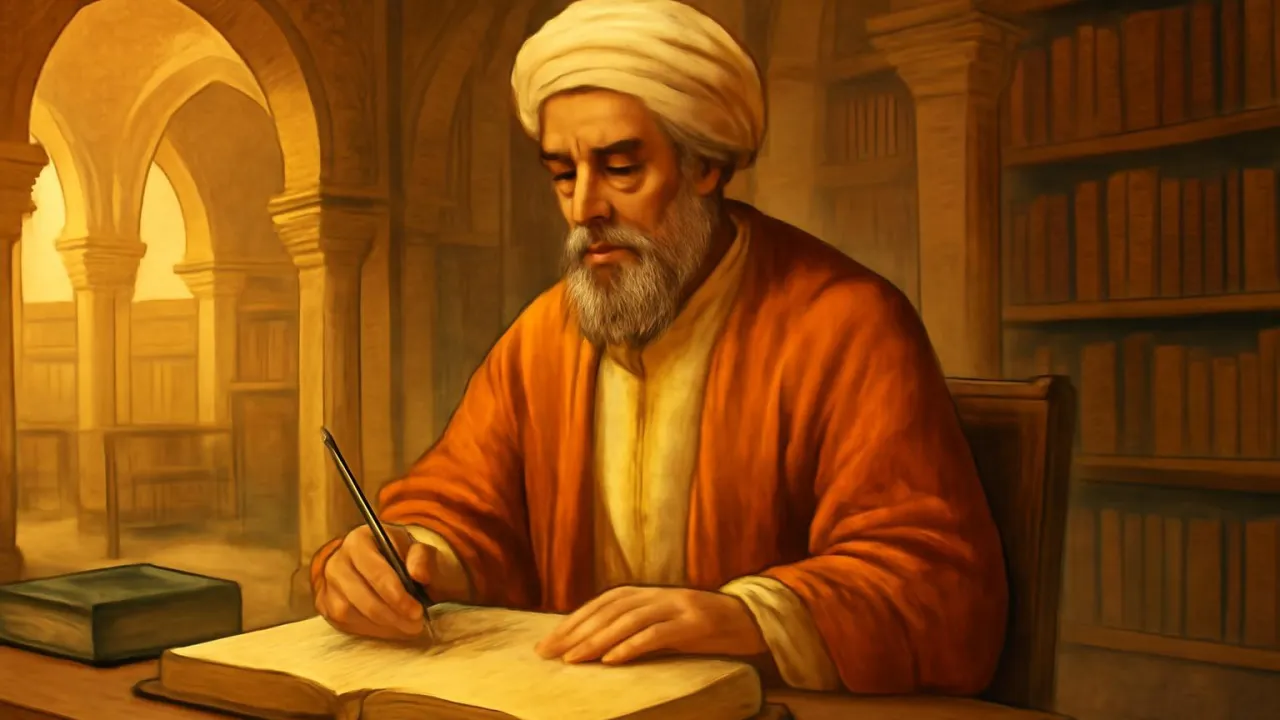
Ibn Rushd’s books were translated into Latin and Hebrew so more people could read them.
✨ Word Sparks (Grade 3 Glossary)
Tap 🔊 to hear
commentary
A book that explains another book
legacy
Something important left behind
philosophy
The study of big life questions
🪝
What if you could connect science and belief to answer life’s biggest questions?
1
A Young Thinker in Córdoba
In the bustling city of Córdoba, Ibn Rushd listened to teachers and studied many subjects. He was fascinated by the stars, animals, and the way people think. His family encouraged his curiosity and love for learning. Every night, he read books and asked questions about the world.
2
Chasing Knowledge Everywhere
Ibn Rushd learned about medicine, law, and from wise scholars. He spent hours in libraries full of ancient Greek and Arabic texts. He believed that reason and faith could work together to find truth. His careful study helped him understand difficult ideas and solve problems.
3
Explaining Aristotle to the World
Ibn Rushd wrote long commentaries on Aristotle, a famous Greek philosopher. He explained tricky ideas so more people could understand them. His books traveled to Europe and inspired new ways of thinking. Many scholars called him "The Commentator" for his clear explanations.
4
A Legacy of Learning
Ibn Rushd’s work helped connect Islamic, Jewish, and Christian thinkers. He showed that science and religion could both help us seek knowledge. His ideas shaped and science for hundreds of years. Today, people still study his writings to learn about reason and belief.
Ibn Rushd’s work helped start the European Renaissance by bringing ancient ideas back to life.
✨ Word Sparks (Grade 4 Glossary)
Tap 🔊 to hear
Renaissance
A time of new ideas and art
logic
Careful thinking to solve problems
astronomy
The study of stars and planets
🪝
Imagine living in a city where every street is filled with books and ideas—what would you want to discover?
1
Growing Up in a City of Wisdom
Córdoba in the 1100s was a center for learning, where Ibn Rushd’s family valued knowledge and discussion. From a young age, he was surrounded by scholars, libraries, and debates about science, law, and philosophy. His curiosity led him to study , medicine, and mathematics with some of the best teachers of his time. This rich environment inspired him to seek answers to the world’s biggest questions.
2
Uniting Reason and Faith
Ibn Rushd believed that reason and faith could work together to help people understand the universe. He read ancient Greek texts, especially Aristotle’s works, and wrote detailed commentaries to explain them. His writing made complex ideas clear for students in both the Muslim world and Europe. He argued that using and observation could strengthen, not weaken, religious belief.
3
A Bridge Across Cultures
Ibn Rushd’s commentaries were translated into Latin and Hebrew, spreading his influence far beyond Spain. European scholars called him "The Commentator" because his work helped them rediscover Aristotle. His ideas encouraged Christian, Jewish, and Muslim thinkers to share knowledge and debate important questions together. This cultural exchange helped spark new discoveries in science and philosophy.
4
Lasting Impact on the World
Even after facing challenges and criticism, Ibn Rushd continued to write about law, medicine, and philosophy. His books inspired generations of thinkers, including those in the European . Today, Ibn Rushd is remembered as a symbol of curiosity, open-mindedness, and the power of learning. His legacy shows that asking questions and seeking understanding can change the world.
1. Why did European scholars call Ibn Rushd 'The Commentator'?
2. How did Ibn Rushd help different cultures share ideas?
🤯 Mind-Blowing Fact • Grade 5
Ibn Rushd wrote over 100 books on philosophy, medicine, law, and astronomy, many of which survive today.
✨ Word Sparks (Grade 5 Glossary)
Tap 🔊 to hear
commentary
A book that explains another book’s ideas
exile
Forced to leave one’s home or city
critical thinking
Carefully examining ideas to find the truth
🪝
What happens when one person dares to unite science, philosophy, and faith in a divided world?
1
A Childhood Surrounded by Knowledge
In twelfth-century Córdoba, Ibn Rushd grew up in a family of respected judges and scholars who encouraged his relentless curiosity. His early years were spent exploring vast libraries, listening to heated debates, and studying mathematics, astronomy, and medicine under renowned teachers. The city was a crossroads of cultures, where Muslim, Jewish, and Christian thinkers exchanged ideas freely. This rich intellectual environment inspired Ibn Rushd to pursue knowledge in every direction, always asking 'Why?' and 'How?' about the world around him.
2
Mastering Philosophy and Science
Ibn Rushd became fascinated by the works of Aristotle, whose writings on logic, ethics, and nature shaped much of his thinking. He devoted years to writing detailed commentaries that clarified Aristotle’s most challenging ideas for students across the Islamic world and Europe. Alongside philosophy, Ibn Rushd excelled in medicine, authoring influential texts that described diseases, treatments, and the importance of observation in diagnosis. His scientific approach emphasized careful reasoning, evidence, and the belief that faith and logic could work together to reveal truth.
3
A Bridge Between Civilizations
Ibn Rushd’s commentaries were translated into Latin and Hebrew, earning him the title 'The Commentator' among European scholars. His works played a crucial role in reintroducing Aristotle’s philosophy to the West, fueling intellectual movements that led to the Renaissance. By arguing that reason and faith are not enemies but partners in the search for knowledge, Ibn Rushd inspired dialogue among Muslim, Christian, and Jewish philosophers. His influence helped create a shared tradition of and debate that shaped universities for centuries.
4
Facing Challenges and Leaving a Legacy
Despite his achievements, Ibn Rushd faced opposition from political and religious leaders who feared his bold ideas. He was exiled from Córdoba and some of his works were banned, yet he continued to write and teach until the end of his life. His courage in defending free inquiry and rational thought made him a symbol of intellectual freedom. Today, scholars recognize Ibn Rushd as a pioneer whose ideas helped lay the foundation for modern science, philosophy, and medicine.
5
Lessons for the Modern World
Ibn Rushd’s life teaches us the importance of curiosity, open-mindedness, and respectful debate across cultures and beliefs. His insistence on combining careful reasoning with faith encourages us to seek understanding, even when ideas seem different or difficult. By bridging worlds and daring to ask the biggest questions, Ibn Rushd changed the course of history and inspired generations to keep learning. His legacy reminds us that great discoveries often begin with a single, thoughtful question.