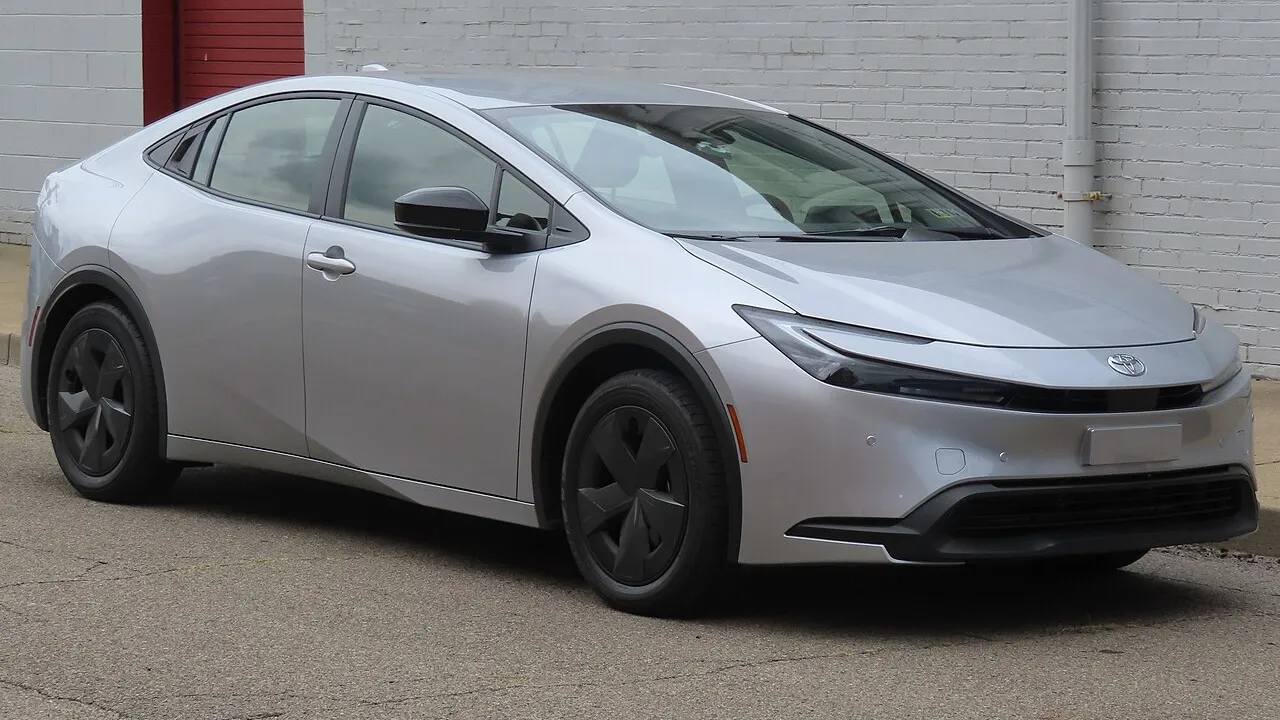
1. Which two power sources work together inside a hybrid car?
2. How does a standard hybrid car refill its battery while driving around town?
🤯 Mind-Blowing Fact • Grade 2
Plug-in hybrids add a bigger battery with a charging port so families can run short daily errands on electricity alone and still take long road trips!
✨ Word Sparks (Grade 2 Glossary)
Tap 🔊 to hear
powertrain
All the car parts sending power to wheels
idle
Running an engine while standing completely still
computer
An electronic brain making super-fast smart choices
🪝
Why do ordinary gas cars waste so much fuel in stop-and-go city traffic?
1
Stopping Wastes Energy
Screech, vroom, screech! In busy city traffic, ordinary gas cars burn fuel while waiting at red lights and turn moving energy into hot brake pads every time they stop.
2
A Century-Old Idea Reborn
Young engineer Ferdinand Porsche built an early gas-electric carriage back in 1900! Almost a hundred years later in 1997, Japanese engineer Takeshi Uchiyamada and his Toyota team launched the Prius—the first -guided family hybrid.
3
Switching Smoothly on the Go
A smart onboard decides which helper works best each second. Electric power handles slow creep-and-roll traffic, gasoline cruises steady highways, and both team up whenever the driver passes or climbs!
1. Where does wasted stopping energy go on a regular non-hybrid car?
2. Which country launched the first mass-produced computer-controlled hybrid family car in 1997?
🤯 Mind-Blowing Fact • Grade 3
Formula 1 race cars and Le Mans endurance champions now use hybrid powertrains to harvest braking energy and blast out of corners!
✨ Word Sparks (Grade 3 Glossary)
Tap 🔊 to hear
microprocessor
A tiny computer chip that controls machines
planetary gear
Gears orbiting a center wheel like planets
regenerate
To capture and reuse energy again
🪝
How do two completely different machines share the exact same set of car wheels without clashing?
1
Strengths That Match
Electric motors pull strongly from a complete stop, while gasoline engines work most efficiently at steady highway speeds. Pairing both inside one powertrain lets each machine cover the other's weak spot!
2
From 1900 Vienna to 1997 Tokyo
In 1900, Austrian designer Ferdinand Porsche bolted electric motors into front wheel hubs powered by an onboard gasoline generator. Nearly a century later, finally grew fast enough for Toyota's 1997 Prius and Honda's 1999 Insight to blend both power sources automatically.
3
Inside the Planetary Gearset
At the heart of many hybrids sits a clever ring of gears shaped like a miniature solar system. A central sun gear, orbiting planet gears, and an outer ring gear blend torque smoothly from the engine and electric motor-generators.
4
Saving Fuel Mile After Mile
Whenever the car coasts or brakes, the motor flips into generator mode to recharge the battery pack. At intersections, the gasoline engine shuts off completely so zero fuel burns while waiting.
1. Why do electric motors and gasoline engines make such good teammates?
2. What does a hybrid car's gasoline engine usually do while stopped at a red traffic light?
🤯 Mind-Blowing Fact • Grade 4
Because regenerative electric braking handles most gentle stops in city driving, taxi drivers in hybrid cars often go more than 100,000 miles before wearing out a single set of brake pads!
✨ Word Sparks (Grade 4 Glossary)
Tap 🔊 to hear
transaxle
Combined transmission and axle assembly driving wheels
epicyclic
Having smaller gears rolling around a center gear
compression
Squeezing air and fuel into smaller space
🪝
How did an obscure 1882 engine cycle and a sun-and-planet gearset slash automobile fuel consumption nearly in half?
1
Solving the Sizing Trap
Conventional gasoline cars face an engineering trap: their engines must be large enough for steep hills and highway passing, yet ninety percent of daily driving uses only a fraction of that power—forcing big engines to run inefficiently. Hybrid powertrains break that compromise by letting an electric motor provide instant burst torque alongside a downsized engine.
2
Series, Parallel, and Power-Split Designs
Ferdinand Porsche's 1900 Lohner-Porsche Mixte used a series layout where a gasoline engine only spun a dynamo feeding wheel motors. In contrast, parallel hybrids let both motor and engine turn the axle directly. Chief engineer Takeshi Uchiyamada's 1997 Toyota Prius pioneered a series-parallel power-split using an planetary gearset to blend both paths seamlessly.
3
Unlocking the Atkinson Cycle
Because its electric motor handles low-speed acceleration, a hybrid's combustion engine can use British inventor James Atkinson's 1882 valve cycle. Keeping intake valves open slightly longer creates a longer expansion stroke than stroke—squeezing far more work from every drop of burning fuel.
4
Cleaner Cities and Plug-In Evolution
Regenerative braking also spares mechanical brake pads, often allowing them to last over 100,000 miles. Combined with plug-in hybrid (PHEV) batteries that charge overnight from household outlets, hybrid technology has saved tens of billions of gallons of gasoline worldwide.
1. Why can hybrid cars use an efficient Atkinson-cycle engine when ordinary gas cars struggled to use it alone?
2. How did Ferdinand Porsche's 1900 Lohner-Porsche Mixte hybrid drive its wheels?
🤯 Mind-Blowing Fact • Grade 5
Modern Formula 1 hybrid power units pair regenerative wheel braking with an electric turbine harvesting exhaust heat, pushing total thermal efficiency above an astonishing 50 percent!
✨ Word Sparks (Grade 5 Glossary)
Tap 🔊 to hear
decouple
To separate two linked motions so each varies
thermal efficiency
Share of heat energy turned into useful work
continuously variable
Changing smoothly across ratios without fixed steps
🪝
How does an electronically controlled planetary gearset eliminate clutches and stepped gears while lifting engine thermal efficiency past 41 percent?
1
Conquering Brake Specific Fuel Consumption
Internal combustion engines reach peak only inside a narrow island of heavy load and moderate rotational speed; outside that sweet spot, throttling and friction losses waste up to four-fifths of fuel energy. Hybrid electric powertrains road wheel speed from engine RPM, keeping combustion operating inside its optimal thermodynamic zone while shutting the engine off completely during idle stops.
2
Kinematics of the Power-Split Device
In the electronically controlled transaxle (e-CVT) introduced by Takeshi Uchiyamada and Satoshi Ogiso in 1997, the engine turns the planetary carrier, Motor-Generator 1 (MG1) connects to the central sun gear, and traction Motor-Generator 2 (MG2) drives the outer ring gear and wheels. Varying MG1's electrical generation torque adjusts engine RPM smoothly across infinite ratios with zero clutches or stepped gears.
3
Atkinson Expansion and Thermal Milestones
Freed from sluggish low-RPM torque demands by instant electric motor support, modern hybrid engines use variable intake-valve timing to run the 1882 Atkinson cycle—shortening effective compression to roughly 10:1 while preserving a long 14:1 power expansion stroke. Paired with cooled exhaust-gas recirculation, production hybrid engines surpass 41 percent peak versus roughly 28 percent in conventional cars.
4
Power Electronics and Battery Chemistry
Bidirectional DC-DC boost converters step a compact 200-volt nickel-metal-hydride or lithium-ion battery pack up to 600 volts before high-speed transistor inverters drive MG1 and MG2. Strict battery-management software cycles state of charge gently between 40 and 80 percent capacity—preventing lithium plating and electrode stress so hybrid packs routinely outlast 250,000 kilometers of daily driving.
5
Global Fleet Impact and Motorsport Transfer
Across series, parallel, power-split, and plug-in hybrid (PHEV) designs—spanning diesel-electric freight locomotives, urban transit buses, and Formula 1 kinetic-and-exhaust-heat recovery units exceeding 50 percent —hybridization bridges existing fuel networks with electrified transport, slashing urban nitrogen-oxide smog and global carbon-dioxide emissions.