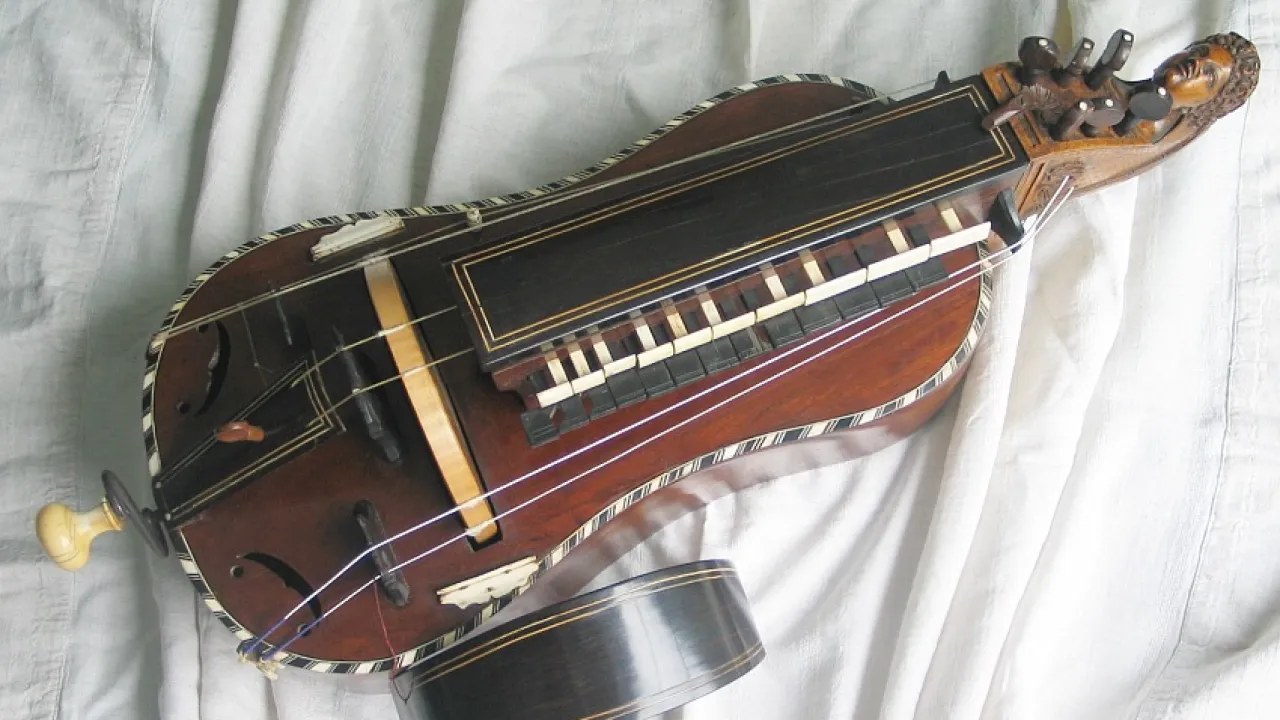
1. What rubs against the strings inside a hurdy-gurdy instead of a straight stick bow?
2. Why do French musicians call the hurdy-gurdy's buzzing bridge 'the little dog'?
🤯 Mind-Blowing Fact • Grade 2
A thousand years ago, the giant church ancestor of the hurdy-gurdy—called the organistrum—was five feet long and took one monk to crank the wheel while a second monk pulled the keys!
✨ Word Sparks (Grade 2 Glossary)
Tap 🔊 to hear
rosin
Hardened tree sap rubbed onto wheels for grip.
organistrum
Giant medieval two-person ancestor of the hurdy-gurdy.
harmony
Notes sounding together to support a melody.
🪝
Why did medieval monks need *two* people just to play the earliest giant hurdy-gurdy?
1
The Endless Circular Bow
Hummmm—bzzzt—doodle-dee! Imagine a violin bow bent into a smooth wooden circle that never runs out of room! Over a thousand years ago in medieval Europe, builders invented the hand-cranked hurdy-gurdy.
2
Three Jobs at the Same Time
Turning the curved brass crank spins a sticky, rosined pearwood wheel against several strings at once. Low drone strings hum steady like bagpipes, while central melody strings sing out tunes whenever left-hand fingers press wooden keys!
3
Waking Up the Little Dog
Watch the player's cranking hand give quick, snappy wrist flicks! Each sudden burst of speed lifts a tiny asymmetric bridge called the dog, making it tap and buzz against the spruce top like a built-in snare drum!
1. How many musicians were needed to play the giant medieval 'organistrum' a thousand years ago?
2. How does a hurdy-gurdy player add drum-like rhythmic buzzes without stopping the melody?
🤯 Mind-Blowing Fact • Grade 3
During the 1700s in France, Queen Marie Antoinette and royal nobles loved the hurdy-gurdy so much that luthiers inlaid them with ivory, pearl, and carved lute backs!
✨ Word Sparks (Grade 3 Glossary)
Tap 🔊 to hear
chanterelle
Central melody string inside a hurdy-gurdy keybox.
gravity
Downward pull that resets tilted hurdy-gurdy keys.
chien
French name for the rhythmic buzzing bridge.
🪝
How can one hand-cranked wooden box play bass drones, violin melodies, and snare-drum rhythms all at once?
1
A Whole Medieval Band in Your Lap
Vrrrr—snap-buzz—sing! Close your eyes at a folk festival in central France or Hungary and you might think a bagpiper, a fiddler, and a drummer are performing together—until you spot a single musician cradling a hurdy-gurdy!
2
Cotton, Rosin, and Pearwood
Inside the maple-and-spruce body spins a polished pearwood wheel coated in pine rosin. Even more surprisingly, players wrap fine wisps of raw cotton around every string right where it touches the wheel to cushion harsh scrapes into a warm, singing tone!
3
Gravity Keys in the Keybox
Two central melody strings thread through a wooden keybox lined with two rows of chromatic keys, like black and white piano notes. Tilting the instrument slightly forward lets pull keys back out cleanly the instant fingers let go!
4
Coup de Poignet: Wrist-Snap Percussion
One outer trumpet string rests on a loose, one-legged bridge called the . Snapping the crank with crisp wrist pulses—coup de poignet—triggers rhythmic buzzing beats!
1. Why do hurdy-gurdy players wrap tiny wisps of cotton around their strings right where the wheel rubs them?
2. What pulls a pressed hurdy-gurdy key back out when the player lifts their finger?
🤯 Mind-Blowing Fact • Grade 4
Wolfgang Amadeus Mozart enjoyed the hurdy-gurdy's rustic drone sound so much that he wove hurdy-gurdy parts right into lively Viennese minuets and German dances!
✨ Word Sparks (Grade 4 Glossary)
Tap 🔊 to hear
bourdon
Deep, continuous low drone string on hurdy-gurdies.
pastoral
Art celebrating peaceful countryside life and folk music.
trompette
Drone string driving the buzzing chien bridge.
🪝
Why did composers like Vivaldi and Mozart write music for a hand-cranked medieval drone machine?
1
Cathedrals, Royal Courts, and Country Dances
What would happen if an instrument traveled from tenth-century monastery choirs to glittering Versailles palaces, wandered dusty village roads, and then roared back onto twenty-first-century film scores? Few instruments boast a wilder biography than the hurdy-gurdy—known in France as the vielle a roue, or 'wheel fiddle.'
2
From Two-Player Organistrum to Solo Vielle
Sculpted in stone around 1188 on the Portico of Glory in Santiago de Compostela, Spain, the medieval organistrum required two seated monks. By the thirteenth century, builders shrank it into the portable symphonia with push-keys that fell back by gravity. During the eighteenth-century French craze, luthiers mounted wheel-and-key mechanisms onto lute and guitar bodies, inspiring Baroque masterworks and even charming dances by Wolfgang Amadeus Mozart!
3
Wheel Friction and String Architecture
A classic six-string French hurdy-gurdy separates its strings into three acoustic roles: two central gut or fluorocarbon melody chanterelles running through the twenty-four-key chromatic tangent box, two low wound drones humming continuous fifths or octaves, and high mouche and strings flanking the upper bout.
4
Mastering the Trompette and Tirant
The secret of the rhythmic buzz lies in the string's asymmetric chien bridge, whose foot hooks loosely into a slot while its head touches the spruce soundboard. Adjusting tension via a tailpiece peg called the tirant tunes sensitivity so gentle cranking hums smoothly, while crisp four-point wrist impulses make the bridge chatter in intricate dance grooves!
1. How do French hurdy-gurdy builders shape the two most classic body styles?
2. What does the 'tirant' adjustment peg on the tailpiece let a hurdy-gurdy player control?
🤯 Mind-Blowing Fact • Grade 5
Because each wooden tangent inside a hurdy-gurdy keybox pivots on its own post, players can twist individual notes into pure 'just intonation' so chords ring completely beat-free against the drones!
✨ Word Sparks (Grade 5 Glossary)
Tap 🔊 to hear
tribology
Science of friction between rubbing moving surfaces.
just intonation
Pure whole-number ratio tuning with zero wavering beats.
tekerolant
Traditional Hungarian folk cousin of the hurdy-gurdy.
🪝
How do continuous pearwood-wheel stick-slip excitation, cotton-wrapped string interfaces, and non-linear chien bridge dynamics power the vielle a roue?
1
Polyphonic Mechanics of the Wheel Fiddle
Part bowed fiddle, part mechanical keyboard, part bagpipe drone, and part percussive snare, the European hurdy-gurdy—French vielle a roue—occupies a class of its own in acoustic organology. Driven by an S-shaped crank rotating a solid or laminated pearwood rimmed wheel roughly sixteen centimetres in diameter, a single performer sustains multi-octave drones, ornaments two-octave chromatic melodies, and articulates crisp rhythmic subdivisions simultaneously.
2
Millennial Trajectory: Organistrum to Electro-Acoustic Revival
Cataloged under Hornbostel-Sachs 321.322-72 as a bowed lute stopped by keys and sounded by a friction wheel, the instrument appears in tenth-century treatises attributed to Odo of Cluny and in twelfth-century Romanesque sculptures across northern Spain and France. Evolving from the two-person monastic organistrum into the portable Gothic symphonia, it experienced an aristocratic Baroque golden age under French virtuoso Henri Baton—who transplanted mechanisms onto lute and guitar shells around 1720—and thrives today in Auvergne, Bourbonnais, Hungarian , and modern avant-garde traditions.
3
Tribology of Rosin, Pearwood, and Cotton Wrapping
Continuous circular bowing presents a delicate tribological challenge: raw wood grinding directly against taut gut, nylon, or wound-metal strings generates chaotic screeching. Performers solve this by burnishing the true-turned pearwood wheel rim with solid pine rosin while spinning a microscopic sleeve of long-staple cotton fiber around every string's contact point. Properly dressed, the rosined cotton locks into stable Helmholtz stick-slip oscillation across two unison or octave chanterelles, bourdons, and sympathetic strings.
4
Diatonic-Chromatic Keybox and Swivelling Tangents
Inside the central keybox, twenty-four gravity-returned wooden keys arranged in two staggered tiers—mirroring piano naturals below and accidentals above—carry swivelling flag-shaped wooden tangents. Rotating individual tangents with needle-nose pliers allows microtonal or just-intonation temperament adjustments so melody thirds lock beatlessly into pure harmonic resonance with the open drones.
5
Non-Linear Percussion of the Chien Bridge
Most ingenious of all is the trompette string's unbalanced hardwood bridge, le chien. Anchored loosely by a tail heel while its forward nose rests lightly against an ivory or bone soundboard plate—regulated by lateral pull from a secondary tirant cord—sudden angular crank accelerations (coups de poignet) exceed static downforce, lifting the bridge nose into a rapid, buzzing percussive chatter.