🧬 HUMAN BODY
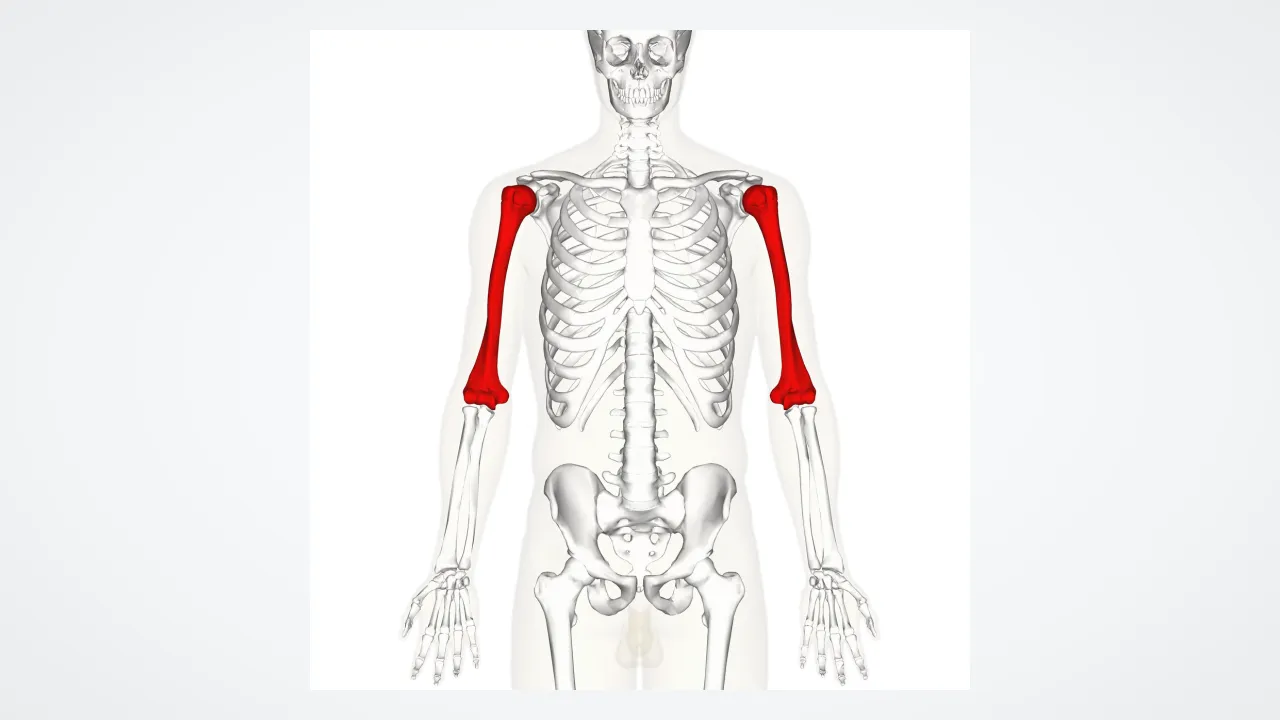
🧬 Humerus • Appendicular Skeletal System (Upper Limb)
VA Science & Health SOL 1.1, 3.1, 4.2, 5.1 (Cells, Organs & Body Systems)
Humerus
Upper Arm Lever Behind the Tingly Funny Bone
Grade 4 • Expanding • 212 words
🩺 Body System & LocationUpper Arm (Brachium) • Bridging Shoulder Socket to Elbow Joint
🔬 Size / Cell Count~12–14 in (30–35 cm) in adults • Largest bone in the entire arm!
⚙️ Core JobSwings freely at the shoulder and hinges with forearm bones at the elbow
⚡ Body SuperpowerHome of the 'funny bone'—actually a tingly nerve groove at its lower tip!
🤯 Mind-Blowing Fact • Grade 1
Your 'funny bone' gets its nickname partly because your upper arm bone—the humerus—sounds just like the word 'humorous'!
✨ Word Sparks (Grade 1 Glossary)
Tap 🔊 to hear
Humerus
Long bone inside your upper arm
Elbow
Bending middle hinge joint of your arm
Humorous
Silly or funny enough to make laughs
🪝
Flex your arm muscle like a superhero—what big bone hides right inside?
1
Champion Bone of Your Arm
Bend your and make a strong muscle in your upper arm! Underneath that muscle sits one long, sturdy bone called your . It is the biggest bone in your arm!
2
Shoulder to Elbow
Up top, a smooth round ball plugs into your shoulder so you can wave high. Down below, it meets your two lower arm bones to build your bending .
3
The Tingly 'Funny Bone'!
Have you ever bumped your and felt a funny buzz? sounds like ',' which means funny!
1. Which two joints sit at the top end and bottom end of your humerus?
2. Which bone is the longest and largest bone in your entire arm?
🤯 Mind-Blowing Fact • Grade 2
When you bump your 'funny bone,' you are actually tapping your ulnar nerve right where it crosses a bony bump at the bottom of your humerus!
✨ Word Sparks (Grade 2 Glossary)
Tap 🔊 to hear
Biceps
Front upper-arm muscle that bends your elbow
Triceps
Back upper-arm muscle that straightens your elbow
Nerve
Tiny body wire carrying fast feeling signals
🪝
Why does bumping the inside of your elbow send a weird tingly buzz all the way to your pinky finger?
1
Solving the Funny Bone Mystery!
Ouch-tingle-buzz! Everyone calls that spot on your inner elbow the 'funny bone,' yet what you bumped is not really a bone at all! Right behind a smooth bump at the bottom of your humerus runs a telephone-wire called the ulnar nerve. Bumping it squeezes the nerve gently against the humerus bone, sending harmless tingles down to your pinky!
2
Biceps in Front, Triceps in Back
Two famous muscle teams hug your humerus. In front, your muscle pulls to bend your elbow and lift your lunchbox. In back, your muscle pulls to straighten your arm!
3
Built for Reaching
Because humans walk on two legs instead of four, your humerus stays light and nimble for painting, climbing, and catching.
1. What are you ACTUALLY bumping when your 'funny bone' sends a tingly buzz to your pinky finger?
2. How do your biceps and triceps muscles team up around your humerus?
🤯 Mind-Blowing Fact • Grade 3
Four-fifths—about eighty percent—of your upper arm's length grows from the single growth plate up near your shoulder!
✨ Word Sparks (Grade 3 Glossary)
Tap 🔊 to hear
Deltoid
Triangle shoulder muscle lifting your humerus sideways
Trochlea
Spool-shaped lower humerus pulley hinging with ulna
Capitulum
Rounded lower humerus knob meeting radius bone
🪝
How can one arm bone plug into a ball-and-socket joint at the top AND two completely different elbow joints at the bottom?
1
Half-Sphere at the Top
Examine a humerus from top to bottom and admire its smart shapes! At the upper end, a smooth, half-sphere head faces inward to meet the shoulder blade's glenoid saucer. Right beside that smooth ball sit two rough bumps—the greater and lesser tubercles—where rotator-cuff tendons hold on tight.
2
Muscle Ridges Along the Shaft
Halfway down the outer side of the humerus shaft sits a V-shaped rough patch called the tuberosity. Your triangular shoulder muscle—the deltoid—grips that exact spot to lift your arm sideways like airplane wings!
3
Two Shapes at the Elbow!
Down at the widened bottom end, the humerus splits its joint surface into two custom shapes side by side: a spool-shaped pulley (the ) that hinges with your ulna bone, and a little round ball (the ) where your radius bone glides and spins!
4
Growing Primarily From the Top
Interestingly, about eighty percent of your humerus's childhood growth happens at its upper shoulder growth plate rather than the elbow end!
1. Why does the bottom end of the humerus have BOTH a spool shape (trochlea) and a round knob (capitulum)?
2. Where does about 80 percent of a child's humerus length grow from?
🤯 Mind-Blowing Fact • Grade 4
Deep hollows carved into the front and back of the lower humerus act like custom parking garages for your forearm bones so your elbow can lock completely straight or fold completely tight!
✨ Word Sparks (Grade 4 Glossary)
Tap 🔊 to hear
Epicondyles
Side elbow bumps anchoring wrist and finger muscles
Bicipital
Front humerus groove guiding long biceps tendon
Olecranon
Pointy elbow tip fitting back humerus hollow
🪝
Why does a spiral groove wind down the back of your humerus like a twisty mountain road?
1
Nerves Traveling Along Bone Highways
Run your finger down the back of a model humerus, and you will feel a smooth diagonal valley spiraling from inside to outside—the radial groove! Winding right along that sheltered canyon runs the radial nerve alongside the deep brachial artery, powering the triceps muscle and the muscles that lift your wrist and fingers. In fact, three major arm nerves hug different spots on the humerus: the axillary nerve around the surgical neck, the radial nerve in the spiral groove, and the ulnar nerve behind the medial epicondyle ('funny bone')!
2
Intertubercular Groove: A Tendon Track
Up front between the greater and lesser tubercles runs another neat vertical channel—the (intertubercular) groove. Held down by a ligament strap like a train on tracks, the long tendon of your biceps brachii glides smoothly up and down this groove whenever you pitch or lift.
3
Built-In Pockets for Full Elbow Bend
How can your forearm fold tightly to touch your shoulder AND straighten to a flat 180-degree line without bones clashing? Just above the elbow spool, the humerus features hollow depressions—the coronoid fossa in front and deep fossa in back—catching forearm bone tips at both extremes!
4
Epicondyles Anchor Forearm Grippers
Flaring out on either side above the elbow sit the medial and lateral , anchoring nearly twenty forearm muscles that flex and extend your wrists and fingers!
1. What is the job of the deep olecranon fossa hollow on the back of the lower humerus?
2. Which major nerve winds down the spiral groove along the back shaft of the humerus?
🤯 Mind-Blowing Fact • Grade 5
Whether you look at a blue whale's giant flipper, a bat's wing, a frog's leg, or your own arm, every four-limbed vertebrate starts its upper limb with the exact same single bone—the humerus—inherited from 375-million-year-old lobe-finned fish!
✨ Word Sparks (Grade 5 Glossary)
Tap 🔊 to hear
Torsion
Twisting force or built-in spiral along bone
Homologous
Sharing the same evolutionary ancestor bone blueprint
Periosteum
Living outer membrane wrapping around bone shafts
🪝
How does a 164-degree evolutionary twist along the shaft of the human humerus orient your hands right in front of your eyes for precision toolmaking?
1
Proximal Architecture and Two Anatomical Necks
Measuring roughly 30 to 35 centimeters in adults, the humerus is the longest, most robust bone of the upper extremity. Proximally, its hemispherical articular head angles ~135 degrees relative to the shaft and ~30 degrees posteriorly (humeral retroversion) to face the scapular glenoid cavity. Anatomists distinguish two 'necks': the true anatomical neck ringing the articular cartilage margin, and the narrower surgical neck just distal to the greater and lesser tubercles—where the axillary nerve and posterior circumflex humeral artery wrap around the bone to supply the deltoid.
2
Humeral Torsion: An Evolutionary Twist for Dexterous Hands
In quadrupedal mammals whose shoulder blades sit on the sides of narrow chests, the humeral head points backward while the elbow hinges forward. When hominoid primates shifted the scapula onto a broad dorsal thorax, the humeral shaft evolved a dramatic ~164-degree internal longitudinal twist known as 'humeral '! That built-in twist keeps your elbow cubital fossa facing forward toward your workspace while your shoulder ball faces inward and backward toward the glenoid!
3
Diaphyseal Biomechanics and Neurovascular Intimacy
Unlike the femur, which endures relentless axial compression, the free-hanging humerus excels at resisting torsional torque (as in baseball pitching, where rotational velocities exceed 7,000 degrees per second!) and cantilever bending. Three major brachial-plexus nerves lie directly against along its course: the axillary nerve at the surgical neck, the radial nerve in the spiral groove between medial and lateral triceps heads, and the ulnar nerve in the cubital tunnel behind the medial epicondyle—where tapping elicits classic C8–T1 paresthesia ('funny bone' tingles) in the fifth digit!
4
Distal Condylar Complex and Carrying Angle
Distally, the asymmetric medial flange of the trochlea tilts the extended forearm ~10 to 15 degrees laterally away from the hip—the 'carrying angle'—so swung arms clear the wide human pelvis cleanly during walking!
5
Comparative Homology
From whale flippers and bat wings to T. rex forelimbs and concert pianists' arms, every tetrapod shares one single proximal bone—the humerus—discovered in 375-million-year-old lobe-finned fish like Tiktaalik!