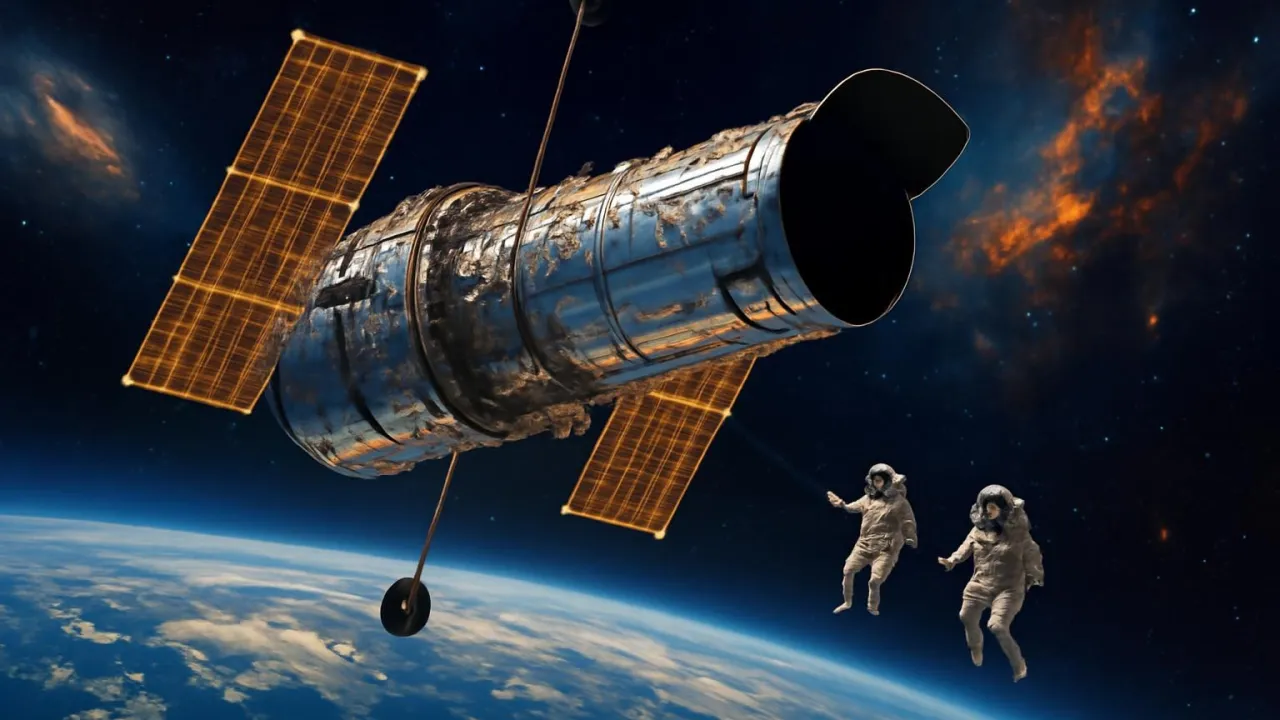
Can you imagine peeking at stars with a telescope floating in space?
1
Hubble’s Space Adventure
Hubble high above our planet, far from city lights. It looks like a shiny cylinder with big . Hubble can see things regular telescopes cannot, because it is above the clouds.
2
How Hubble Works
Hubble uses giant curved mirrors to catch light from space. The light bounces inside and goes to special cameras. These cameras send colorful pictures back to scientists on Earth.
3
What Hubble Shows Us
Hubble has shown us new galaxies, planets, and star clouds. Some pictures look like bright swirls and glowing dots. Hubble helps scientists discover amazing things about our .
1. Why can Hubble see better than ground telescopes?
2. What does Hubble send to Earth?
🤯 Mind-Blowing Fact • Grade 3
Hubble’s main mirror is 2.4 meters wide—about as long as a small car!
✨ Word Sparks (Grade 3 Glossary)
Tap 🔊 to hear
orbit
A path something takes around Earth.
reflection
When light bounces off a surface.
nebula
A colorful cloud of gas in space.
🪝
What if you could see the birth of stars from above the clouds?
1
Hubble’s Place Above Earth
The Hubble Space Telescope circles Earth in a special path called an . It travels about 340 miles above us, moving fast to stay in space. Up there, Hubble avoids the air and clouds that blur ground telescopes. This lets it capture clear images of distant galaxies and nebulae.
2
Mirrors and Light Magic
Hubble uses a large curved mirror to gather faint starlight. The light bounces off the mirror and focuses onto scientific cameras. These cameras record the light and send the data to Earth. This process uses the principle of to make sharp pictures.
3
Discoveries Across the Universe
Hubble has revealed new planets, star nurseries, and even the age of the universe. Its images show swirling galaxies, glowing nebulae, and exploding stars called supernovas. Scientists use these discoveries to learn how stars and planets form. Hubble helps us understand our place in the cosmos.
4
A Team Effort in Space
NASA and the European Space Agency worked together to build Hubble. Astronauts have visited Hubble in space to fix and upgrade its parts. These repairs kept Hubble working for over thirty years. Hubble’s teamwork shows how people across the world can explore together.
Hubble has helped scientists estimate the universe is about 13.8 billion years old!
✨ Word Sparks (Grade 4 Glossary)
Tap 🔊 to hear
spectrograph
A tool that splits light into colors.
distortion
When something looks blurry or twisted.
cosmic
Something that comes from space.
🪝
Imagine peering through a telescope that floats above the atmosphere—what mysteries would you uncover?
1
Hubble’s Journey Beyond the Clouds
The Hubble Space Telescope orbits Earth at about 28,000 kilometers per hour, soaring above the atmosphere. Its position in space means it avoids atmospheric , which can blur images for ground telescopes. This allows Hubble to capture incredibly sharp and detailed photographs of distant objects. Its location gives scientists a crystal-clear window into the universe.
2
Engineering Marvel: Mirrors and Instruments
Hubble’s main mirror measures 2.4 meters across and collects faint light from faraway stars. The light reflects off the mirror and is focused onto sensitive scientific instruments, including cameras and . These instruments record images and break light into its colors to study what stars and galaxies are made of. This optical system uses the principles of reflection and refraction to reveal hidden details.
3
Revealing the Universe’s Secrets
Hubble has measured the age of the universe and discovered planets outside our solar system. It has captured images of star-forming nebulae, black holes, and galaxies billions of light-years away. These discoveries have changed what scientists know about how stars, planets, and galaxies form and evolve. Hubble’s data helps answer questions about the universe’s past and future.
4
A Global Science Mission
Built by NASA and the European Space Agency, Hubble was launched in 1990 aboard the Space Shuttle Discovery. Astronauts have visited Hubble five times to repair and upgrade its instruments, extending its life and abilities. The telescope’s discoveries are shared with scientists and students worldwide, inspiring new generations to explore space. Hubble’s teamwork shows how international cooperation can lead to amazing scientific achievements.
1. Why does Hubble take clearer pictures than ground telescopes?
2. What important discovery did Hubble help make?
🤯 Mind-Blowing Fact • Grade 5
Hubble’s discoveries have led to over 20,000 published scientific papers, making it one of the most productive scientific instruments in history.
✨ Word Sparks (Grade 5 Glossary)
Tap 🔊 to hear
Ritchey-Chrétien
A special mirror design for sharp images.
exoplanet
A planet outside our solar system.
resolution
How clearly a telescope can see details.
🪝
What would you discover if you could build a telescope powerful enough to peer back in time?
1
Engineering a Telescope for the Cosmos
Launched in 1990, the Hubble Space Telescope was engineered to orbit Earth at an altitude of approximately 547 kilometers, beyond the blurring effects of the atmosphere. Its cylindrical body measures 13.2 meters long and weighs about 11,110 kilograms, with two solar arrays providing electrical power. Hubble’s primary mirror, 2.4 meters in diameter, is crafted from ultra-polished glass to reflect and focus faint light from the farthest reaches of space. This design allows Hubble to capture images with a impossible for ground-based telescopes of similar size. The telescope’s structure must withstand extreme temperature changes and the vacuum of space, ensuring stable, vibration-free observations.
2
Optics and Instruments: Unlocking the Universe
Hubble’s optical system uses a design, where the primary and secondary mirrors work together to minimize optical distortion. Incoming light is reflected by the primary mirror, then by a smaller secondary mirror, and finally directed to scientific instruments including the Wide Field Camera 3 and the Cosmic Origins Spectrograph. These instruments can observe ultraviolet, visible, and near-infrared wavelengths, enabling scientists to analyze the composition, temperature, and movement of distant celestial objects. The spectrograph splits light into its component colors, revealing unique ‘fingerprints’ of atoms and molecules in stars and galaxies. This combination of precision optics and advanced detectors makes Hubble a powerful tool for astronomical research.
3
Historic Discoveries and Scientific Impact
Hubble has fundamentally changed our understanding of the universe by measuring the rate of cosmic expansion and helping determine that the universe is approximately 13.8 billion years old. Its observations have revealed the existence of supermassive black holes at the centers of galaxies and discovered thousands of orbiting distant stars. Hubble’s images of star-forming regions, such as the Eagle Nebula’s ‘Pillars of Creation,’ have become iconic symbols of cosmic evolution. The telescope has also studied the atmospheres of planets in our solar system and beyond, providing clues about their weather and potential for life. These discoveries have influenced everything from textbooks to future space missions.
4
International Collaboration and Ongoing Legacy
Hubble was developed through a partnership between NASA and the European Space Agency, demonstrating the importance of global scientific cooperation. Five Space Shuttle servicing missions between 1993 and 2009 repaired, upgraded, and replaced Hubble’s instruments, dramatically extending its operational life and capabilities. Data from Hubble is made publicly available, supporting research by scientists and students worldwide and inspiring countless educational projects. Hubble’s success paved the way for even more advanced telescopes, such as the James Webb Space Telescope, which will explore the universe in new ways. The telescope’s legacy continues to shape astronomy and our understanding of the cosmos.
5
The Future: Hubble’s Enduring Influence
Although Hubble will eventually stop working, its scientific contributions will endure for generations. The telescope has collected over 1.5 million observations, resulting in more than 20,000 scientific papers and countless discoveries. Its data archive remains a valuable resource for ongoing and future research, allowing scientists to revisit and reanalyze observations as technology improves. Hubble’s breathtaking images have inspired artists, writers, and the public to imagine the wonders of space. As new telescopes continue the search for answers, Hubble’s pioneering spirit reminds us that curiosity and teamwork can unlock the mysteries of the universe. The telescope’s journey proves that science is a never-ending adventure.