1. Why does an allergy make you sneeze when flower pollen floats into your nose?
2. What chemical pops out of nose guard cells to trigger watery eyes and sneezes?
🤯 Mind-Blowing Fact • Grade 2
Medicine called an antihistamine works like a little cap that blocks histamine docks so your nose stops itching!
✨ Word Sparks (Grade 2 Glossary)
Tap 🔊 to hear
Mast Cell
Guard cell storing packets of histamine chemical
Allergen
Harmless thing like pollen triggering an allergy
Antihistamine
Medicine that blocks histamine from causing sneezes
🪝
Why does a tiny mosquito bump itch or spring grass make one kid sneeze while their friend feels fine?
1
Watchful Mast Cells
Lining your skin, eyes, and nose sit special guard cells called . Inside each mast cell are hundreds of tiny storage bubbles packed with a messenger chemical named histamine.
2
Mistaken Identity
In people with allergies, the immune system treats harmless visitors—like cat fur, dust mites, peanuts, or tree pollen—like sneaky invaders. We call these harmless triggers .
3
How Histamine Works
As soon as an touches watchful , they spill histamine out! Histamine widens tiny blood vessels, tickles nearby nerves, and makes extra mucus to rinse your nose clean.
1. Which cells store tiny bubbles of histamine under your skin and inside your nose?
2. How does an antihistamine medicine calm down seasonal sniffles?
🤯 Mind-Blowing Fact • Grade 3
Histamine doesn't just work in your nose—in your brain it acts as a wake-up neurotransmitter, which is why older allergy medicines could make people sleepy!
✨ Word Sparks (Grade 3 Glossary)
Tap 🔊 to hear
IgE Antibody
Antibody type attached to allergy mast cells
Granule
Tiny packet inside a cell holding chemicals
Hives
Raised itchy pink bumps on allergic skin
🪝
Why does your body need to meet an allergen once before an allergy can ever happen?
1
Step One: Setting the Trap
Believe it or not, nobody sneezes the very first time their immune system meets ragweed pollen or pet dander! During that quiet first meeting, B-cells mistakenly build a special class of Y-shaped tags called IgE antibodies. Those antibodies clip onto mast cells in your nose, skin, and airways like tiny tripwires.
2
Step Two: Bursting Granules
Next time that exact same allergen drifts in, it bridges across two IgE antibodies sitting side by side on a mast cell. Instantly, the mast cell pops open its inner storage and floods the neighborhood with histamine!
3
Why Histamine Exists
Histamine is not a villain—it actually evolved to help us! Widening blood vessels lets white blood cells rush to a splinter, while extra mucus and sneezing physically eject real parasites before they settle in.
4
Calming Big Reactions
Most allergies cause mild sniffles or itchy on skin. For strong food or bee-sting allergies, doctors prescribe rescue epinephrine pens that quickly relax airways and steady blood vessels.
1. What acts like a tiny tripwire on the outside of a mast cell waiting for returning pollen?
2. Why could older antihistamine medicines sometimes make people feel drowsy?
🤯 Mind-Blowing Fact • Grade 4
Your stomach uses the exact same histamine chemical every time you eat lunch, plugging it into H2 receptors to release acid for digesting food!
✨ Word Sparks (Grade 4 Glossary)
Tap 🔊 to hear
Sensitization
First exposure when IgE antibodies arm mast cells
Degranulation
Rapid release of chemical packets from cells
Basophil
Circulating white blood cell carrying histamine granules
🪝
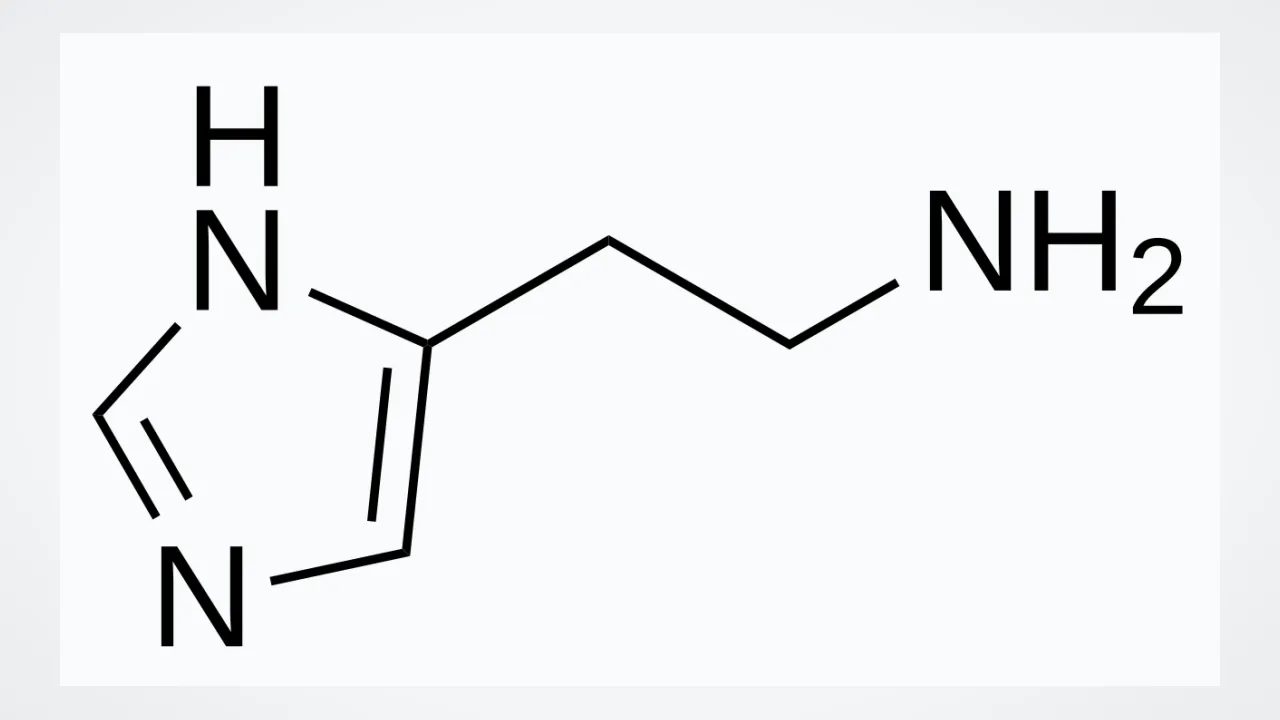
How can a tiny molecule made of just seventeen atoms trigger watery eyes, itchy hives, a runny nose, and stomach acid all at once?
1
Sensitization and Degranulation
Allergic reactions unfold like a two-act play. In Act One——an immune system encounters a harmless protein in dust mites, grass pollen, or shellfish and produces custom IgE antibodies that anchor onto mast cells and blood . In Act Two, returning allergens cross-link pairs of those IgE sensors, sparking : within seconds, mast cells fuse hundreds of internal vesicles with their outer membrane and release histamine.
2
One Molecule, Four Different Locks
Built from a single amino acid called histidine, histamine is tiny yet versatile because different organs carry different histamine receptors—named H1 through H4. Locking into H1 receptors widens capillaries so fluid leaks into tissues, causing puffy eyelids or raised hives, while tickling sensory nerves to trigger sneezes and itches. Meanwhile, H2 receptors live in your stomach lining, where histamine peacefully signals cells to make digestive acid!
3
Evolution's Parasite Ejector
Immunologists wondered why mammals keep IgE and mast-cell alarms at all. Evidence shows this rapid flush-and-expel system evolved to defend skin and guts against microscopic worms, ticks, and venoms—modern clean indoor environments occasionally leave it bored enough to misfire at birch pollen!
4
Smart Medical Solutions
Modern second-generation H1 antihistamines selectively quiet nasal and skin symptoms without crossing into the brain, while allergy immunotherapy gradually retrains T-cells and B-cells to tolerate allergens calmly.
1. How can histamine cause sneezes in your nose yet trigger digestive acid in your stomach?
2. What original job do scientists think the IgE and mast-cell alarm system evolved to handle?
🤯 Mind-Blowing Fact • Grade 5
Husband-and-wife immunologists Kimishige and Teruko Ishizaka solved a fifty-year medical mystery in 1966 by discovering IgE—an antibody class so scarce in blood it makes up less than 0.001 percent of total immunoglobulins!
✨ Word Sparks (Grade 5 Glossary)
Tap 🔊 to hear
Vasodilation
Widening of blood vessels increasing local flow
Hypersensitivity
Exaggerated immune response to a harmless trigger
Immunotherapy
Gradual training helping immunity tolerate an allergen
🪝
What molecular chain reaction turns two microscopic grains of pollen into a thirty-mile-per-hour sneeze in less than sixty seconds?
1
Type I Hypersensitivity at the Molecular Scale
Immunologists classify classic allergies as Type I immediate . During initial exposure to an innocuous environmental protein, Th2 helper T-cells secrete interleukin-4 and interleukin-13, instructing B-cells to switch antibody classes and produce allergen-specific Immunoglobulin E (IgE). High-affinity Fc-epsilon receptors on tissue-resident mast cells and circulating basophils bind these IgE tails tightly, arming mucosal borders for months.
2
Cross-Linking and the Histamine Cascade
Upon re-exposure, a single multivalent pollen or peanut protein bridges two adjacent IgE molecules on a mast cell's membrane. Calcium ions rush inward, prompting instant degranulation of preformed secretory granules packed with histamine—a biogenic amine synthesized by removing a carboxyl group from the amino acid histidine—followed minutes later by newly built leukotrienes and prostaglandins.
3
Vascular Permeability and Receptor Pharmacology
When histamine binds endothelial H1 receptors along post-capillary venules, lining cells contract slightly and release nitric oxide. brings warm redness, while widened intercellular gaps allow plasma to seep out as localized edema or urticaria (hives). Simultaneously, H1 activation on sensory C-fibers fires itch and sneeze reflexes, whereas bronchial smooth-muscle constriction narrows airways.
4
The Hygiene Hypothesis and Immune Retraining
Epidemiologists note that allergic conditions rose sharply in industrialized nations over the past century. According to the microbiome and old-friends hypotheses, early-life exposure to diverse soil and gut microbes calibrates regulatory T-cells, keeping Th2 pathways balanced. Clinicians mimic this natural calibration through allergen , administering tiny escalating doses so B-cells switch from reactive IgE toward blocking IgG4 antibodies.
5
Pioneers of Allergy and Antihistamine Science
Vienna pediatrician Clemens von Pirquet coined the word allergy in 1906 from Greek roots meaning altered reactivity, and pharmacologist Sir Henry Dale isolated histamine's physiological actions in 1910. Three decades later, Daniel Bovet developed the first therapeutic antihistamines—work honored with the 1957 Nobel Prize—and in 1966 Kimishige and Teruko Ishizaka identified IgE as the mysterious antibody behind hay fever.