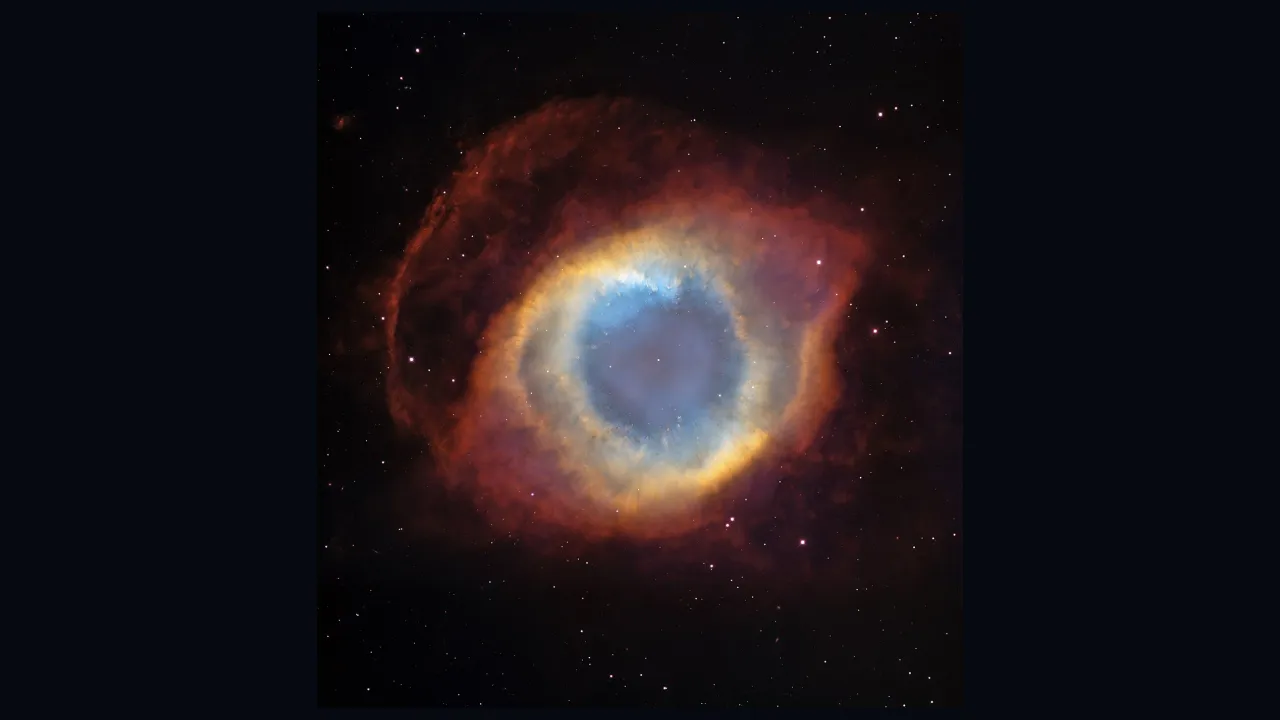
1. What part of the body does the Helix Nebula look just like in telescope pictures?
2. How big is just one tadpole-shaped gas knot inside the Helix Nebula?
🤯 Mind-Blowing Fact • Grade 2
Each comet-shaped knot inside the Helix Nebula has a glowing tail stretching a hundred billion miles long!
✨ Word Sparks (Grade 2 Glossary)
Tap 🔊 to hear
helix
A 3D spiral or corkscrew shape
Aquarius
Autumn constellation called the Water Bearer
spread out
Stretched wide across a big area
🪝
Why did early comet hunters look right past a nebula half the width of the full Moon?
1
Huge Yet Shy
Sitting only 650 light-years away in , the Nebula is one of the closest dying-star clouds to Earth! Because it sits so close, it spreads out half as wide as the full Moon in our sky. That wide, gentle glow was actually so that Charles Messier missed it completely!
2
Why Is It Named Helix?
A is a coiled spring shape, like a corkscrew. Astronomers in the 1800s saw two overlapping loops of glowing gas that looked like a giant twisted coil floating in space.
3
Forty Thousand Eyelashes
Pointing away from the hot central white dwarf star are 40,000 tadpole-shaped gas droplets, streaming tails billions of miles long like eyelashes!
1. Why did famous sky hunter Charles Messier miss the Helix Nebula even though it is closer than the Ring Nebula?
2. What shape does the word 'helix' mean?
🤯 Mind-Blowing Fact • Grade 3
Surviving icy comets still crash together around the Helix Nebula's dead white dwarf star, wrapping it in a glowing dust halo!
✨ Word Sparks (Grade 3 Glossary)
Tap 🔊 to hear
cometary knot
Tadpole-shaped gas clump with long tail
ultraviolet light
Invisible high-energy rays from hot stars
surface brightness
How bright each patch of sky looks
🪝
What sculpted 40,000 giant tadpole tails inside the Cosmic Eye of Aquarius?
1
Discovered in Aquarius
German astronomer Karl Ludwig Harding spotted NGC 7293—the Helix Nebula—in 1824 while scanning Aquarius. Sitting roughly 650 light-years away, this planetary nebula spans 2.5 light-years across its bright main iris, with outer loops stretching over five light-years!
2
Ten Thousand Years of Puffing
Around ten thousand years ago, a Sun-like star ran out of core fuel and shed outer shells of gas in multiple waves. Today its tiny leftover core—a 120,000-kelvin white dwarf—floods the hollow center with .
3
Cometary Knots Under Stellar Wind
When fast, hot gas from the central star slammed into slower, cooler gas puffed out earlier, the collision broke the shell into 40,000 dense droplets called . Each knot's head is twice as wide as Pluto's orbit, with a glowing tail blown outward like windsocks in a breeze!
4
Dusty Disk at the Center
NASA's Spitzer Space Telescope even found a warm dusty ring right around the central white dwarf—leftover comets smashing together after surviving the star's death!
1. How did the 40,000 cometary knots inside the Helix Nebula get their long, radial tails?
2. What surprising discovery did the Spitzer Space Telescope make right around the Helix Nebula's central white dwarf?
🤯 Mind-Blowing Fact • Grade 4
Despite each cometary knot spanning twice the diameter of Pluto's orbit, its gas is thin enough that each knot weighs roughly the same as Mars or Earth!
✨ Word Sparks (Grade 4 Glossary)
Tap 🔊 to hear
perpendicular
Crossing at a ninety-degree right angle
instability
Fluid ripple breaking gas into clumps
kinematic
Relating to measured 3D gas motion
🪝
Why does proximity make the Helix Nebula our clearest magnifying glass into planetary nebula physics?
1
Four Times Closer Than the Ring
Compare the famous Ring Nebula at 2,570 light-years away with NGC 7293—the Helix Nebula—at just 650 light-years distant in Aquarius. Being nearly four times closer means space telescopes see features in the Helix four times sharper! Spanning nearly half a degree on the sky, its main rings stretch 2.5 light-years wide while dim shockwave plumes reach beyond five light-years.
2
Two Crossed Disks in 3D
Rather than a simple corkscrew, Doppler studies revealed the Helix actually consists of two nearly gaseous disks! An inner disk launched roughly 6,500 years ago expands faster inside an older outer torus shed about 12,000 years ago—creating the overlapping 'coil' illusion from Earth's vantage point.
3
Hydrodynamic Instabilities and Knots
When hot, tenuous plasma collided with dense, cold neutral shells, Rayleigh-Taylor fluid instabilities—similar to heavy cream swirling into hot coffee—shattered the inner rim into 40,000 cometary knots. Each dusty head shields cold molecular hydrogen and carbon monoxide at just 25 kelvins while its sunlit skin boils into a 100-billion-mile tail!
4
JWST Zooms Inside the Eyelashes
Recent James Webb Space Telescope NIRCam observations resolved turbulent wakes and wind-blown eddies trailing behind individual Helix knots in crisp orange and blue infrared detail, showing how dying Sun-like stars enrich interstellar space with recycled dust and organic molecules.
1. What 3D structure creates the Helix Nebula's overlapping corkscrew appearance from Earth?
2. Roughly how cold is the shielded molecular gas hiding inside the dense heads of the Helix's cometary knots?
🤯 Mind-Blowing Fact • Grade 5
Together, all 40,000 cometary knots inside the Helix Nebula contain more mass than thirty thousand Earths—more than all the planets in our Solar System combined dozens of times over!
✨ Word Sparks (Grade 5 Glossary)
Tap 🔊 to hear
eddy
Swirling whirlpool current behind an obstacle
photometry
Precise measurement of celestial light brightness
coronal
Relating to magnetically heated outer plasma
🪝
How can icy comets, frigid carbon monoxide, and scorching X-rays all coexist inside the same dying star cloud?
1
Closest Showcase of Late Stellar Evolution
Situated just 200 parsecs (650 light-years) away in Aquarius according to Gaia satellite parallax measurements, NGC 7293—the Helix Nebula—offers unmatched spatial resolution of planetary-nebula microphysics. Cataloged by German astronomer Karl Ludwig Harding in 1824, its multi-shell geometry traces two major mass-loss episodes roughly 12,000 and 6,500 years ago from an intermediate-mass red giant whose exposed 0.57-solar-mass white dwarf core (WD 2226-210) blazes at 120,000 kelvins.
2
Extreme Temperature Contrasts
Few astronomical realms pack wider thermal extremes inside a 2.5-light-year span! Right at the center, NASA's Chandra X-ray Observatory detects unexpected hard X-rays pointing to magnetic activity or accretion from a close unseen companion onto the white dwarf, while Spitzer mid-infrared uncovered a 35-to-150-AU warm debris disk fed by surviving Kuiper-belt-like comets colliding in the wake of stellar mass loss.
3
Physics of 40,000 Cometary Globules
Surrounding the central blue-green cavity of doubly ionized helium and oxygen ([O III]), roughly 40,000 neutral globules stud the inner torus. Sculpted by Rayleigh-Taylor and Vishniac hydrodynamic instabilities, each Earth-mass knot features a ~100-AU dusty head shielding frigid 20-to-40-kelvin H2, CO, HCN, and HCO+ molecules while photoevaporated ionized gas streams radially outward along swept-back tails exceeding 1,000 AU.
4
JWST NIRCam's Sub-AU Precision
Observing with NIRCam narrowband filters, the James Webb Space Telescope resolved crisp orange shock-heated molecular hydrogen pillars and turbulent Kelvin-Helmholtz eddies peeling off individual cometary heads, mapping the razor-sharp boundary separating ultra-hot ultraviolet winds from frigid molecular cores.
5
Seeding the Galactic Ecosystem
Summing all 40,000 dense globules proves a substantial fraction of a planetary nebula's ejected envelope survives harsh ultraviolet radiation in cold molecular form—delivering ready-made organic carbon compounds, water vapor, and silicate stardust straight into the Milky Way's interstellar medium to help assemble future generations of stars and rocky planets.