1. About how often does Halley's Comet swing back past Earth?
2. When will Halley's Comet shine bright near Earth next?
🤯 Mind-Blowing Fact • Grade 2
Artists in the year 1066 stitched a picture of blazing Halley's Comet right onto the famous 230-foot-long Bayeux Tapestry!
✨ Word Sparks (Grade 2 Glossary)
Tap 🔊 to hear
predict
Use science clues to tell what happens next
geyser
A strong jet of gas spraying upward
meteor shower
Many shooting stars streaking from comet dust
🪝
How did one clever scientist predict the exact year a comet would come back?
1
Edmond Halley Solves a Mystery
Long ago, people thought every bright comet in the sky was a brand-new stranger passing through once. In 1705, English astronomer Edmond Halley studied old sky records from 1531, 1607, and 1682. Using math, he realized all three sightings were the exact same comet returning every 76 years!
2
Dark Crust, Bright Jets
In 1986, a robotic spacecraft named Giotto flew close to Halley's icy heart. Surprisingly, its 9-mile-long peanut-shaped core is blacker than coal! Sunlight heats cracks in that dark crust, shooting bright of gas and dust into space.
3
Two Shooting Star Showers
Bits of dust left behind in Halley's path give Earth two yearly every May and October!
1. What big discovery did Edmond Halley make in 1705?
2. What color is the solid rocky-ice surface of Halley's Comet?
🤯 Mind-Blowing Fact • Grade 3
Famous American author Mark Twain was born two weeks after Halley's Comet shone in 1835 and passed away one day after it blazed again in 1910!
✨ Word Sparks (Grade 3 Glossary)
Tap 🔊 to hear
retrograde
Orbiting backward compared to the eight planets
coma
Glowing cloud of gas around a comet's core
solar wind
Fast stream of particles blowing from the Sun
🪝
Why do Halley's Comet's glowing tails always point away from the Sun, even when the comet flies outward?
1
Gravity Proved Right
Picture farmers on Christmas night in 1758 spotting a glowing fuzzball exactly where Edmond Halley predicted fifty-three years earlier! Using Isaac Newton's laws of gravity, Halley proved comets orbit the Sun on giant ovals. Officially labeled 1P/Halley, it became the first recognized periodic comet, recorded by Chinese, Babylonian, and European skywatchers since 240 BCE.
2
Flying Backward Around the Sun
Unlike the eight planets, Halley travels in a orbit—looping around the Sun in the opposite direction! Its stretched path swings closer to the Sun than Venus, then coasts out beyond Neptune before turning back.
3
Two Tails Blown by Sunlight
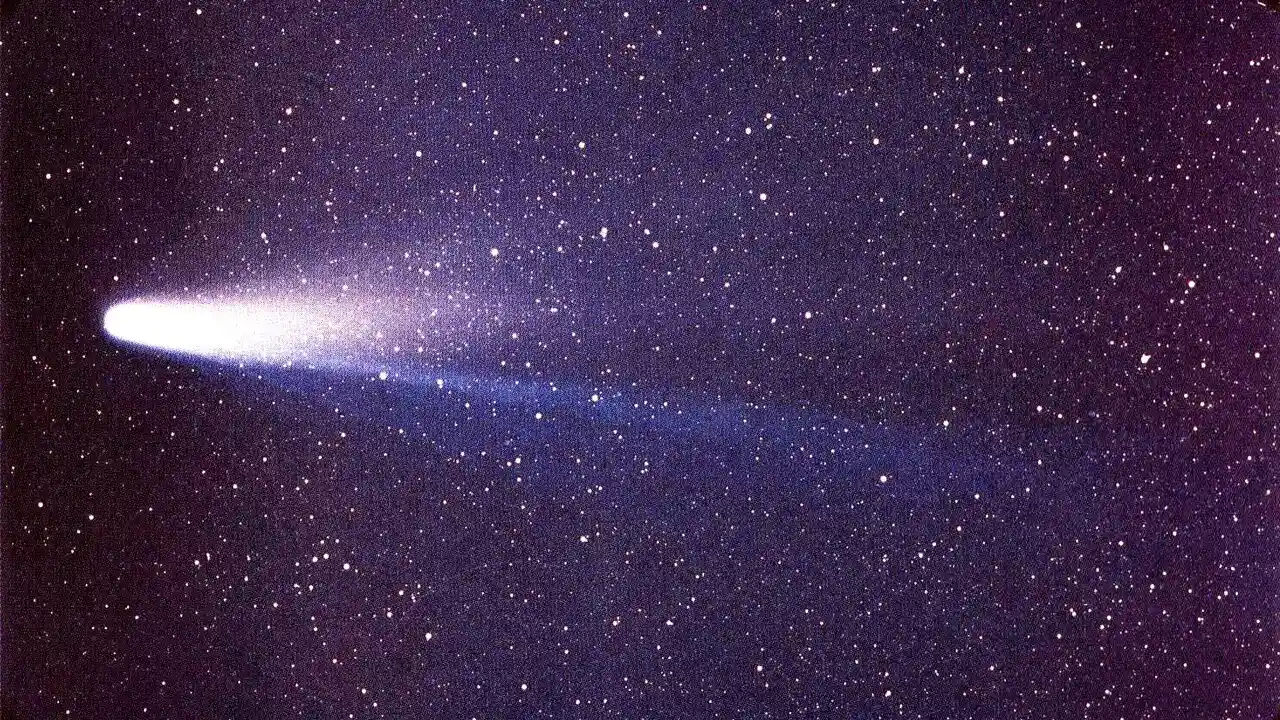
When solar heat vaporizes Halley's water and carbon monoxide ices, a fuzzy atmosphere called a swells wider than Earth. blows charged gas into a straight blue ion tail, while sunlight pushes dust into a curved white dust tail—both pointing away from the Sun!
4
Up Close with the Halley Armada
During its 1986 visit, five international spacecraft—led by Europe's Giotto probe—raced past its 9-mile-long nucleus, snapping history's first close-up photos of a comet core.
1. Which direction do a comet's gas and dust tails always point?
2. What does it mean that Halley's Comet has a retrograde orbit?
🤯 Mind-Blowing Fact • Grade 4
Every time Halley's Comet loops past the hot Sun, it sheds a layer of ice and dust about six to twenty feet thick—slowly shrinking with every visit!
✨ Word Sparks (Grade 4 Glossary)
Tap 🔊 to hear
sublimation
Ice turning straight into gas without melting first
periodic
Repeating on a regular, predictable orbital schedule
nucleus
Solid icy and rocky heart of a comet
🪝
How did five daring spacecraft survive a storm of hyper-speed dust to photograph Halley's Comet up close?
1
Newton's Physics Tested in the Sky
For millennia, sudden comets inspired awe from Han Dynasty court astronomers in 240 BCE to Norman weavers stitching the 1066 Bayeux Tapestry. Working beside his friend Isaac Newton, Edmond Halley applied universal gravitation to twenty-four comet tracks, factoring in subtle tugs from Jupiter and Saturn—which nudge Halley's period between 74 and 79 years. When 1P/Halley reappeared on Christmas night 1758 sixteen years after Halley's death, Newtonian physics won one of its greatest triumphs.
2
Braving the 1986 Halley Armada
Because Halley orbits retrograde—clockwise when viewed from above the Sun's north pole—the European Space Agency's Giotto probe met it nearly head-on at 42 miles per second! Protected by a double-layered bumper shield, Giotto survived pummeling dust grains small enough to fit on a fingertip yet packing bullet-like energy, imaging a 9.3-by-5-mile .
3
Sublimation Jets on a Coal-Black Crust
Giotto proved Fred Whipple's 'dirty snowball' model with a twist: 90 percent of Halley's crust is pitch-black organic dust reflecting just 4 percent of sunlight, while active vents cover 10 percent, blasting tons of sublimating water and carbon monoxide gas per second.
4
Turning Homeward for 2061
In December 2023, Halley reached its 35-AU aphelion beyond Neptune and began falling sunward again, ready for a dazzling July 2061 return—while gifting Earth the Eta Aquariid and Orionid meteor showers every year!
1. Why does Halley's orbital period vary between 74 and 79 years instead of staying identical every trip?
2. Why did ESA's Giotto spacecraft need a tough double bumper shield during its 1986 flyby?
🤯 Mind-Blowing Fact • Grade 5
In 1910, Earth actually passed right through the sweeping tail of Halley's Comet—completely harmlessly, despite sensational newspaper headlines after astronomers detected trace cyanogen gas in its spectrum!
✨ Word Sparks (Grade 5 Glossary)
Tap 🔊 to hear
albedo
Fraction of sunlight a surface reflects into space
apparition
Scheduled bright appearance of a returning comet
refractory
Heat-resistant dust and carbon that stay solid
🪝
How did twenty-two centuries of human sky records and a 1986 fleet of robot probes unlock the anatomy of 1P/Halley?
1
Twenty-Two Centuries of Recorded Apparitions
Cataloged officially as 1P/Halley—the very first periodic comet ever identified—this traveler bridges ancient human history and modern astrophysics. Every single perihelion passage since Chinese Qin Dynasty chronicles of 240 BCE has been documented, including Babylonian clay tablets of 164 BCE, Giotto di Bondone's 1305 fresco Star of Bethlehem, and the 1066 immortalized on the Bayeux Tapestry. In his 1705 Synopsis of the Astronomy of Comets, Edmond Halley applied Newtonian orbital mechanics and planetary perturbation math to link the 1531, 1607, and 1682 comets, predicting the 1758 return that cemented celestial mechanics.
2
An Oort Cloud Exile on a Retrograde Track
Dynamically, 1P/Halley leads its own class of 'Halley-type' comets. Although its 75-to-79-year period places it under the 200-year short-period threshold, its steep 162-degree inclination—meaning it orbits backward relative to the ecliptic—signals an origin in the spherical Oort Cloud rather than the flat Kuiper Belt. Ancient gravitational encounters with giant planets captured Halley onto an ellipse spanning from 0.59 AU inside Venus's orbit out to 35.1 AU beyond Neptune.
3
Inside the 1986 Armada Findings
In March 1986, five probes from Europe, the Soviet Union, and Japan—Vega 1, Vega 2, Sakigake, Suisei, and ESA's Giotto—converged on Halley at relative velocities near 68 kilometers per second. Giotto skimmed within 596 kilometers of the 15-by-8-kilometer bilobed nucleus, revealing an ultra-low of 0.04—darker than asphalt—where carbon-rich lag deposits insulate porous ices of water, carbon monoxide, methane, and ammonia.
4
Outgassing Jets, Tails, and Meteor Streams
Near perihelion, solar radiation drives violent sublimation through localized sunlit vents, shedding roughly 20 to 50 metric tons of gas and dust every second! Ultraviolet light ionizes escaping molecules so the solar wind sweeps out a straight blue plasma tail, while radiation pressure fans silicate and organic grains into a sweeping dust tail—leaving dual debris ribbons that Earth crosses each May (Eta Aquariids) and October (Orionids).
5
Past Aphelion and Bound for 2061
On December 9, 2023, Halley coasted past aphelion at less than one kilometer per second and tipped sunward again. Having shed up to 85 percent of its original mass over thousands of orbits, it remains luminous enough to command summer skies in July 2061.