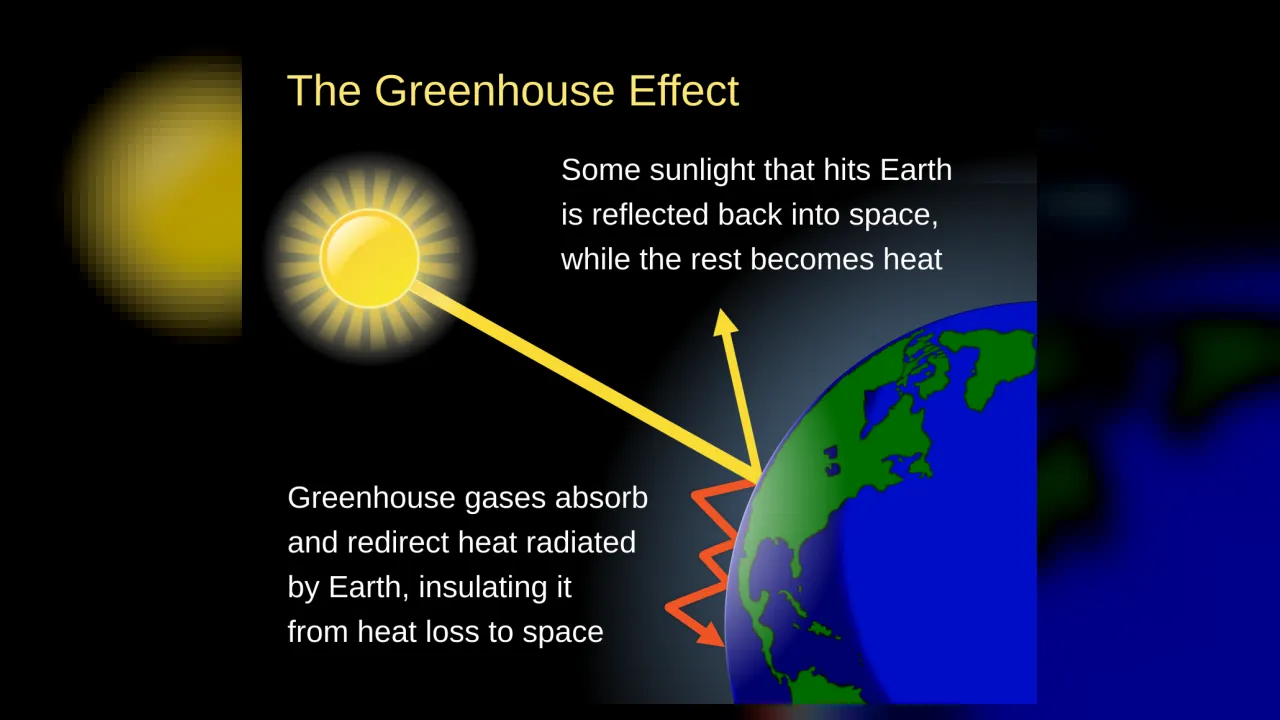
1. What acts like a cozy blanket around planet Earth?
2. What would happen to Earth if it had no air blanket at all?
🤯 Mind-Blowing Fact • Grade 2
Without the natural greenhouse effect, Earth's average temperature would plunge to zero degrees Fahrenheit—colder than a kitchen freezer!
✨ Word Sparks (Grade 2 Glossary)
Tap 🔊 to hear
Water Vapor
Invisible water floating as gas in air
Absorb
To soak up light, water, or heat
Temperature
A measure of how hot or cold
🪝
How can invisible air keep oceans warm the same way a glass greenhouse warms tomato plants?
1
Sunlight Comes Right In
Walk inside a glass garden greenhouse on a chilly spring morning, and the air feels toasty warm! Sunlight shines easily through the clear glass panes and heats the dark soil inside. Planet Earth works in a remarkably similar way.
2
Heat-Holding Gases
Bright sunlight passes through our sky and warms land and oceans. Next, the warm ground sends invisible heat rising back upward. Special greenhouse gases—like and carbon dioxide—catch some of that rising warmth and share it back toward Earth.
3
Not Too Cold, Not Too Hot
This natural blanket keeps lakes liquid for frogs, fish, and people. Adding too many extra greenhouse gases, however, acts like piling on too many heavy blankets at night.
1. Which two gases help hold warmth in Earth's air?
2. What is adding lots of extra greenhouse gases compared to?
🤯 Mind-Blowing Fact • Grade 3
Planet Venus has an atmosphere made of ninety-six percent carbon dioxide, creating a runaway greenhouse effect hot enough to melt solid lead!
✨ Word Sparks (Grade 3 Glossary)
Tap 🔊 to hear
Infrared
Invisible heat waves given off by warm objects
Methane
A strong heat-trapping gas in Earth's air
Radiate
To send out energy in waves
🪝
Why does sunlight zip straight through the sky while Earth's rising heat gets caught on the way out?
1
Two Kinds of Invisible Energy
Hold your hand near a sun-warmed brick wall after sunset, and you can feel gentle warmth radiating outward! Sunlight arrives at Earth mostly as short-wave visible light that glides right past air molecules. Once continents and oceans warm up, they send energy upward as longer-wave heat.
2
Tiny Three-Atom Catchers
Most of our air is nitrogen and oxygen, which let heat slip right into space. However, trace greenhouse gases—including water vapor, carbon dioxide, and —wiggle and absorb infrared waves, sending warmth back in every direction.
3
Life's Essential Thermostat
Thanks to this natural process, Earth averages a comfortable 59 degrees Fahrenheit (15 degrees Celsius). Without greenhouse gases, oceans would freeze from pole to equator!
4
Keeping the Blanket Balanced
When factories, power plants, and engines burn coal, oil, and gas, extra carbon dioxide enters the sky. Planting trees and using clean solar and wind energy help keep Earth's atmospheric blanket balanced.
1. What kind of energy does warm ground send upward toward the sky?
2. Why is neighboring planet Venus so scorching hot?
🤯 Mind-Blowing Fact • Grade 4
Although carbon dioxide makes up less than one-tenth of one percent of Earth's air, those trace molecules act as the control knob that sets how much water vapor the air can hold!
✨ Word Sparks (Grade 4 Glossary)
Tap 🔊 to hear
Troposphere
Lowest sky layer where weather and clouds happen
Trace Gas
Atmospheric gas present in tiny percentages
Thermal
Related to heat energy and temperature
🪝
How did an 1850s scientist using glass cylinders and summer sunlight prove which gases warm our planet?
1
Eunice Foote's Sunlight Jars
In 1856, American scientist Eunice Newton Foote placed thermometers inside glass cylinders filled with different gases and set them in bright sunlight. The cylinder holding moist air warmed noticeably, and the cylinder filled with carbonic acid gas—today called carbon dioxide—became hottest of all! Three years later, physicist John Tyndall measured how those gases block invisible infrared radiation, unveiling how Earth's atmosphere regulates planetary warmth.
2
Shortwave In, Longwave Out
About thirty percent of incoming solar radiation reflects right back to space off bright clouds, snow, and polar ice. The remaining seventy percent warms continents and seas. As Earth's surface warms, it emits longwave infrared energy upward through the .
3
How Greenhouse Molecules Work
Diatomic gases like N2 and O2 make up ninety-nine percent of dry air, yet they are transparent to infrared waves. Greenhouse gases—water vapor (H2O), carbon dioxide (CO2), methane (CH4), and nitrous oxide (N2O)—have three or more atoms whose bonds bend and vibrate when struck by infrared energy, re-radiating heat downward and sideways.
4
Natural Benefit vs. Enhanced Warming
Earth's natural greenhouse effect raises global average temperatures by roughly 33 degrees Celsius (59 degrees Fahrenheit), making liquid water ecosystems possible. Over the past two centuries, burning fossil fuels and clearing forests have thickened this greenhouse layer, creating an enhanced greenhouse effect that scientists monitor using weather satellites and ocean buoys.
1. What did Eunice Newton Foote discover with her sun-warmed glass cylinders in 1856?
2. Why don't nitrogen (N2) and oxygen (O2) act as greenhouse gases?
🤯 Mind-Blowing Fact • Grade 5
French mathematician Joseph Fourier first calculated in 1824 that Earth ought to be frozen solid at its distance from the Sun unless our atmosphere acted as an insulating barrier!
✨ Word Sparks (Grade 5 Glossary)
Tap 🔊 to hear
Albedo
Fraction of sunlight reflected by bright surfaces
Wavelength
Distance between peaks of light or heat waves
Convection
Heat movement caused by rising warm air
🪝
Why does Mars shiver at minus sixty degrees Celsius while Venus broils at four hundred sixty degrees—with temperate Earth poised right between them?
1
A Tale of Three Rocky Atmospheres
Compare our solar system's rocky neighbors and a striking pattern emerges. Thin-aired Mars freezes at an average minus 63 degrees Celsius, whereas cloud-shrouded Venus—despite reflecting most sunlight—bakes at 465 degrees Celsius under crushing carbon dioxide skies. Earth maintains a life-sustaining mean surface temperature near 15 degrees Celsius instead of an icy minus 18 degrees Celsius solely because trace atmospheric gases modulate its planetary energy budget.
2
Wavelengths and Radiative Equilibrium
Because the Sun's photosphere blazes at 5,500 degrees Celsius, solar energy peaks in shortwave visible (0.4 to 0.7 micrometers) that traverse Earth's clear sky unimpeded. After subtracting Earth's planetary —about 30 percent reflected by clouds, aerosols, and ice—absorbed sunlight warms land and ocean surfaces, which emit longwave terrestrial infrared radiation peaking around 10 micrometers.
3
Molecular Vibrations and Re-Emission
Symmetric diatomic nitrogen and oxygen lack shifting electric dipoles, allowing 10-micrometer photons to pass freely. Triatomic and polyatomic molecules—including H2O, CO2, CH4, N2O, and tropospheric ozone (O3)—possess asymmetric stretching and bending modes tuned to infrared frequencies. Excited molecules collide with surrounding air and re-emit infrared photons isotropically, slowing heat's escape to space.
4
Water Vapor Feedback vs. Non-Condensing Drivers
Water vapor supplies the largest share of natural greenhouse warming, yet it condenses as rain or snow within days whenever air cools. Long-lived, non-condensing CO2 lingers for centuries, acting as the structural thermostat: slightly higher CO2 warms the air, enabling the atmosphere to hold roughly seven percent more water vapor per degree Celsius and amplifying total warming.
5
Measuring Radiative Forcing Today
Notice one subtle distinction from a backyard glasshouse: real glass roofs mainly stop warm air from rising by , whereas Earth's atmosphere slows radiative heat loss at high altitudes. Since 1750, atmospheric CO2 has climbed from ~280 parts per million past 420 ppm, inspiring global innovations in renewable power, energy efficiency, and reforestation.