2. How fast do gravitational waves travel through space?
🤯 Mind-Blowing Fact • Grade 2
The first gravitational waves caught in 2015 had been traveling through space since long before dinosaurs lived on Earth!
✨ Word Sparks (Grade 2 Glossary)
Tap 🔊 to hear
detector
machine built to sense hidden signals
laser
super straight beam of pure light
collision
powerful crash between two moving objects
🪝
How did Albert Einstein predict invisible space waves 100 years before anyone caught one?
1
Space Like a Trampoline
Imagine bouncing on a giant stretchy trampoline with your friends! Every jump sends waves shaking across the mat. In 1916, scientist Albert Einstein figured out that space itself stretches like a cosmic trampoline.
2
Cosmic Crashes
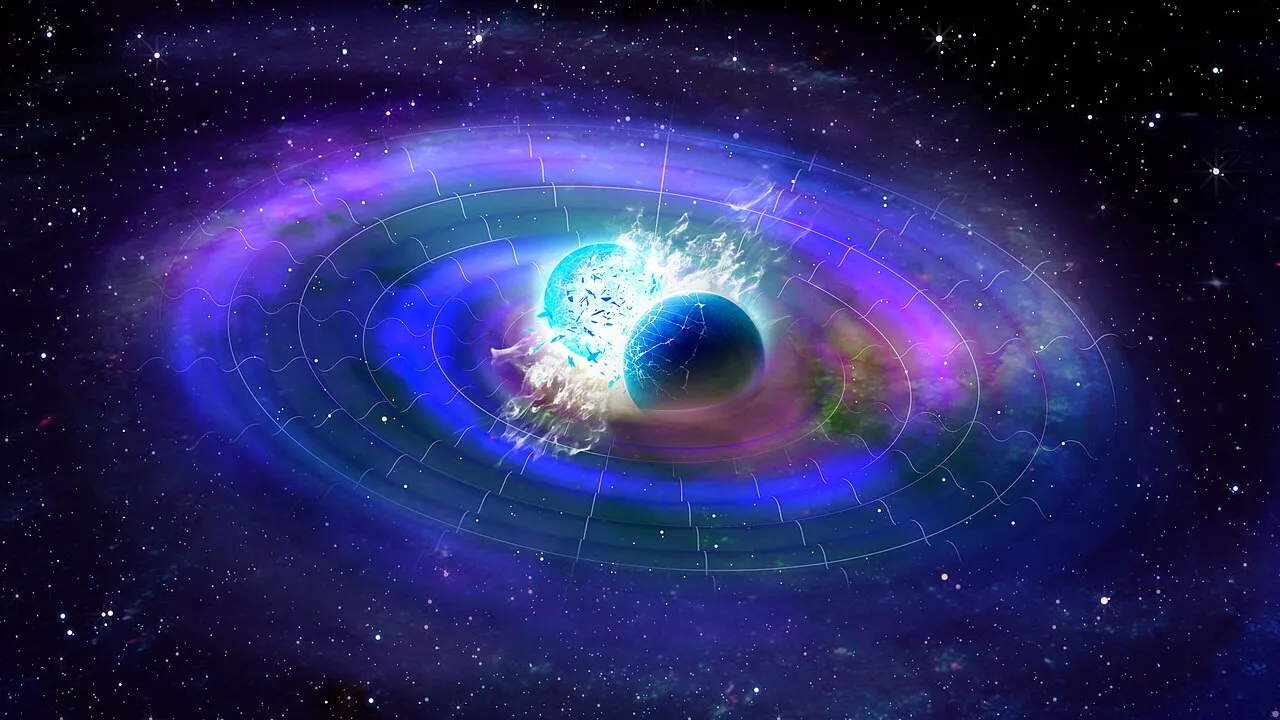
Gentle planets barely jiggle space at all. It takes monster —like two ultra-heavy black holes spiraling together—to launch strong gravitational waves rolling across the universe.
3
Laser Rulers on Earth
For 99 years, no machine was sensitive enough to feel those tiny wiggles. Then in 2015, twin giant called LIGO finally caught gravitational waves washing through Earth!
1. Which scientist predicted gravitational waves back in 1916?
2. What kind of cosmic event creates gravitational waves strong enough for Earth detectors to catch?
🤯 Mind-Blowing Fact • Grade 3
LIGO's laser rulers are so accurate they could measure the distance to the nearest star 25 trillion miles away within the width of a single human hair!
✨ Word Sparks (Grade 3 Glossary)
Tap 🔊 to hear
spacetime
four-dimensional fabric of space and time
observatory
special science center for studying space
vacuum tube
sealed pipe with all air pumped out
🪝
How can a 2.5-mile laser beam measure a space wiggle smaller than an atom?
1
Stretching and Squeezing Space
Picture two heavy black holes whirling around each other faster and faster until they smash into one! Their immense gravity churns the fabric of , launching invisible gravitational waves outward at 186,282 miles per second. As a wave passes, it gently stretches space in one direction while squeezing it in the other.
2
LIGO's Giant L-Shaped Rulers
By the time these ripples cross a billion light-years to reach Earth, they are almost unimaginably tiny. To catch them, scientists built LIGO—two L-shaped observatories in Washington State and Louisiana, each with 2.5 miles long.
3
The Chirp Heard Around the World
Inside LIGO, split laser beams bounce between hanging mirrors to check if one arm stretches longer than the other. On September 14, 2015, both detectors felt the exact same space ripple, which scientists turned into a rising 'chirp' sound!
4
A New Way to Listen to Space
Unlike starlight, gravitational waves never get blocked by dust clouds. Astronomers can now 'hear' dark cosmic crashes that telescopes could never see!
During the final tenth of a second before the GW150914 black holes merged, they released fifty times more power in gravitational waves than all the shining stars in the observable universe combined!
✨ Word Sparks (Grade 4 Glossary)
Tap 🔊 to hear
interferometer
tool combining light waves to measure tiny shifts
neutron star
ultra-dense core of a collapsed giant star
kilonova
bright blast from two colliding neutron stars
🪝
What happens when two city-sized neutron stars collide and shower the universe with both light and gravitational waves?
1
Einstein's Doubt and LIGO's Triumph
When Albert Einstein derived gravitational waves from his general theory of relativity in 1916, even he doubted humans could ever build an instrument sensitive enough to detect them. Yet on September 14, 2015, LIGO's twin laser recorded signal GW150914—a ripple forged 1.3 billion years ago when two black holes weighing 29 and 36 Suns spiraled together, converting three whole Suns' worth of mass into pure gravitational wave energy!
2
How Laser Interferometry Works
Each LIGO detector splits a powerful laser beam down two perpendicular 2.5-mile vacuum arms. Normally, the returning light waves cancel each other out cleanly at a photodetector. When a gravitational wave sweeps through Earth, it stretches one arm while compressing the other by less than one-thousandth the diameter of a proton, causing laser light to flicker in telltale interference patterns.
3
Cosmic Gold Factories
In August 2017, LIGO and Europe's Virgo detector caught ripples from two colliding 130 million light-years away. Within seconds, seventy telescopes spotted a glowing '' fireball at that exact spot, proving neutron star mergers forge much of the universe's gold and platinum!
4
Multi-Messenger Astronomy
Combining gravitational waves with visible, X-ray, and gamma-ray telescopes launched multi-messenger astronomy—letting scientists both see and feel cosmic cataclysms.
1. How much did LIGO's mirrors shift when the first detected gravitational wave passed through Earth?
2. What precious heavy metals did astronomers watch form during the 2017 neutron star merger?
🤯 Mind-Blowing Fact • Grade 5
By monitoring 68 ultra-precise millisecond pulsars for fifteen years, astronomers turned the entire Milky Way Galaxy into a detector for slow, decade-long gravitational waves!
✨ Word Sparks (Grade 5 Glossary)
Tap 🔊 to hear
pulsar
spinning neutron star beaming regular radio pulses
strain
fractional stretch divided by original length
coalescence
coming together of two orbiting bodies
🪝
How can astronomers use spinning dead stars across the Milky Way as a galaxy-sized gravitational wave antenna?
1
Quadrupole Ripples in Spacetime
In Isaac Newton's classical physics, gravity acted instantaneously across empty space. Albert Einstein overturned that view in 1915, demonstrating that massive objects curve four-dimensional spacetime and that asymmetric accelerating masses radiate energy outward as transverse quadrupole waves at light speed. Indirect proof arrived in 1974, when Russell Hulse and Joseph Taylor tracked a binary whose orbit steadily shrank at the exact rate predicted for gravitational wave emission.
2
Engineering Sub-Atomic Precision
Directly capturing those waves required extraordinary engineering. At LIGO in the United States, Virgo in Italy, and KAGRA in Japan, four-kilometer Fabry-Perot laser cavities bounce infrared beams hundreds of times between multi-stage pendulum mirrors isolated from seismic tremors and thermal jitter. When event GW150914 arrived from 1.3 billion light-years away, it registered a dimensionless of 10 to the minus 21—equivalent to shifting a 4-kilometer arm by one ten-thousandth of an atomic nucleus.
3
Cataloging Black Hole Mergers
Since 2015, global interferometer runs have cataloged hundreds of compact binary : black hole pairs, neutron star collisions like GW170817, and mixed black-hole-neutron-star mergers. Analyzing each waveform's rising frequency and amplitude—its 'chirp'—reveals exact progenitor masses, spins, and luminosity distances.
4
Pulsar Timing Arrays
Ground interferometers hear high-frequency chirps lasting fractions of a second, but supermassive black hole pairs weighing billions of Suns emit slow waves with wavelengths light-years long. In 2023, NANOGrav and international Timing Arrays detected this low-frequency gravitational wave background by monitoring microsecond arrival shifts from dozens of millisecond pulsars across our galaxy.
5
LISA: Taking Interferometry to Space
In the 2030s, the European Space Agency and NASA will launch LISA—the Laser Interferometer Space Antenna—flying three spacecraft in a 2.5-million-kilometer triangle trailing Earth around the Sun to listen even deeper into cosmic dawn.