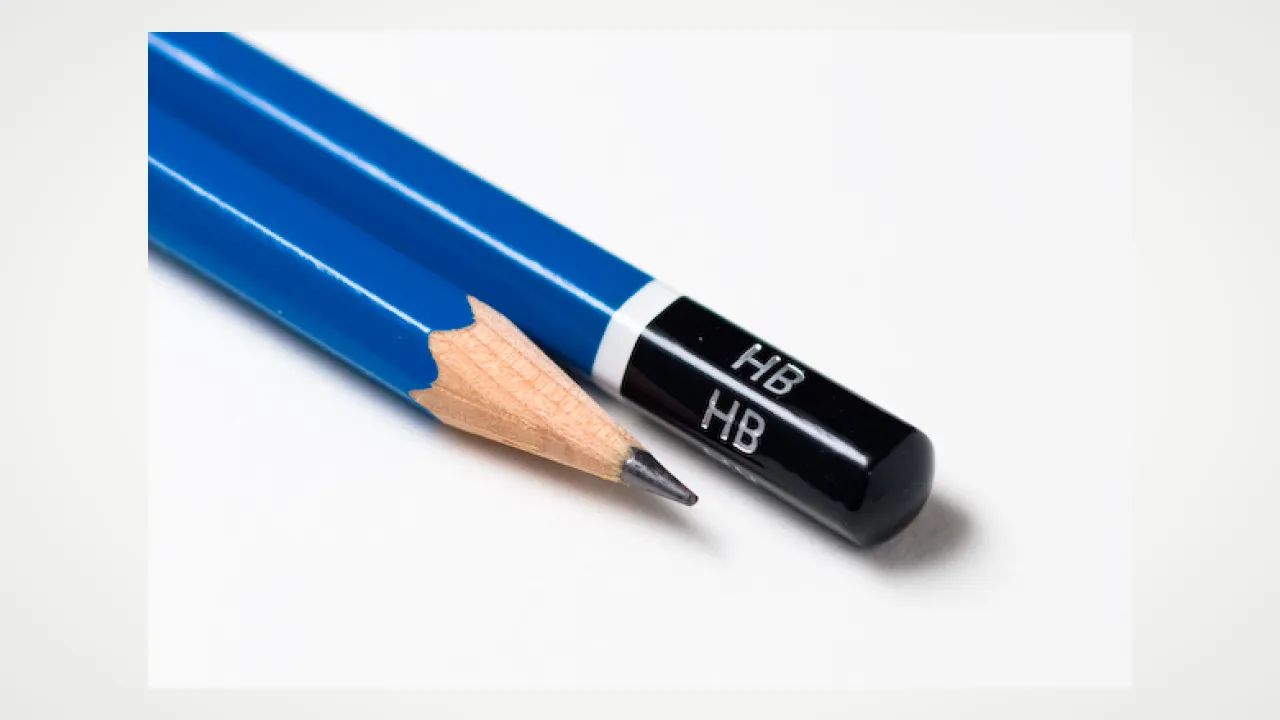
1. What material actually makes the dark writing core inside a pencil?
2. How did farmers in England first use chunks of pure graphite long ago?
🤯 Mind-Blowing Fact • Grade 2
Why are so many school pencils painted bright yellow? In the 1890s, makers painted top-quality pencils yellow—the royal color in China, where prized smooth graphite came from!
✨ Word Sparks (Grade 2 Glossary)
Tap 🔊 to hear
kiln
A super-hot oven for baking clay
cedar
Smooth fragrant wood easy to sharpen neatly
mineral
A natural solid material formed inside Earth
🪝
How do factory machines get a thin rod of graphite inside a solid wooden stick without drilling a hole?
1
Born Under Fallen Trees
Whoosh, crash! After a fierce 1564 storm in Borrowdale, England, shepherds found a glittering black clinging to uprooted tree roots. Wrapping sticks of this soft graphite in string or wood created the world's earliest pencils.
2
Baking Graphite With Clay
In 1795, French scientist Nicolas-Jacques Conté ran short of English graphite during a war. He mixed powdered graphite with wet clay and baked thin rods in a hot —discovering that extra clay made harder, lighter lines while extra graphite made softer, darker shading!
3
The Wood-Sandwich Trick
Factories never drill down a round stick! Instead, machines cut tiny grooves into two flat boards, lay graphite rods inside like hot dogs in buns, glue both boards together, and slice individual pencils apart.
1. What did French inventor Nicolas-Jacques Conté mix with powdered graphite in 1795?
2. How do factories put the graphite core inside a wooden pencil?
🤯 Mind-Blowing Fact • Grade 3
Before rubber erasers became popular in the late 1700s, artists and students kept crustless pieces of fresh bread on their desks to dab away stray pencil lines!
✨ Word Sparks (Grade 3 Glossary)
Tap 🔊 to hear
carbon
A common element forming graphite and diamonds
ferrule
The crimped metal ring holding an eraser
crystal
Atoms arranged in a neat repeating pattern
🪝
How can a sparkling diamond ring and a humble school pencil be made of the exact same chemical element?
1
Cousins Made of Carbon
Hold a pencil beside a diamond and they look like total opposites—one is soft and dark gray, while the other is clear and ultra-hard! Yet chemists proved both are pure whose atoms connect in different patterns.
2
Like a Deck of Playing Cards
Inside a diamond, atoms lock tightly in every direction. Inside graphite, carbon atoms link into flat honeycomb sheets stacked loosely like a deck of slippery playing cards—sliding effortlessly off the tip onto rough paper fibers!
3
Decoding H, B, and #2
Using Nicolas-Jacques Conté's 1795 clay recipe, makers grade pencils with letters: H stands for hard (more clay for crisp, pale lines) and B stands for black (more graphite for dark artist shading). A classic American #2 pencil matches the balanced middle grade HB!
4
Adding the Eraser Cap
For centuries people rubbed away pencil marks using moist bread crumbs! Then in 1858, Philadelphia inventor Hyman Lipman attached a rubber eraser to one end with a tiny metal band called a .
1. Why does graphite leave smooth dark marks on paper while diamond scratches glass?
2. What does an 'HB' or '#2' stamp on the side of a pencil tell you?
🤯 Mind-Blowing Fact • Grade 4
Every time you draw a faint pencil line, tiny spots along your mark leave ultra-thin flakes of graphene—a carbon sheet just one atom thick that won the 2010 Nobel Prize in Physics!
✨ Word Sparks (Grade 4 Glossary)
Tap 🔊 to hear
graphene
A honeycomb carbon sheet one atom thick
hexagonal
Shaped with six flat straight sides
polymer
Long flexible chains of linked molecules
🪝
How did a wartime naval blockade in 1795 lead to the pencil grading scale—and two centuries later, a Nobel Prize?
1
Plumbago and the Borrowdale Monopoly
When sixteenth-century English villagers uncovered solid graphite in Cumbria in 1564, chemistry was still young, so scholars mistook the shiny mineral for lead ore and called it plumbago. Guards soon patrolled the Borrowdale mine under armed watch because pure solid graphite not only made unmatched writing sticks—named from Latin penicillus, meaning little tail—but also lined smooth cannonball molds.
2
Conté's Kiln Solves a Blockade
During the French Revolutionary Wars in 1795, Britain's naval blockade cut France off from Borrowdale graphite. Asked by France's War Ministry to invent a substitute within days, polymath Nicolas-Jacques Conté ground impure graphite into fine powder, blended it with potter's clay and water, pressed paste into square channels, and fired the rods at 1,000 degrees Celsius.
3
Hexagonal Shapes and Sticky Erasers
Why are most pencils six-sided instead of round? barrels save cedar wood during milling and stop pencils from rolling off slanted school desks! Meanwhile, rubber erasers work because rubbing warms chains until they turn slightly sticky—grabbing graphite flakes tighter than paper cellulose does.
4
One Pencil Line Wins a Nobel Prize
In 2004, physicists Andre Geim and Konstantin Novoselov pressed ordinary sticky tape onto graphite flakes—just like a pencil trace—and peeled away a sheet a single atom thick! That wonder material, , conducts electricity faster than copper and is two hundred times stronger than steel, earning them the 2010 Nobel Prize in Physics.
1. Why are most wooden pencils shaped as six-sided hexagons instead of smooth cylinders?
2. How did scientists isolate Nobel-winning graphene from graphite in 2004?
🤯 Mind-Blowing Fact • Grade 5
Pencils write effortlessly in zero gravity, yet astronauts stopped using them in space because floating microscopic crumbs of graphite conduct electricity and can short-circuit spacecraft electronics!
✨ Word Sparks (Grade 5 Glossary)
Tap 🔊 to hear
allotrope
Different crystal forms of one pure element
van der Waals
Weak attraction between nearby stacked molecule layers
conductive
Allowing electrical current to flow easily through
🪝
How do weak van der Waals forces between sp2-hybridized carbon planes explain both a kindergartner's sketch and twenty-first-century nanoelectronics?
1
Atomic Architecture of Allotropes
Few everyday tools illustrate chemical bonding as vividly as the humble graphite pencil. Diamond and graphite are pure carbon , yet diamond locks every atom in rigid three-dimensional tetrahedral $sp^3$ bonds, whereas graphite arranges carbon in planar $sp^2$ hexagonal lattices. Within each flat sheet, covalent bonds outstrip steel in strength; between stacked sheets, weak attraction lets layers shear off effortlessly onto rough paper cellulose fibers.
2
From Cumbria's Borrowdale Seam to Conté's Ceramic Matrix
Swedish chemist Carl Wilhelm Scheele proved in 1779 that 'black lead' mined from England's 1564 Borrowdale seam oxidized into carbon dioxide—identifying it as pure carbon rather than toxic lead ($Pb$), which German mineralogist Abraham Gottlob Werner named graphite from Greek graphein ('to write') in 1789. Six years later, Nicolas-Jacques Conté's wartime kiln process vitrified kaolin clay around powdered graphite at roughly 1,030 degrees Celsius, ending reliance on rare solid seams.
3
The 9H-to-9B Scale and Incense Cedar
Adjusting the graphite-to-clay ratio spans twenty European drafting grades from hard 9H (over 60 percent clay for pale technical lines) through balanced HB (roughly 68 percent graphite, 26 percent clay, and 5 percent wax—equivalent to an American #2) to velvety 9B (nearly 90 percent graphite for deep artist shading). California incense-cedar slats—kiln-dried and wax-treated so uniform grain sharpens cleanly without splintering—encase extruded 2-millimeter cores.
4
Tribology of Erasure and Spaceflight Hazards
Vulcanized rubber and polyvinyl-chloride erasers lift marks through controlled adhesive wear: rubbing warms flexible polymer chains until sticky surfaces grab loose graphite platelets tighter than paper fibers do, rolling away fresh crumbs to expose clean eraser underneath. Notably, NASA phased wooden pencils out of crewed spacecraft not because gravity was required, but because floating graphite dust in microgravity risked short-circuiting cabin electronics!
5
Mechanical Leads and Two-Dimensional Materials
Today, high-strength polymer-bonded 0.3-to-0.9-millimeter mechanical pencil leads—building on Tokuji Hayakawa's 1915 Ever-Ready Sharp Pencil in Japan—write crisp lines without sharpening, while single-atom graphene sheets exfoliated from graphite drive breakthroughs in ultrafast semiconductors, water-desalination membranes, aerospace composites, and high-capacity battery anodes.