🇺🇸 U.S. HISTORY
🏛️ 41st President of the United States (1989–1993)
VA History & Social Science SOL K.1, 1.2, 2.4, VS.1–VS.10, USI & USII
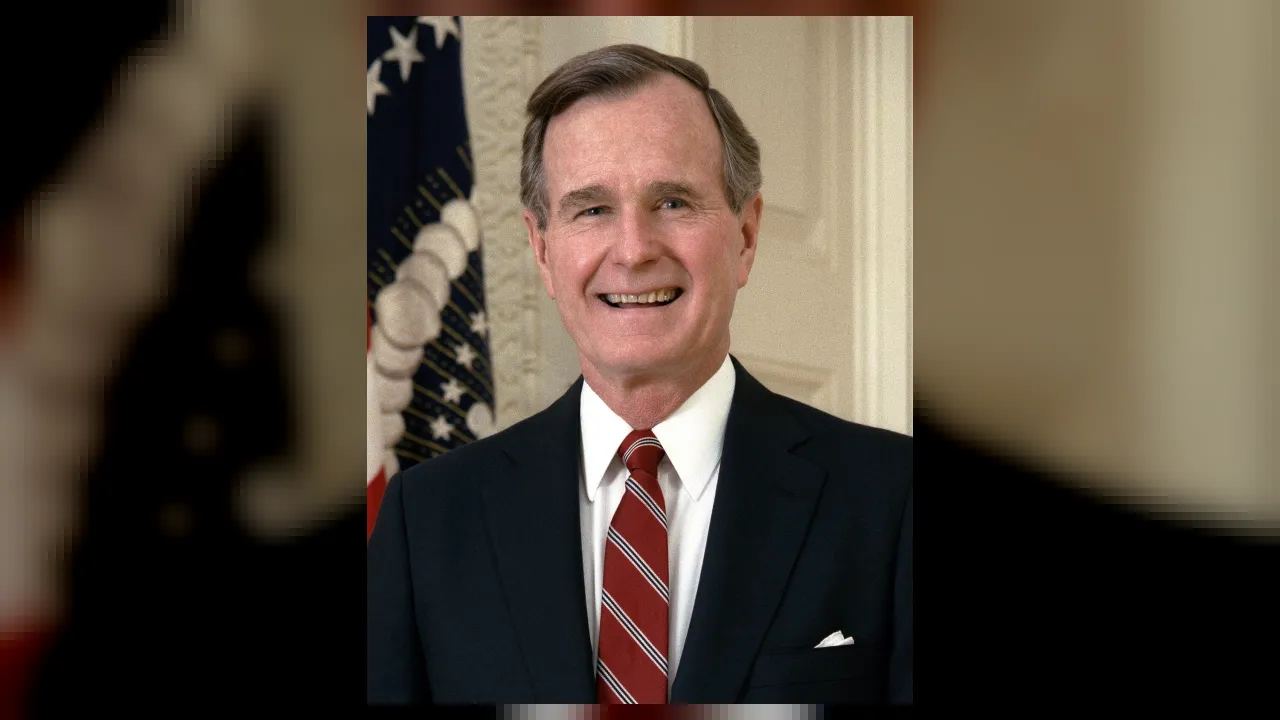
George H.W. Bush
Steady Statesman of the Peaceful Cold War End
Grade 3 • Fluent • 177 words
⏳ Era / StatehoodPresidential Term: 1989–1993 (Born June 12, 1924, Massachusetts)
🗺️ Region / CapitalHouston, Texas; Kennebunkport, Maine & Washington, D.C.
📜 Key MilestonePeaceful End of Cold War, Americans with Disabilities Act & Clean Air
⚡ Historical SparkSigned the Americans with Disabilities Act and guided peaceful diplomacy as the Berlin Wall fell
🤯 Mind-Blowing Fact • Grade 1
To celebrate his seventy-fifth, eightieth, eighty-fifth, and ninetieth birthdays, former Navy pilot George H.W. Bush went skydiving out of an airplane with a parachute!
✨ Word Sparks (Grade 1 Glossary)
Tap 🔊 to hear
accessible
Easy for everyone, including wheelchair users, to enter
Braille
Raised dots people touch with fingers to read
parachute
A big fabric canopy slowing a skydiver safely
🪝
Have you ever noticed wheelchair ramps and Braille bumps on elevator buttons?
1
Brave Young Pilot
Zoom, roar! At just eighteen years old, young George became one of the youngest pilots in the U.S. Navy during World War II. Later he served in many public jobs!
2
Opening Doors for Everyone
As our forty-first president, he signed the Americans with Disabilities Act in 1990. That kind law added wheelchair ramps, buses, and signs across America!
3
Points of Light and Peace
While he was president, the Berlin Wall came down peacefully! He also cheered on everyday volunteers, calling helpful neighbors 'a thousand points of light.'
1. How did the Americans with Disabilities Act signed by George H.W. Bush in 1990 help communities?
2. What phrase did President Bush use to praise everyday volunteers helping their neighbors?
🤯 Mind-Blowing Fact • Grade 2
George H.W. Bush and his son George W. Bush became only the second father-and-son pair of U.S. presidents in history—right after John Adams and John Quincy Adams!
✨ Word Sparks (Grade 2 Glossary)
Tap 🔊 to hear
submarine
A special naval vessel built to travel underwater
dissolved
Broke apart peacefully into separate independent countries
pollution
Dirty smoke or waste harming air and water
🪝
How did decades of experience around the world prepare our forty-first president for the peaceful end of the Cold War?
1
Lifetime of Public Service
Splash! Rescued by an American in the Pacific Ocean after his Navy plane was hit in World War II, young George H.W. Bush dedicated his life to service. After building a family and business in Texas, he served in Congress, at the United Nations, in China, and eight years as Ronald Reagan's vice president.
2
Calm Hands When the Wall Fell
Elected forty-first president in 1988, Bush watched history change fast as the Berlin Wall opened in 1989 and the Soviet Union in 1991. By staying calm and respectful rather than boasting, he helped keep the end of the forty-year Cold War peaceful!
3
Equal Access and Cleaner Air
At home in 1990, Bush worked with both parties in Congress to pass the landmark Americans with Disabilities Act and major Clean Air Act updates reducing factory .
1. Which earlier father-and-son pair matched George H.W. Bush and George W. Bush as U.S. presidents?
2. Why did world leaders praise President Bush's reaction when the Berlin Wall fell in November 1989?
🤯 Mind-Blowing Fact • Grade 3
First Lady Barbara Bush championed family reading literacy across America, and her Springer Spaniel dog, Millie, 'authored' a playful White House book that raised nearly one million dollars for literacy charities!
✨ Word Sparks (Grade 3 Glossary)
Tap 🔊 to hear
reunification
Bringing two divided parts of a country together
envoy
A diplomatic representative sent to another nation
acid rain
Rainwater harmed by smokestack air pollution
🪝
What made George H.W. Bush one of the most experienced diplomats ever to enter the Oval Office?
1
Navy Aviator to Global Diplomat
Picture enlisting in the U.S. Navy on your eighteenth birthday right after graduating high school! Born in Massachusetts in 1924, George Herbert Walker Bush flew fifty-eight World War II combat missions, graduated from Yale, moved to Texas, and served as a U.S. Representative, UN Ambassador, to China, CIA Director, and Vice President.
2
Guiding the End of the Cold War
Months after Bush became our forty-first president in January 1989, democratic movements swept Eastern Europe and the Berlin Wall came down. Knowing scores of world leaders personally, Bush negotiated Germany's peaceful in 1990 and signed the START I treaty slashing strategic nuclear weapons in 1991.
3
Building an International Coalition
When dictator Saddam Hussein's army invaded the small neighboring country of Kuwait in August 1990, Bush patiently united thirty-five nations—backed by the United Nations and Congress—to liberate Kuwait swiftly during Operation Desert Storm in early 1991.
4
Lasting Bipartisan Laws at Home
Working across party lines, Bush signed two towering 1990 laws: the Americans with Disabilities Act guaranteeing civil rights for forty-three million citizens with disabilities, and Clean Air Act Amendments curbing . He also compromised on a 1990 budget deal that later helped balance federal finances.
1. How did President Bush respond when Iraq invaded its small neighbor Kuwait in 1990?
2. What environmental problem did the 1990 Clean Air Act Amendments signed by President Bush sharply reduce?
🤯 Mind-Blowing Fact • Grade 4
Years after competing against Bill Clinton in the 1992 election, George H.W. Bush and Bill Clinton teamed up as close friends to lead joint humanitarian disaster-relief fundraising after the 2004 Indian Ocean tsunami and 2005 Hurricane Katrina!
✨ Word Sparks (Grade 4 Glossary)
Tap 🔊 to hear
mandate
Official instructions setting the limits of a mission
exclusion
Unfairly shutting people out from participating
humanitarian
Helping save lives and ease human suffering
🪝
How did George H.W. Bush's quiet diplomacy and bipartisan teamwork leave enduring achievements both abroad and in every American hometown?
1
Unmatched Resume of Public Service
Before taking the presidential oath in January 1989—becoming the first sitting vice president since Martin Van Buren in 1836 to win the presidency directly at the ballot box—George H.W. Bush had built an extraordinary civic resume. A decorated World War II Navy torpedo-bomber pilot rescued at sea by the submarine USS Finback, he later represented Houston in Congress, served as U.S. Ambassador to the United Nations, headed the U.S. Liaison Office in Beijing, directed Central Intelligence, and served two terms as Vice President.
2
Statesmanship Amid Historic Upheaval
Between 1989 and 1991, the postwar map transformed at breathtaking speed. As Poland held free elections, the Berlin Wall opened in November 1989, Germany reunified inside NATO in October 1990, and the Soviet Union peacefully dissolved in December 1991, Bush purposefully refused to 'dance on the Berlin Wall.' That gracious restraint reassured Mikhail Gorbachev and European neighbors, enabling ratification of the START I nuclear-reduction treaty and a peaceful close to the Cold War.
3
Collective Security in the Persian Gulf
Testing post-Cold War international law in August 1990, Iraq invaded and annexed neighboring Kuwait. Working tirelessly by telephone with presidents, prime ministers, and monarchs, Bush gained United Nations Security Council resolutions and bipartisan congressional authorization to lead a thirty-five-nation coalition. In early 1991, Operation Desert Storm expelled Iraqi forces from Kuwait in just one hundred hours of ground operations while keeping strictly within the UN .
4
ADA, Clean Air, and Fiscal Courage
Domestically, Bush signed landmark bipartisan statutes in 1990: the Americans with Disabilities Act—proclaiming on the South Lawn, 'Let the shameful wall of finally come tumbling down'—and the Clean Air Act Amendments pioneering market-based pollution reductions. Facing rising deficits and a brief recession, he also accepted a politically costly 1990 bipartisan budget compromise that restrained deficits for the decade ahead, even though economic headwinds cost him reelection in 1992.
1. What did President Bush mean when he said at a July 1990 signing ceremony, 'Let the shameful wall of exclusion finally come tumbling down'?
2. Why did President Bush halt coalition ground troops in 1991 right after liberating Kuwait rather than occupying all of Iraq?
🤯 Mind-Blowing Fact • Grade 5
Before walking out of the Oval Office on January 20, 1993, George H.W. Bush left a warm handwritten note for incoming President Bill Clinton reading, 'Your success now is our country's success. I am rooting hard for you'—a tradition of civic unity every departing president followed for decades!
✨ Word Sparks (Grade 5 Glossary)
Tap 🔊 to hear
multilateral
Involving many countries cooperating on shared action
prudent
Acting with wise caution and foresight for tomorrow
incumbent
Currently holding an official position or office
🪝
Why do diplomatic historians view George H.W. Bush's single term (1989–1993) as a masterclass in prudent statecraft and bipartisan governance?
1
Patrician Ethos of Duty and Global Preparation
Enlisting as a naval aviation cadet on his eighteenth birthday in June 1942 despite his father's counsel to enter Yale first, George Herbert Walker Bush flew fifty-eight carrier missions across the Pacific theater, surviving anti-aircraft downing near Chichi Jima in September 1944. Graduating Phi Beta Kappa from Yale in 1948 and building an energy enterprise in West Texas, he entered public life—serving two terms in the U.S. House from Houston (voting for the Fair Housing Act of 1968), Ambassador to the United Nations, Chief of the U.S. Liaison Office in China, Director of Central Intelligence, and two terms as Ronald Reagan's loyal vice president.
2
Managing the Peaceful End of the Cold War
Inaugurated in January 1989 as the first vice president elected president in 152 years, Bush confronted history's most delicate geopolitical transition: the collapse of Communist regimes across Central and Eastern Europe. Alongside Secretary of State James A. Baker III and National Security Adviser Brent Scowcroft, Bush practiced personal 'rolodex diplomacy'—refusing to gloat when the Berlin Wall opened on November 9, 1989, brokering the 'Two Plus Four' agreement that reunified a democratic Germany within NATO in October 1990, signing the Strategic Arms Reduction Treaty (START I) cutting strategic warheads by roughly one-third in July 1991, and supporting secure nuclear stewardship as the Soviet Union dissolved into fifteen republics in December 1991.
3
Operation Desert Storm and Multilateral Order
When Iraqi ruler Saddam Hussein invaded Kuwait in August 1990, Bush declared that unchecked aggression 'will not stand.' Assembling an unprecedented thirty-five-nation coalition encompassing NATO allies, Arab governments, and Soviet diplomatic backing at the UN Security Council—plus securing formal congressional authorization in January 1991—Coalition forces under General Norman Schwarzkopf and Joint Chiefs Chairman Colin Powell liberated Kuwait after a 100-hour ground campaign, deliberately halting once the UN mandate was fulfilled.
4
Transformative Domestic Legislation and the 1990 Budget Accord
Working constructively with a Democratic Congress, Bush enacted enduring domestic milestones: the bipartisan Americans with Disabilities Act of 1990 (extending comprehensive civil-rights and accessibility protections to more than forty million Americans), the Clean Air Act Amendments of 1990 (pioneering cap-and-trade reductions in sulfur dioxide emissions causing acid rain), the Immigration Act of 1990, the Points of Light volunteerism initiative, and initial negotiation of the North American Free Trade Agreement. In autumn 1990, prioritizing long-term fiscal responsibility over a campaign tax pledge, Bush signed the Omnibus Budget Reconciliation Act establishing 'PAYGO' spending caps that laid essential groundwork for late-1990s budget surpluses.
5
Civic Grace Beyond the Presidency
Though a lingering 1991–1992 economic slowdown contributed to his reelection loss to Governor Bill Clinton, Bush left a graceful handwritten note of encouragement on the Oval Office Resolute Desk for his successor—initiating a cherished modern civic tradition—and later partnered closely with former rival Clinton on global humanitarian relief, receiving the Presidential Medal of Freedom in 2011.