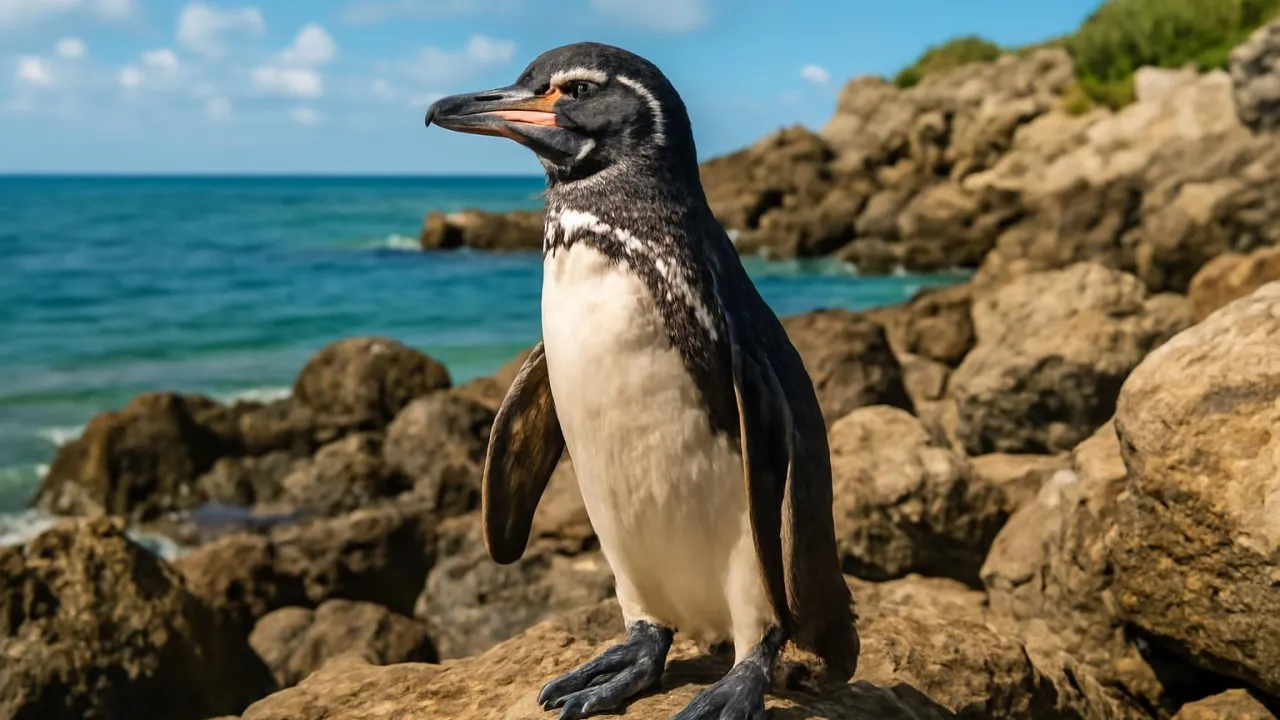
Galapagos penguins are the only penguins that live in tropical climates!
✨ Word Sparks (Grade 2 Glossary)
Tap 🔊 to hear
equator
An imaginary line around the middle of Earth
shores
Land along the edge of the sea or ocean
flippers
Flat wings penguins use to swim in water
🪝
How can a penguin live where it is hot and sunny all year?
1
Living in Warm Islands
The Galapagos penguin lives on islands near the . These islands have warm weather and rocky . It swims in the ocean to catch fish and small sea animals.
2
Cool Ways to Stay Comfortable
This penguin spreads its wings to cool down in the hot sun. It also rests in shady places to avoid heat. Sometimes it splashes water on its body to stay cool.
3
Special Features of the Penguin
It has a small body and short beak that help it swim fast. Its black and white feathers protect it from the sun and water. The penguin uses its wings to swim like .
Galapagos penguins have adapted to live in the only tropical penguin habitat on Earth!
✨ Word Sparks (Grade 3 Glossary)
Tap 🔊 to hear
camouflage
Colors that help animals hide from others
predator
An animal that hunts other animals for food
ecosystem
A community of plants and animals living together
🪝
What special adaptations help the Galapagos penguin survive in warm tropical waters?
1
Habitat and Warm Climate
The Galapagos penguin lives on rocky islands near the equator in the Pacific Ocean. Unlike most penguins, it survives in warm tropical waters. Its habitat includes volcanic rocks and small coves where it can hide from .
2
Physical Adaptations
This penguin has black and white feathers that provide in the water, helping it avoid . Its small size and short beak allow quick, agile swimming to catch fish. The penguin’s wings act as flippers, perfect for underwater movement.
3
Cooling Behaviors
To avoid overheating, the penguin spreads its wings to release heat and rests in shaded areas. It also uses panting and splashes water on its body to cool down. These behaviors help it survive in the hot sun.
4
Role in the Ecosystem
Galapagos penguins are important in their , feeding on small fish and helping control fish populations. They also serve as prey for larger animals, balancing the food web. Their presence indicates a healthy marine environment.
2. What role does the penguin play in its ecosystem?
🤯 Mind-Blowing Fact • Grade 4
The Galapagos penguin’s survival depends on cool ocean currents near warm tropical islands!
✨ Word Sparks (Grade 4 Glossary)
Tap 🔊 to hear
currents
Large flows of water in the ocean
conservation
Protecting animals and their homes
archipelago
A group of islands close together
🪝
Why is the Galapagos penguin’s survival linked to its unique island ecosystem?
1
Island Habitat and Climate Effects
The Galapagos penguin inhabits rocky islands near the equator where ocean bring cool water. This cool water helps keep the penguins from overheating despite the tropical sun. When currents change, penguins face challenges finding food and staying cool. These changes affect their survival and breeding success.
2
Physical and Behavioral Adaptations
This penguin’s black and white coloration provides camouflage to avoid predators in water and on land. It uses its flipper-like wings for swift swimming to catch fish, its main food source. To regulate body temperature, it spreads its wings and rests in shade during hot periods. These adaptations are vital for living in a warm environment.
3
Ecosystem Role and Human Impact
Galapagos penguins are key predators that help balance fish populations in their marine food web. Human activities such as fishing and tourism can disrupt their habitat and food supply. efforts focus on protecting their island homes and reducing human threats. Protecting their environment helps maintain the ecosystem’s health.
4
Geographic Distribution and Conservation
These penguins are found only on a few islands in the Galapagos . Their limited range makes them vulnerable to climate change and habitat loss. Protected areas and monitoring programs help conserve their populations for the future. Scientists study them to better understand how to protect these unique birds.
1. How do ocean currents help the Galapagos penguin?
2. Why is conservation important for Galapagos penguins?
🤯 Mind-Blowing Fact • Grade 5
Galapagos penguins swim up to 15 miles per hour in warm tropical waters unlike any other penguin species!
✨ Word Sparks (Grade 5 Glossary)
Tap 🔊 to hear
Spheniscidae
The family all penguins belong to
El Niño
A weather event that warms ocean water
predator
An animal that hunts other animals for food
🪝
How does the Galapagos penguin’s unique biology and environment shape its survival challenges and conservation?
1
Taxonomy and Scientific Classification
The Galapagos penguin, scientifically named Spheniscus mendiculus, belongs to the family. It is the smallest penguin species in the Galapagos Islands, uniquely adapted to tropical conditions. Its closest relatives are other banded penguins found in South America and Africa. This classification helps scientists understand its evolutionary history and traits.
2
Physiological Adaptations for Tropical Life
Unlike cold-climate penguins, this species has developed behaviors to regulate heat, such as panting and wing-spreading to dissipate body heat. Its smaller body size reduces heat retention, and its feathers provide waterproofing while reflecting sunlight. These adaptations allow survival in water temperatures up to 25°C (77°F). The penguin’s circulatory system also helps cool its blood in warm conditions.
3
Conservation History and Threats
The Galapagos penguin population has fluctuated due to events, which warm ocean waters and reduce fish availability. Human activities like fishing, habitat disturbance, and introduced also threaten them. Conservation programs include habitat protection, research monitoring, and public education. These efforts aim to stabilize and increase penguin numbers over time.
4
Ecological Role and Food Web Interactions
As mid-level , Galapagos penguins feed mainly on small schooling fish such as sardines and mullet. They help maintain fish population balance, which supports overall marine ecosystem health. Predators such as hawks and introduced cats pose risks to eggs and chicks. Their nesting sites on rocky shores provide protection but remain vulnerable to environmental changes.
5
Quantitative Comparisons and Unique Traits
Adult Galapagos penguins measure about 16 to 18 inches (40 to 46 cm) tall and weigh around 5 pounds (2.3 kg). They can swim at speeds up to 15 miles per hour (24 km/h). Their tropical habitat is unique, as most penguins live in cold climates, making their survival adaptations remarkable. Their breeding season is linked closely to ocean temperature and food availability.