🇺🇸 U.S. HISTORY
🏛️ Abolitionist Orator, Author & Civil Rights Statesman (1818–1895)
VA History & Social Science SOL K.1, 1.2, 2.4, VS.1–VS.10, USI & USII
Frederick Douglass
How Reading Unlocked a Voice for Human Freedom
Grade 5 • Advanced • 512 words
⏳ Era / StatehoodHistorical Era: 1818–1895 (Escaped to Freedom: Sept 3, 1838)
🗺️ Region / CapitalTalbot County, Maryland; Rochester, New York & Washington, D.C.
📜 Key MilestonePublished The North Star, Advised Lincoln & Championed Equal Rights
⚡ Historical SparkTaught himself to read in secret and used words to help end slavery and expand voting rights
🤯 Mind-Blowing Fact • Grade 1
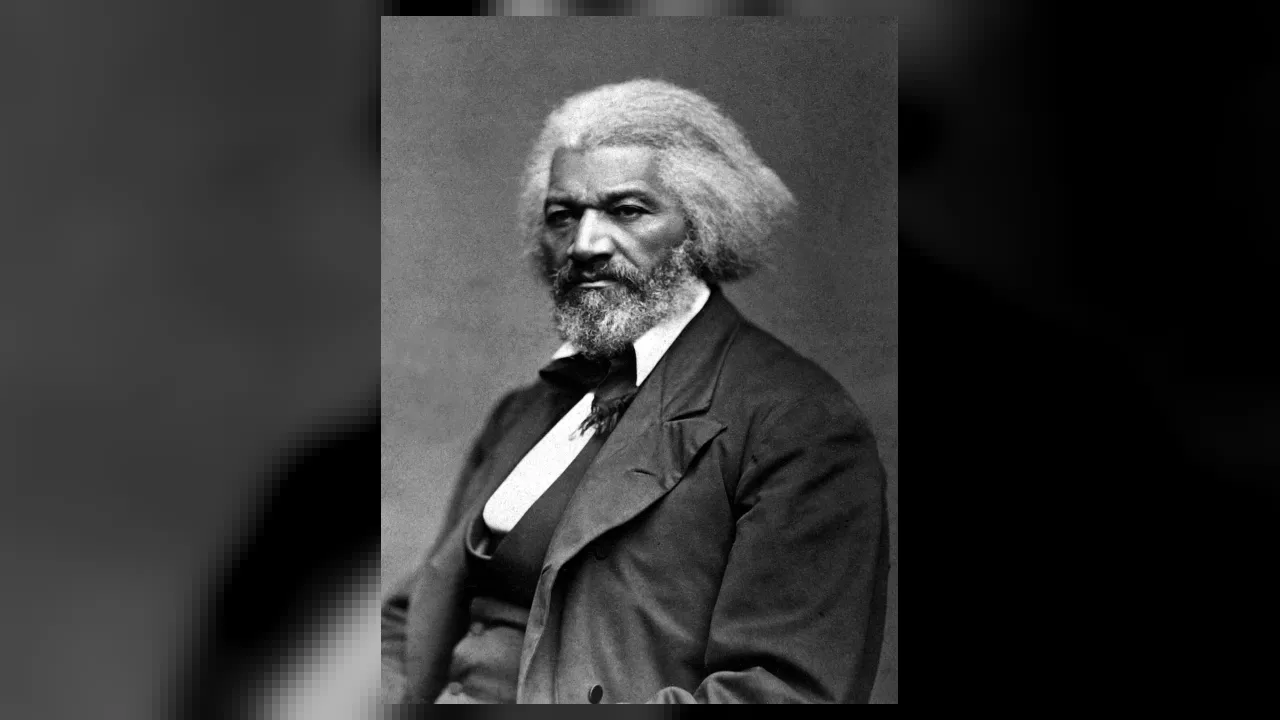
Frederick Douglass intentionally posed for more than 160 serious, dignified portraits—making him the most photographed American of the entire 1800s!
✨ Word Sparks (Grade 1 Glossary)
Tap 🔊 to hear
enslaved
Unfairly forced to work without freedom
newspaper
Printed pages sharing important news and ideas
dignified
Calm, proud, and worthy of deep respect
🪝
Can learning to read help change an entire country?
1
Trading Bread for Letters
Shhh, look! as a young boy in Maryland, Frederick was not allowed to attend school. So he traded pieces of bread with neighborhood kids to learn his ABCs!
2
Speaking Up for Freedom
At age twenty, Frederick bravely escaped to freedom in the North. Soon he wrote a famous book about his life and started his own !
3
Helping End Slavery
With a booming, powerful voice, he met President Abraham Lincoln at the White House and worked his whole life for equal rights for all people!
1. How did young Frederick Douglass cleverly learn to read on Baltimore streets when schools were closed to him?
2. Which U.S. president welcomed Frederick Douglass to the White House to talk about ending slavery and fair pay for Black soldiers?
🤯 Mind-Blowing Fact • Grade 2
Never knowing his exact birth date, Frederick Douglass chose February 14—Valentine's Day—as his birthday because his mother had lovingly called him her 'Little Valentine'!
✨ Word Sparks (Grade 2 Glossary)
Tap 🔊 to hear
abolitionist
Someone working to end slavery completely
orator
A skilled, inspiring public speaker
disguise
Clothes worn to hide who you really are
🪝
Why did Frederick Douglass name his famous anti-slavery newspaper after a bright star in the night sky?
1
Secret Lessons in Baltimore
Chalk squeaked against brick walls along Baltimore shipyards as twelve-year-old Frederick copied letters from wooden ship timbers! Enslaved from childhood in Maryland, he saved fifty cents shining shoes to buy a speech book called The Columbian , practicing every word aloud.
2
Escaping North and Publishing Truth
Disguised in a sailor's uniform in 1838, twenty-year-old Frederick rode trains and steamboats to freedom and chose the new last name 'Douglass.' In 1845 he published his bestselling life story, and in Rochester, New York, he founded a newspaper called The North Star—named after the star freedom-seekers followed north at night!
3
Champion for Every Person's Rights
Douglass spoke up for women's voting rights alongside Elizabeth Cady Stanton and Susan B. Anthony, advised President Abraham Lincoln during the Civil War, and later served as a respected U.S. official in Washington, D.C.
1. Why did Frederick Douglass choose 'The North Star' as the title of his Rochester newspaper?
2. Why did Frederick Douglass celebrate his birthday every year on February 14?
🤯 Mind-Blowing Fact • Grade 3
Why did Historian Carter G. Woodson choose the month of February in 1926 to celebrate Black History? Specifically to honor the February birthdays of two freedom champions: Abraham Lincoln (February 12) and Frederick Douglass (February 14)!
✨ Word Sparks (Grade 3 Glossary)
Tap 🔊 to hear
eloquent
Speaking or writing with clear, moving power
Underground Railroad
Secret network of safe houses aiding freedom-seekers
emancipate
To set people free from slavery
🪝
Why did people who heard young Frederick Douglass speak so brilliantly at first refuse to believe he had ever been enslaved?
1
'Knowledge Makes a Man Unfit to Be a Slave'
Picture hiding a tattered book of speeches inside your coat pocket and reading it whenever nobody was watching! Separated from his mother in Talbot County, Maryland, young Frederick Bailey learned the alphabet briefly before laws forbade teaching enslaved children. Realizing literacy meant power, he secretly taught himself to read and write.
2
Proving His Story in Print
With crucial help from Anna Murray—a free Black woman in Baltimore who became his wife of forty-four years—Frederick escaped north in September 1838. When listeners doubted such an speaker had really been enslaved, he bravely published his 1845 Narrative with real names and places, then toured Britain and Ireland for two years until friends purchased his legal freedom.
3
Seneca Falls and the Civil War
Returning to Rochester, New York, Douglass published The North Star and sheltered travelers on the . At the 1848 Seneca Falls Convention, he was the sole Black attendee—and his speech helped convince delegates to support women's right to vote! During the Civil War, he urged President Lincoln to enslaved people and enlist Black troops, including two of Douglass's own sons.
4
Statesman at Cedar Hill
After the war, living at his hilltop home Cedar Hill in Washington, D.C., Douglass championed the Thirteenth, Fourteenth, and Fifteenth Amendments and served as U.S. Marshal and U.S. Minister to Haiti.
1. What crucial role did Frederick Douglass play at the 1848 Seneca Falls Women's Rights Convention?
2. Why did Douglass put himself in danger by publishing real names and towns in his 1845 autobiography?
🤯 Mind-Blowing Fact • Grade 4
On the day Abraham Lincoln delivered his Second Inaugural Address in March 1865, Lincoln spotted Frederick Douglass at the White House reception, called out 'Here comes my friend Douglass!', and asked him directly what he thought of the speech—saying there was no man in the country whose opinion he valued more!
✨ Word Sparks (Grade 4 Glossary)
Tap 🔊 to hear
rhetoric
The art of speaking and writing persuasively
masthead
The banner at the top of a newspaper
caricature
An unfair, exaggerated drawing meant to mock people
🪝
How did Frederick Douglass use literacy, photography, journalism, and constitutional argument to transform nineteenth-century America?
1
Literacy as the Pathway to Freedom
Sent at age eight from Maryland's Eastern Shore to Baltimore, young Frederick Augustus Washington Bailey heard Sophia Auld begin teaching him the alphabet before her husband ordered her to stop, warning that learning would make him 'unfit to be a slave.' Recognizing that exact truth as his key to liberty, Frederick traded bread with white dockside boys for reading lessons, studied in Caleb Bingham's The Columbian Orator, and copied chalk shipyard letters until he could write fluently.
2
Escape, Autobiography, and The North Star
Aided by free Black Baltimorean Anna Murray—who sewed a sailor's disguise and provided savings before marrying him in New York—twenty-year-old Frederick escaped northward on September 3, 1838, adopting the surname Douglass. Recruited by abolitionists after an electrifying 1841 speech on Nantucket, he published Narrative of the Life of Frederick Douglass, an American Slave (1845), selling 30,000 copies within five years. Settling in Rochester, New York, in 1847, he founded The North Star, declaring on its : 'Right is of no Sex—Truth is of no Color—God is the Father of us all, and all we are Brethren.'
3
Constitutional Abolitionism and Civil War Partnership
Whereas some abolitionists rejected the U.S. Constitution, Douglass studied its text deeply—concluding in his famous 1852 speech and writings that the Constitution's Preamble ('We the People... to secure the Blessings of Liberty') was 'a glorious liberty document' when applied faithfully to all Americans. During the Civil War, Douglass recruited Black soldiers—including his sons Charles and Lewis in the famed 54th Massachusetts Infantry—and met three times with President Abraham Lincoln to advocate emancipation and equal military pay.
4
Reconstruction Statesman and Visual Pioneer
Relocating to Washington, D.C., Douglass championed the Thirteenth, Fourteenth, and Fifteenth Amendments, became the first African American confirmed by the U.S. Senate to high federal posts—serving as U.S. Marshal for the District of Columbia (1877), Recorder of Deeds (1881), and U.S. Minister to Haiti (1889)—and intentionally sat for over 160 photographs to counter racist with unmistakable human dignity. On February 20, 1895, hours after receiving a standing ovation at a women's rights council, he passed away at his Anacostia home, Cedar Hill.
1. Why did Frederick Douglass deliberately sit for more than 160 portrait photographs—making him the most photographed nineteenth-century American?
2. How did Frederick Douglass describe the U.S. Constitution after studying its text and Preamble closely?
🤯 Mind-Blowing Fact • Grade 5
After President Abraham Lincoln's assassination in April 1865, First Lady Mary Todd Lincoln sent Lincoln's favorite walking stick directly to Frederick Douglass as a lasting token of the president's esteem—a cane still preserved today at Douglass's Cedar Hill National Historic Site in Washington, D.C.!
✨ Word Sparks (Grade 5 Glossary)
Tap 🔊 to hear
clandestine
Kept carefully secret to avoid unfair punishment
synonymous
Closely linked as having the exact same meaning
daguerreotype
An early sharp photograph made on silver-coated copper
🪝
How did Frederick Douglass evolve from self-liberated Maryland youth into one of the supreme constitutional thinkers and moral voices in American history?
1
Clandestine Literacy and Self-Liberation
Comprehending at age eight in Baltimore why enslavers feared literacy—hearing Hugh Auld warn that reading would forever unfit a child for bondage—Frederick Augustus Washington Bailey recognized education as the architecture of freedom. Trading bread to poor white children along Philpot Street for spelling lessons, purchasing a worn fifty-cent copy of Caleb Bingham's 1797 anthology The Columbian Orator, and copying chalk shipbuilding marks until his handwriting was crisp, he later organized Sabbath schools teaching dozens of fellow enslaved youths on Maryland's Eastern Shore. Aided financially and logistically by free Black Baltimorean Anna Murray—whom he married immediately upon reaching New York—twenty-year-old Frederick escaped north on September 3, 1838, adopting the surname Douglass in New Bedford, Massachusetts.
2
Three Autobiographies, Transatlantic Voice, and Rochester Press
Propelled onto the lecture circuit after speaking at Nantucket in August 1841, Douglass answered skeptics who doubted his enslavement by publishing Narrative of the Life of Frederick Douglass, an American Slave (1845)—the first of three classic autobiographies, followed by My Bondage and My Freedom (1855) and Life and Times of Frederick Douglass (1881). After lecturing to packed halls across Ireland, Scotland, and England from 1845 to 1847 while British supporters purchased his legal manumission papers to prevent recapture, Douglass used donations to establish an independent Black-owned press in Rochester, New York: founding The North Star (1847) and Frederick Douglass' Paper, while he and Anna Murray Douglass sheltered more than four hundred freedom-seekers along the Underground Railroad.
3
Seneca Falls, July 5th, and Constitutional Antislavery
Douglass's intellectual independence transformed reform movements. In July 1848, as the sole Black participant among three hundred attendees at the Seneca Falls Women's Rights Convention, his floor speech proved decisive in carrying Elizabeth Cady Stanton's women's suffrage resolution. Breaking with William Lloyd Garrison's view that the Constitution was irredeemably proslavery—and mentored by Gerrit Smith and Lysander Spooner's textualism—Douglass argued in his towering July 5, 1852 Rochester address ('What to the Slave Is the Fourth of July?') that both the Declaration of Independence's natural-rights creed and the Constitution's text ('a glorious liberty document') mandated abolition through political and legal action.
4
Recruiting Union Victory and Advising Abraham Lincoln
Once Civil War erupted in 1861, Douglass pressed relentlessly to make Union victory with emancipation and Black citizenship. Following Lincoln's January 1, 1863 Emancipation Proclamation, Douglass toured the North proclaiming 'Men of Color, To Arms!'—helping recruit the famed 54th Massachusetts Infantry, in which his sons Lewis and Charles enlisted first. Across three historic White House meetings (1863–1865), Douglass candidly pressed Lincoln for equal pay and protection for Black troops while forging deep mutual respect; after Lincoln's death, Mary Todd Lincoln gifted Douglass the late president's favorite walking cane.
5
Reconstruction Statesman, Photography Theorist, and Cedar Hill
Moving to Washington, D.C.—and purchasing his fifteen-acre Anacostia estate, Cedar Hill, in 1877—Douglass championed the Thirteenth, Fourteenth, and Fifteenth Amendments, presided over the Freedmen's Savings Bank in its final months trying using personal funds to rescue depositors, and earned Senate confirmation as U.S. Marshal for D.C. (1877–1881), Recorder of Deeds (1881–1886), and U.S. Minister Resident and Consul General to Haiti (1889–1891). Equally pioneering in visual culture, he sat purposefully for more than 160 and photographs—more than any nineteenth-century American—to democratize dignified self-representation, speaking tirelessly for universal suffrage until the very afternoon of his death on February 20, 1895.
1. Why did Frederick Douglass shift from calling for breakup of the Union to defending the U.S. Constitution as 'a glorious liberty document'?
2. What milestone in federal public service did Frederick Douglass achieve in 1877 when President Rutherford B. Hayes nominated him as U.S. Marshal for the District of Columbia?