🇺🇸 U.S. HISTORY
🏛️ 32nd President of the United States (1933–1945)
VA History & Social Science SOL K.1, 1.2, 2.4, VS.1–VS.10, USI & USII
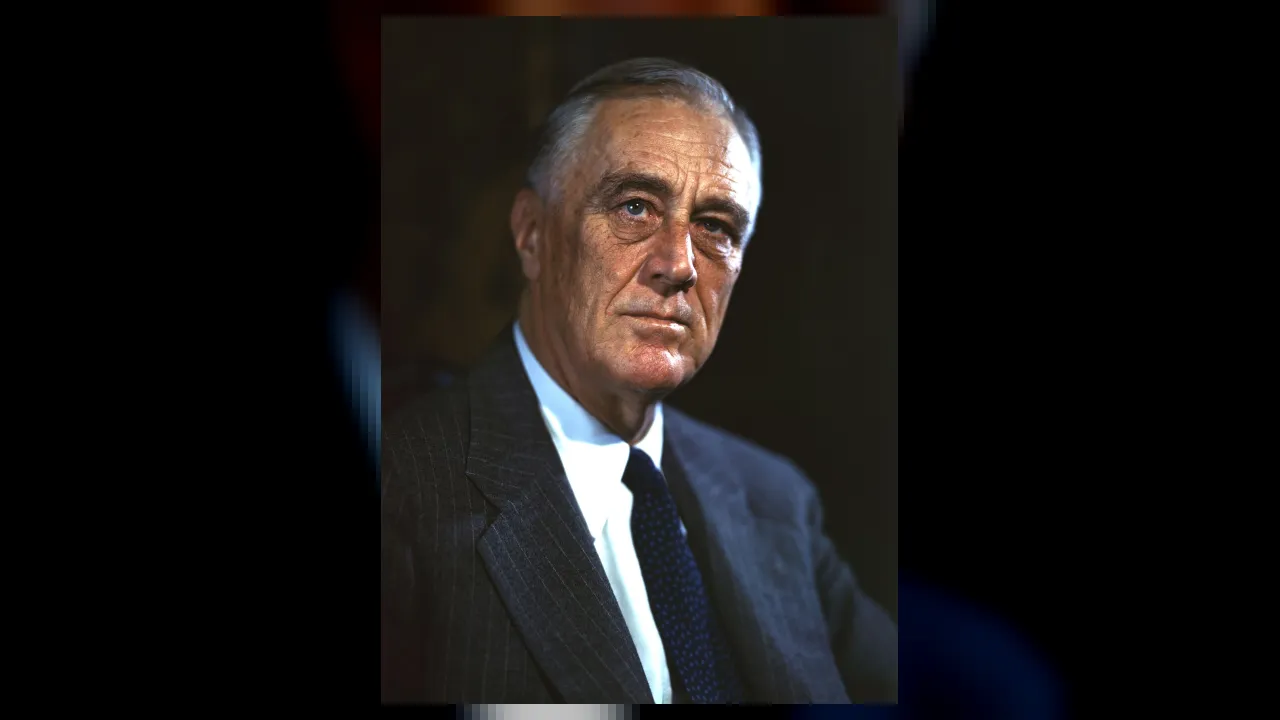
Franklin D. Roosevelt
Steady Radio Voice Through Depression and World War
Grade 5 • Advanced • 345 words
⏳ Era / StatehoodPresidential Term: 1933–1945 (Only 4-Term U.S. President)
🗺️ Region / CapitalHyde Park, New York; Warm Springs, Georgia & Washington, D.C.
📜 Key MilestoneNew Deal Recovery, Social Security & Allied Victory in WWII
⚡ Historical SparkLed America from a wheelchair through both the Great Depression and World War II
🤯 Mind-Blowing Fact • Grade 1
Americans sent millions of shiny ten-cent coins to FDR's 'March of Dimes' to help scientists find a vaccine against polio—that is why FDR's face is on the dime today!
✨ Word Sparks (Grade 1 Glossary)
Tap 🔊 to hear
scarce
Hard to find because there is very little
braces
Strong supports worn to steady weak legs
allies
Friendly nations working together on the same team
🪝
How could one calm voice on the radio cheer up millions of worried families?
1
A Friendly Voice on the Radio
Click, hum! Families gathered around wooden radios in their living rooms. Speaking warmly like a kind neighbor, our thirty-second president, called FDR, told Americans not to lose hope!
2
Leading From a Wheelchair
An illness called polio left his legs unable to walk on their own. Using a wheelchair and leg , FDR showed amazing courage and never gave up.
3
Helping Workers and Winning Peace
When jobs were , his New Deal put people back to work planting trees and building bridges. Then he led America and its through World War II!
1. How did FDR talk directly to millions of American families in their homes?
2. Why is Franklin D. Roosevelt's portrait stamped on every American ten-cent dime?
🤯 Mind-Blowing Fact • Grade 2
FDR's beloved Scottish Terrier dog, Fala, became so famous that soldiers overseas asked about him, and Fala's bronze statue sits right beside FDR at his Washington, D.C., memorial!
✨ Word Sparks (Grade 2 Glossary)
Tap 🔊 to hear
empathy
Understanding and caring about someone else's feelings
depression
A hard time when many businesses and jobs close
vaccine
Medicine that teaches your body to prevent illness
🪝
Why did American voters elect Franklin D. Roosevelt president four times in a row—more than anyone else in history?
1
Courage After Polio
Splash, kick! At age thirty-nine, Franklin D. Roosevelt—a distant cousin of Theodore Roosevelt—lost the use of his legs to polio. Swimming in warm mineral pools in Georgia built his upper-body strength and taught him deep for people facing hardship.
2
The New Deal and Fireside Chats
When FDR became our thirty-second president in 1933 during the Great , millions of workers had lost jobs and savings. Telling Americans 'the only thing we have to fear is fear itself,' he launched the New Deal to create jobs, protect bank savings, and start Social Security.
3
Commander in Chief in World War II
After surprise attacks at Pearl Harbor in December 1941 pulled America into World War II, voters trusted steady leadership. Elected to an unmatched four terms, FDR worked with Allied leaders to restore freedom around the world.
1. How many times was Franklin D. Roosevelt elected president of the United States?
2. What famous words from FDR's first inaugural speech encouraged worried citizens in 1933?
🤯 Mind-Blowing Fact • Grade 3
Young workers in FDR's Civilian Conservation Corps planted over three billion trees across America—earning the nickname 'Roosevelt's Tree Army'—and dedicated Shenandoah National Park in Virginia with FDR himself in 1936!
✨ Word Sparks (Grade 3 Glossary)
Tap 🔊 to hear
insured
Protected by a guarantee against accidental loss
dictator
A ruler who seizes total power without fair laws
liberate
To set people or countries free from control
🪝
How did one president help build Virginia's Skyline Drive during the Great Depression and unite global allies during World War II?
1
Turning Personal Hardship Into Strength
Imagine waking up at age thirty-nine unable to stand, yet refusing to quit public service! Raised in Hyde Park, New York, Franklin Delano Roosevelt contracted polio in 1921. Assisted by his energetic wife, First Lady Eleanor Roosevelt, he returned to politics and became governor of New York.
2
First Hundred Days and the New Deal
Taking office in March 1933 during the worst economic slump in U.S. history, FDR delivered thirty calming radio 'Fireside Chats.' His 'New Deal' family bank accounts, started Social Security for older citizens, and hired young men in the Civilian Conservation Corps—who planted three billion trees and helped build Shenandoah National Park in Virginia!
3
Arsenal of Democracy in World War II
When attacked nations in Europe and Asia, FDR sent supplies to Britain and allies before Japan attacked Pearl Harbor, Hawaii, on December 7, 1941. Mobilizing American factories and troops, FDR partnered with British Prime Minister Winston Churchill to Europe and the Pacific.
4
Four Terms and the Twenty-Second Amendment
Before passing away in April 1945—just weeks before Allied victory in Europe—FDR helped plan the United Nations to safeguard peace. Afterward, Americans ratified the Twenty-Second Amendment limiting future presidents to two terms.
1. Which Virginia mountain treasure did FDR's Civilian Conservation Corps help build and FDR personally dedicate in 1936?
2. Why can no modern president serve four terms like Franklin D. Roosevelt did?
🤯 Mind-Blowing Fact • Grade 4
FDR personally designed his own lightweight, armless wheelchair out of an ordinary kitchen dining chair on wheels so he could maneuver smoothly through narrow White House doorways!
✨ Word Sparks (Grade 4 Glossary)
Tap 🔊 to hear
unprecedented
Never done, seen, or experienced in history before
rehabilitation
Therapy and training to rebuild strength after illness
arsenal
A supply center producing tools and defense equipment
🪝
How did Franklin D. Roosevelt reshape the role of the federal government during the twelve most turbulent years of the twentieth century?
1
Resilience, Eleanor Roosevelt, and Warm Springs
When paralytic illness struck thirty-nine-year-old Franklin D. Roosevelt in August 1921, doctors predicted his career was finished. Instead, FDR founded a center at Warm Springs, Georgia, and created the National Foundation for Infantile Paralysis (the March of Dimes), which later funded Dr. Jonas Salk's polio vaccine. Meanwhile, First Lady Eleanor Roosevelt traveled thousands of miles as his eyes and ears, visiting coal mines, schools, and military hospitals across America.
2
Relief, Recovery, and Reform in the New Deal
Inaugurated on March 4, 1933, with one in four American workers unemployed, FDR launched an 'First Hundred Days' with Congress. His New Deal rested on three pillars: immediate Relief (jobs in the Civilian Conservation Corps and Works Progress Administration), economic Recovery (reopening farms and factories, plus electrifying rural valleys through the Tennessee Valley Authority), and permanent Reform (Federal Deposit Insurance Corporation protecting bank savings and the 1935 Social Security Act supporting retirees and people with disabilities).
3
The Four Freedoms and World War II
In January 1941, FDR outlined 'Four Freedoms' everyone in the world ought to enjoy: freedom of speech, freedom of worship, freedom from want, and freedom from fear. Through Lend-Lease aid, American factories became the ' of Democracy.' After Japan's surprise attack on Pearl Harbor on December 7, 1941, FDR led the Grand Alliance alongside Britain and the Soviet Union, coordinating the 1944 D-Day invasion while also signing Executive Order 9066—a wartime removal of Japanese Americans later recognized by Congress as a grave constitutional injustice.
4
Planning Peace and Enduring Institutions
Reelected to a fourth term in November 1944, FDR coined the name 'United Nations' and worked to build postwar cooperation before dying of a stroke at Warm Springs on April 12, 1945, less than a month before Victory in Europe Day.
1. What were the three main goals ('Three Rs') of Franklin D. Roosevelt's New Deal programs?
2. How did First Lady Eleanor Roosevelt transform the role of a president's spouse?
🤯 Mind-Blowing Fact • Grade 5
Signed by FDR in June 1944, the Servicemen's Readjustment Act—known as the GI Bill—sent nearly eight million World War II veterans to college or trade schools and helped millions purchase their first family homes!
✨ Word Sparks (Grade 5 Glossary)
Tap 🔊 to hear
isolationist
Preferring to stay completely out of foreign affairs
totalitarian
Controlling every part of citizens' lives without freedom
bipartisan
Supported jointly by members of two political parties
🪝
How did Franklin D. Roosevelt's twelve-year presidency permanently redefine American economic security, constitutional debate, and global leadership?
1
Crucible of Paralysis and Civic Empathy
Before 1921, Franklin Delano Roosevelt—Harvard graduate, New York state senator, Assistant Secretary of the Navy under Woodrow Wilson, and 1920 vice-presidential nominee—moved effortlessly through privileged circles. Contracting paralytic illness at Campobello Island at age thirty-nine transformed his character. Wearing ten-pound steel leg braces and founding the Warm Springs hydrotherapy institute in Georgia, Roosevelt cultivated unshakable optimism and practical empathy that resonated with millions of struggling Americans when he won the New York governorship in 1928 and the presidency in 1932.
2
The New Deal and Constitutional Tension
Assuming office in March 1933 amid banking panics and 25 percent unemployment, Roosevelt used thirty informal radio 'Fireside Chats' to explain complex policy in plain English. Across the First and Second New Deals (1933–1938), Congress established the FDIC, Securities and Exchange Commission, Civilian Conservation Corps, Works Progress Administration, Rural Electrification Administration, Wagner Labor Relations Act, and the 1935 Social Security Act. While these agencies built lasting economic safeguards, FDR's controversial 1937 proposal to expand the Supreme Court after justices struck down early New Deal statutes met congressional rejection, preserving judicial independence.
3
From Neutrality to 'Arsenal of Democracy'
As aggression spread across Europe and Asia in the late 1930s, Roosevelt nudged an nation toward preparedness. Breaking the unwritten two-term precedent in 1940, he articulated the 'Four Freedoms' (January 1941), enacted the Lend-Lease Act supplying $50 billion in Allied aid, and co-signed the Atlantic Charter with Winston Churchill in August 1941—affirming self-government and collective peace months before the United States entered combat.
4
Global Coalition and Wartime Civil-Liberties Lessons
Following Imperial Japan's December 7, 1941 attack on Pearl Harbor, Roosevelt orchestrated a two-ocean industrial and military mobilization—appointing leaders such as Virginia-educated General George C. Marshall and General Dwight D. Eisenhower—while signing the 1944 GI Bill opening college and homeownership to returning veterans. Simultaneously, historians examine serious wartime failings, notably Executive Order 9066 (1942), which incarcerated approximately 120,000 Japanese Americans—two-thirds of them U.S. citizens—without individual due process.
5
Architect of the Postwar World
Through wartime summits at Casablanca, Cairo, Tehran, and Yalta, and financial conferences at Bretton Woods and Dumbarton Oaks, Roosevelt laid institutional foundations for postwar stability and the United Nations. His death at Warm Springs on April 12, 1945—followed by ratification of the Twenty-Second Amendment in 1951—closed the longest presidency in American constitutional history.