1. What did people have to dip into ink pots every few words before reservoir pens?
2. Where does a fountain pen store its supply of liquid ink?
🤯 Mind-Blowing Fact • Grade 2
More than a thousand years ago in 953 CE, craftsmen in Egypt built an early golden reservoir pen so a ruler could write without staining his hands or clothes!
✨ Word Sparks (Grade 2 Glossary)
Tap 🔊 to hear
reservoir
A chamber built to store extra liquid
cartridge
A small sealed tube of replacement ink
groove
A narrow channel carved into a surface
🪝
How did one ruined business contract lead to a pen that stopped dripping big ink blobs?
1
A Disaster on Signing Day
Splat! In 1883, New York salesman Lewis Waterman handed a client an early pen to sign a big contract, and it leaked a giant puddle of ink! By the time Waterman ran back with a fresh paper, a rival salesman had won the deal.
2
Trading Ink for Air
Tip a full water bottle upside down and watch it glug-glug unevenly as air fights to get inside. Waterman carved tiny under the metal nib so air crept smoothly up into the barrel while ink slid evenly down!
3
Built to Last Generations
Patented in 1884, Waterman's feed made fountain pens reliable for students, authors, and presidents. Refillable ink converters and snap-in still let writers choose hundreds of vibrant ink colors without throwing plastic pens away!
1. What happened to Lewis Waterman in 1883 that pushed him to invent a better pen?
2. Why must tiny bubbles of air travel up into a fountain pen barrel as you write?
🤯 Mind-Blowing Fact • Grade 3
Unlike ballpoint pens that need downward hand pressure to roll a ball, a fountain pen writes under its own light weight—reducing hand cramping during long stories!
✨ Word Sparks (Grade 3 Glossary)
Tap 🔊 to hear
capillary
Drawing liquid through hair-thin narrow spaces
tines
The two narrow prongs of a nib
corrode
To wear away metal through chemical rusting
🪝
How can liquid ink hang inside an open-slit fountain pen without dripping—until the exact instant it touches paper?
1
Controlled Leak Engineering
Hold a fountain pen point-down inches above white paper and not a single drop falls! Touch the tip lightly to the page, however, and vibrant liquid ink streams effortlessly onto the fibers.
2
Centuries of Inventors
Historical records from tenth-century Egypt describe a leak-free gold pen crafted for Caliph al-Mu'izz in 953. In 1827, Romanian student Petrache Poenaru patented a fountain pen in Paris using a hollow swan quill, and Lewis Waterman perfected the three-channel feed in 1884.
3
Capillary Action at Work
Two physics forces team up inside Waterman's grooved comb feed: gravity pulls ink downward, while action draws liquid tightly along hair-thin slits—just like water climbing up a paper towel! Fin-like comb slots underneath catch extra ink if warm hands expand air inside the barrel.
4
Gold Nibs and Rare Tipping
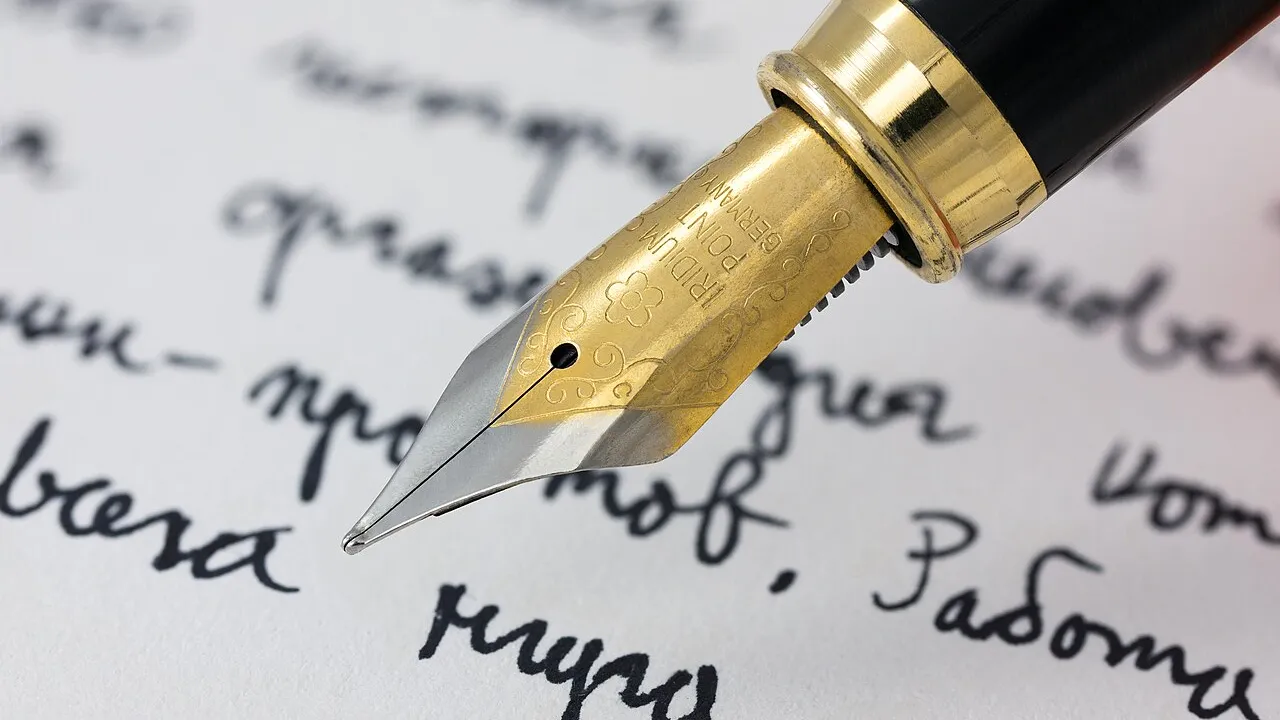
Makers often stamp nibs from 14-karat gold because gold flexes softly and never rusts in acidic inks. Welded right at the tip sits a tiny bead of super-hard metal so the point never wears down.
1. Why did pen makers traditionally craft fine fountain pen nibs out of gold?
2. What job do the comb-like fins underneath a fountain pen nib perform?
🤯 Mind-Blowing Fact • Grade 4
Slicing the microscopic slit between a fountain pen's two metal tines requires a spinning diamond-dusted copper disk thinner than a human eyelash!
✨ Word Sparks (Grade 4 Glossary)
Tap 🔊 to hear
surface tension
Cohesive pull holding liquid drops tightly together
ebonite
Hard vulcanized rubber shaped for pen feeds
alloy
A strong mixture of two or more metals
🪝
Why does warming an ink barrel in your hand threaten to flood your page—and how did hard rubber fins outsmart physics?
1
Taming Atmospheric Pressure
Uncap a classic fountain pen and examine the keyhole-shaped breather hole stamped into its gleaming nib. Far from decoration, that tiny hole anchors a delicate fluid balance between gravity, , and outside atmospheric pressure—allowing free liquid ink to flow on command without flooding.
2
From Cairo and Paris to New York
After tenth-century Fatimid craftsmen built an early upside-down-safe reservoir pen in Cairo and Petrache Poenaru patented a quill-reservoir pen in 1827, nineteenth-century inventors struggled with thermal burping: warmth from a writer's fingers heated trapped air inside half-empty barrels, expanding that air and forcing ink out in sudden blots.
3
Waterman's Three-Channel Feed
In his landmark 1884 patent, Lewis Edson Waterman machined three microscopic channels inside a hard vulcanized rubber rod called . pulled liquid ink smoothly down narrow side capillaries toward the nib slit while letting replacement air travel cleanly up a wider central vent, and comb fins buffered sudden pressure changes.
4
Iridium Tips and Refillable Sustainability
Because soft gold or steel would grind flat against gritty paper fibers within months, nibsmiths weld a pinhead pellet of ultra-hard platinum-group —such as ruthenium, osmium, and iridium—onto the tip before slicing a 0.02-millimeter slit between the two tines. Refilled from glass bottles, one fountain pen replaces thousands of disposable plastic barrels.
1. Why did early nineteenth-century fountain pens suddenly 'burp' ink blots when nearly empty?
2. Why do craftspeople weld a tiny pellet of iridium or ruthenium alloy onto the very tip of a gold nib?
🤯 Mind-Blowing Fact • Grade 5
Engineers subtly taper a fountain pen's nib slit so it grows narrower toward the point—making capillary pull strongest right at the tip so ink keeps flowing smoothly!
✨ Word Sparks (Grade 5 Glossary)
Tap 🔊 to hear
hydrostatic
Relating to pressure exerted by resting liquids
meniscus
The curved liquid surface held by tension
hydrophilic
Attracting water so liquid spreads smoothly across
🪝
How do Laplace capillary pressure, hydrophilic ebonite channels, and tapered nib slits turn a fountain pen into a zero-power fluidic pump?
1
A Controlled Leak Governed by Physics
Every fountain pen operates as what fluid engineers playfully describe as a controlled leak: suspending several milliliters of low-viscosity aqueous dye ink millimeters above clean paper with zero moving valves or rolling spheres. equilibrium holds steady because partial vacuum inside the sealed upper barrel plus surface tension across narrow channels exactly counterbalances gravity's downward pull on the liquid column.
2
Millennium-Long Quest for Reliable Flow
Tenth-century historian Qadi al-Nu'man recorded in 953 CE that Fatimid Caliph al-Mu'izz commissioned a golden internal-reservoir pen in Cairo that never stained garments even when tilted. Following Romanian student Petrache Poenaru's 1827 Paris swan-quill patent, New York inventor Lewis Edson Waterman secured U.S. Patent 293,545 on February 12, 1884, mastering simultaneous air-liquid counterflow inside a grooved vulcanized-rubber feed.
3
Capillary Geometry and Tapered Tine Slits
According to the Young-Laplace equation, capillary pull grows stronger as channel width narrows. Consequently, skilled nibsmiths cut the nib slit so it tapers subtly narrower from the breather hole toward the tip—actively drawing ink forward even at low writing angles! Touching absorbent cellulose paper breaks the liquid at the tip, wicking a smooth ink ribbon onto fibers while tiny air bubbles rise into the reservoir.
4
Metallurgy of Gold and Platinum-Group Tipping
Historical iron-gall inks contained acidic tannins that rapidly corroded plain steel nibs, establishing springy 14-karat gold alloys and ebonite feeds as enduring benchmarks alongside modern stainless steel and plasma-etched plastics. Welded tipping beads alloyed from osmium, ruthenium, tungsten, and iridium score near 7.0 on the Mohs hardness scale and are ground into round, stub, italic, or extra-fine geometries.
5
Piston Fillers, Treaties, and Sustainable Design
Refilling breakthroughs—from Walter Sheaffer's 1912 lever-compressed rubber sac and Theodor Kovacs's 1929 differential screw piston to snap-in cartridges and vacuum fillers—carried fountain pens across historic peace treaties, classic novels, architectural sketches, and today's low-waste refillable writing movement.