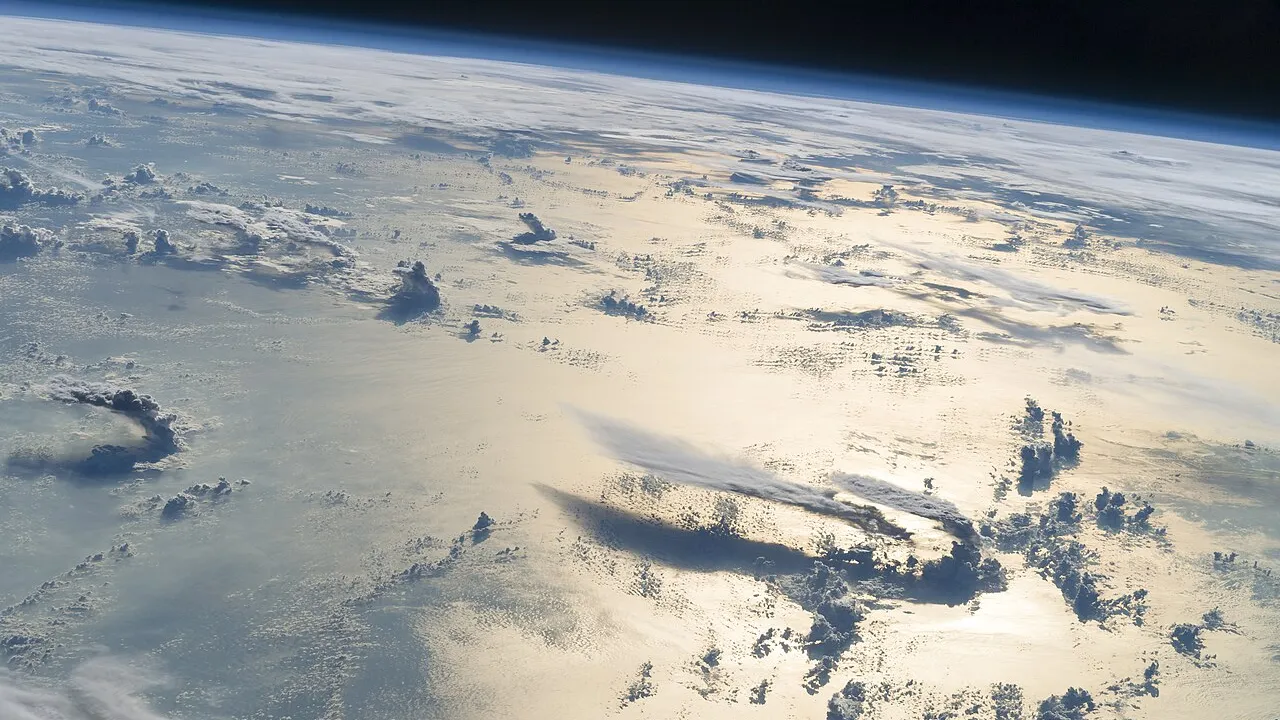
2. What travels smoothly around Earth inside the quiet exosphere?
🤯 Mind-Blowing Fact • Grade 2
The exosphere is thicker than all four lower layers of Earth's atmosphere combined!
✨ Word Sparks (Grade 2 Glossary)
Tap 🔊 to hear
hydrogen
the lightest gas found in the universe
helium
a super-light gas that floats upward
gravity
the invisible pull that holds things near Earth
🪝
Does Earth's air stop at a sharp wall, or fade gently into space?
1
No Hard Border in the Sky
If you rode a rocket straight up for hundreds of miles, you would never cross a painted line saying Welcome to Space. Instead, Earth's air thins out little by little inside its highest layer, the exosphere.
2
Lightest Gases on Top
Beginning around 375 miles high and stretching past 6,000 miles, the exosphere holds the lightest gases of all, mostly and . Atoms float so far apart that there is zero sound and zero breeze.
3
Leaking Into Deep Space
Earth's still pulls most gas bits back down like tiny tossed balls. However, the fastest bits sometimes zoom completely free into outer space!
1. Which two super-light gases make up most of the exosphere?
2. What happens to the very fastest hydrogen bits at the edge of the exosphere?
🤯 Mind-Blowing Fact • Grade 3
Apollo astronauts on the Moon photographed Earth's faint hydrogen halo glowing in ultraviolet light!
✨ Word Sparks (Grade 3 Glossary)
Tap 🔊 to hear
exobase
the bottom starting line of the exosphere
vacuum
empty space with almost no gas at all
drag
air resistance that slows a moving object
🪝
How can an atmospheric layer stretch halfway to the Moon in a ghostly glow?
1
Earth's Final Sky Layer
Picture tossing a baseball straight up: it arcs skyward, slows down, and falls back to your glove. Now shrink that baseball down to a single hydrogen atom 600 kilometers above Earth! That is how gas behaves inside the exosphere, the fifth and outermost layer of our atmosphere.
2
Collisions Almost Never Happen
Down near the ground, trillions of air molecules bounce off one another every second. Above the exosphere's lower boundary, called the , atoms are spread kilometers apart. They loop along giant curved paths without bumping neighbors.
3
Satellites Love Low Drag
Extending up to roughly 10,000 kilometers—nearly as wide as Earth itself—this near- lets communication, weather, and navigation satellites orbit for decades with almost no air resistance.
4
A Faint Hydrogen Halo
Space telescopes looking back at Earth in ultraviolet light actually see a dim hydrogen cloud called the geocorona glowing around our planet!
1. Why can satellites stay in orbit for decades inside the exosphere?
2. How do most atoms move inside the exosphere?
🤯 Mind-Blowing Fact • Grade 4
Earth loses about three kilograms of ultra-light hydrogen gas from the exosphere into space every single second—yet our air supply will last billions of years!
✨ Word Sparks (Grade 4 Glossary)
Tap 🔊 to hear
ballistic
curving under gravity like a thrown ball
escape velocity
speed needed to break free of gravity
geocorona
faint glowing cloud of hydrogen around Earth
🪝
Why does the starting height of the exosphere move up and down like a breathing lung?
1
A Moving Starting Line
If an explorer tried to plant a signpost at the bottom of the exosphere, that sign would need rockets to move up and down! The lower border, known as the exobase, shifts between 500 and 1,000 kilometers above Earth depending on the Sun's mood. During stormy solar years, extra ultraviolet rays puff the thermosphere outward and push the exobase higher; during quiet solar minimums, the atmosphere cools and shrinks inward.
2
Ballistic Atoms instead of Wind
Below the exobase, colliding gas molecules share heat and flow together as wind. Above it, air becomes so sparse that gases stop acting like a fluid altogether. Individual atoms of hydrogen and helium—plus traces of atomic oxygen near the base—follow independent arcs governed by Earth's gravity, traveling hundreds of kilometers without a single collision.
3
Atmospheric Escape and Earth's Ocean
Sunlight heats occasional hydrogen atoms past Earth's of about 11 kilometers per second, allowing roughly three kilograms of hydrogen to leak into space every second! Fortunately, Earth's strong gravity holds tightly onto heavier oxygen, nitrogen, and water vapor down below.
4
Busy Highway of High Orbits
Stretching roughly 10,000 kilometers into space, the exosphere shelters countless Earth-observing and polar-orbiting satellites that monitor hurricanes, sea ice, and global temperatures every day.
1. Why does the exobase rise higher during active solar periods?
2. Why doesn't Earth lose all of the oxygen we breathe through the exosphere?
🤯 Mind-Blowing Fact • Grade 5
Spacecraft observations proved that Earth's ultra-faint hydrogen geocorona stretches past 600,000 kilometers—meaning the Moon technically orbits inside wisps of Earth's outermost exosphere!
✨ Word Sparks (Grade 5 Glossary)
Tap 🔊 to hear
mean free path
average distance an atom travels between collisions
Jeans escape
heat-driven leaking of fast gas into space
radiation pressure
gentle push exerted by sunlight on tiny particles
🪝
Where does planet Earth truly end if its ghostly hydrogen halo reaches past the Moon?
1
Beyond Fluid Air
Imagine rising past every cloud, meteor trail, and aurora until the familiar rules of meteorology vanish completely. Between roughly 500 and 1,000 kilometers (310 to 620 miles) above sea level, you cross the thermopause—also called the exobase—and enter the exosphere. In this outermost atmospheric domain, gas density drops so low that the between atomic collisions exceeds the atmospheric scale height, meaning wind, sound, and barometric weather cease to exist.
2
Jeans Escape and Ballistic Trajectories
Populated overwhelmingly by atomic hydrogen and helium alongside residual atomic oxygen at lower altitudes, exospheric particles behave like microscopic satellites or suborbital projectiles. Most trace graceful ballistic ellipses before gravity reels them back toward the thermopause. However, thermal agitation accelerates a fraction of lightweight hydrogen atoms above local escape velocity (~10.8 kilometers per second at 600 kilometers), a process astrophysicists call .
3
Lessons for Planetary Habitability
Studying exospheric escape explains why worlds evolve so differently. Smaller Mars, possessing weaker gravity and lacking a global magnetic shield, lost much of its ancient atmosphere and water to space, whereas heavier Earth retains nitrogen and oxygen over billions of years.
4
The Geocorona's Surprising Reach
Conventionally, textbooks place the top of the exosphere near 10,000 kilometers (6,200 miles), where solar rivals Earth's gravitational pull on hydrogen. Yet ultraviolet observations from the SOHO spacecraft revealed that Earth's tenuous hydrogen geocorona actually extends past 600,000 kilometers—enveloping the Moon's orbit!
5
Orbital Sanctuary for Spacecraft
For aerospace engineers, the exosphere provides a nearly frictionless sanctuary where Earth-observation and medium-Earth-orbit navigation satellites operate for decades with minimal fuel.