1. How big was the virtual telescope created by linking dishes around the globe?
2. What did the first real black hole photograph look like?
🤯 Mind-Blowing Fact • Grade 2
The Event Horizon Telescope recorded so much data that the Internet was too slow—scientists had to fly crates of hard drives on airplanes!
✨ Word Sparks (Grade 2 Glossary)
Tap 🔊 to hear
event horizon
point of no return around black holes
atomic clock
the most accurate timekeeper ever built
supermassive
weighing millions or billions of suns
🪝
If not even light can escape a black hole, how did astronomers photograph one?
1
Catching the Glowing Edge
Picture water swirling faster and faster down a bathtub drain! Even though a black hole traps light inside its boundary—called the —superheated gas swirling just outside glows brightly with radio waves.
2
Atomic Clocks Across Continents
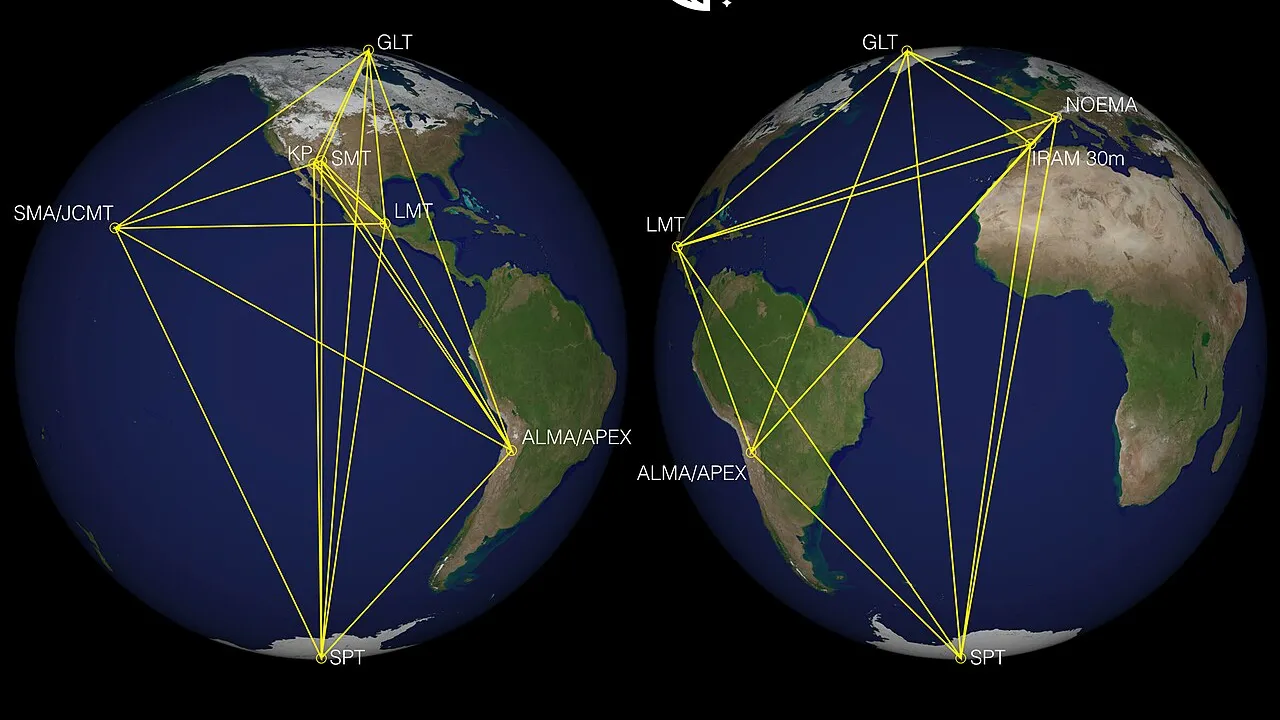
To zoom in across millions of light-years, over three hundred scientists linked radio observatories in Chile, Hawaii, Arizona, Mexico, Spain, and the South Pole. Special stamped every wave to a fraction of a billionth of a second!
3
Two Historic Portraits
First, the Telescope imaged a giant black hole in galaxy M87. Three years later, it revealed Sagittarius A*, the black hole inside our own Milky Way!
1. Why did scientists ship crates of computer hard drives on airplanes instead of emailing the black hole data?
2. What is the name of the supermassive black hole at the center of our own Milky Way galaxy imaged in 2022?
🤯 Mind-Blowing Fact • Grade 3
Waiters had to wait months for the South Pole's winter freeze to end before cargo planes could fly Antarctica's black hole hard drives out to supercomputers!
✨ Word Sparks (Grade 3 Glossary)
Tap 🔊 to hear
VLBI
linking telescopes across continents as one giant eye
petabyte
one million gigabytes of digital information
gravity
pulling force that bends space and light
🪝
How could telescopes scattered from the South Pole to Greenland snap a photo equal to spotting an orange on the Moon?
1
An Impossible-Looking Target
Imagine standing in your backyard and trying to photograph a single orange resting on the surface of the Moon! Even though supermassive black holes weigh millions or billions of Suns, they sit so far away that they appear microscopic in our sky. No single dish could ever resolve one.
2
Very Long Baseline Interferometry
To build an Earth-sized eye, the Event Horizon Telescope collaboration used Very Long Baseline Interferometry, or . During clear April nights when weather stayed dry at every mountain and polar station at once, eight observatories recorded 1.3-millimeter radio waves simultaneously.
3
Synchronized by Hydrogen Masers
Each observatory used a hydrogen maser atomic clock accurate to one second in 100 million years! Later, supercomputers in Massachusetts and Germany aligned the timestamped recordings from Antarctica, Chile's ALMA, Hawaii, North America, and Europe.
4
M87* and Sagittarius A*
On April 10, 2019, humanity saw the glowing lopsided ring around M87, 55 million light-years away, followed in 2022 by our Milky Way's own fast-changing Sagittarius A.
1. Why did the Event Horizon Telescope have to wait months to finish processing its observations?
2. How accurate were the hydrogen maser atomic clocks synchronizing each observatory?
🤯 Mind-Blowing Fact • Grade 4
Because Sagittarius A* is 1,500 times smaller than M87*, hot gas whips around our Milky Way's black hole in minutes instead of weeks—making its photo like snapping a clear portrait of a puppy chasing its tail!
✨ Word Sparks (Grade 4 Glossary)
Tap 🔊 to hear
photon ring
light bent into loops by extreme gravity
microarcsecond
one-millionth of an arcsecond sky angle
accretion disk
superheated swirling matter spiraling toward black holes
🪝
Why does one side of a black hole's fiery ring shine brighter than the other—and how did an Earth-sized telescope prove Einstein right?
1
Piercing Galactic Haze at 1.3 Millimeters
Between Earth and the heart of a galaxy lie thick curtains of gas and hot electrons that scatter ordinary light and long radio waves like frosted glass. Astronomers calculated that right around 1.3 millimeters in wavelength (230 gigahertz), both hot plasma around a black hole and our galaxy's dusty disk turn transparent! Simultaneously, shorter wavelengths boost angular resolution to an astonishing 20 across an Earth-diameter baseline.
2
Turning Five Petabytes into One Picture
During a single multi-night campaign, the Event Horizon Telescope's global stations recorded data at 64 gigabits per second, filling helium-sealed hard drives totaling five petabytes—roughly equal to five thousand years of MP3 music! Once flown to correlators at MIT Haystack Observatory and Germany's Max Planck Institute, independent imaging teams tested blind algorithms to ensure human bias never shaped the picture.
3
Relativistic Beaming and Gravity Bending Light
When all teams converged on the same fiery crescent surrounding M87*, Albert Einstein's century-old equations passed their toughest test yet. Extreme gravity bends light from behind the black hole into a circular 2.6 times wider than the event horizon itself, while Doppler boosting makes magnetized plasma whipping toward Earth near light speed shine brighter on the bottom edge.
4
Two Giants Differing by 1,500 Times
Comparing 6.5-billion-solar-mass M87 with our 4-million-solar-mass Sagittarius A proved general relativity governs black holes identically across giant leaps in scale.
1. Why did one side of M87*'s orange ring look noticeably brighter than the opposite side?
2. Why was photographing our Milky Way's Sagittarius A* even trickier than photographing distant M87*?
🤯 Mind-Blowing Fact • Grade 5
Polarized-light images from the Event Horizon Telescope revealed swirling magnetic fields strong enough to push back against falling gas and launch M87*'s 5,000-light-year cosmic jet!
✨ Word Sparks (Grade 5 Glossary)
Tap 🔊 to hear
Schwarzschild radius
size threshold turning mass into black holes
synchrotron
radiation from fast electrons spiraling around magnets
polarization
wave alignment direction revealing magnetic fields
🪝
How did astronomers synthesize a virtual 12,700-kilometer lens with sparse continental dishes to test general relativity at the edge of spacetime?
1
Targeting the Schwarzschild Shadow
Soon after Albert Einstein published general relativity in 1915, Karl Schwarzschild calculated that compressing mass inside a critical radius creates an event horizon where escape velocity exceeds the speed of light. Surrounding that horizon sits an unstable photon sphere where grazing light rays orbit before either plunging inward or escaping toward distant observers—casting a dark 'black hole shadow' roughly five Schwarzschild radii across against glowing plasma. Only two black holes subtend large enough angles from Earth (~40 to 50 microarcseconds) to resolve: colossal M87 in the Virgo Cluster and nearby Sagittarius A.
2
Millimeter VLBI and Phased-Array ALMA
Traditional centimeter-wave VLBI failed because interstellar electrons blur Sagittarius A* and optically thick plasma hides the horizon core. Pushing VLBI down to 1.3 millimeters (230 GHz) cleared the scattering screen while shrinking the diffraction limit across Earth's diameter to 20 microarcseconds. Crucial to success was phasing Chile's 66-dish ALMA observatory into a single equivalent 85-meter station, boosting network sensitivity alongside facilities in Antarctica, Hawaii, Arizona, Mexico, Spain, France, and Greenland.
3
Sparse Aperture Reconstruction and Polarization
Because oceans leave wide gaps between continental dishes, raw Fourier visibilities contain incomplete information. Four independent EHT analysis teams—employing regularized maximum likelihood algorithms alongside traditional radio CLEAN deconvolution—reconstructed blind synthetic test data before converging on M87*'s 42-microarcsecond ring, confirming a mass of 6.5 billion Suns within fractions of stellar-dynamics estimates. Follow-up polarized-light maps revealed spiraling magnetic field lines twisting right to the horizon's edge, launching M87's 5,000-light-year relativistic jet via the Blandford-Znajek mechanism.
4
Capturing Dynamic Sagittarius A*
Unveiled in May 2022, Sagittarius A*'s 52-microarcsecond ring required mitigating both Milky Way scattering and rapid minute-scale structural variability around a four-million-solar-mass core.
5
Next-Generation Movies in Space
Expanding to 345 gigahertz (0.87 mm) and future orbiting VLBI dishes, the Event Horizon Telescope aims to film real-time movies of plasma plunging across the point of no return.
1. Why did the Event Horizon Telescope collaboration have four separate teams reconstruct M87*'s image independently without talking to one another at first?
2. What secret did mapping polarized radio waves around M87* and Sagittarius A* uncover?