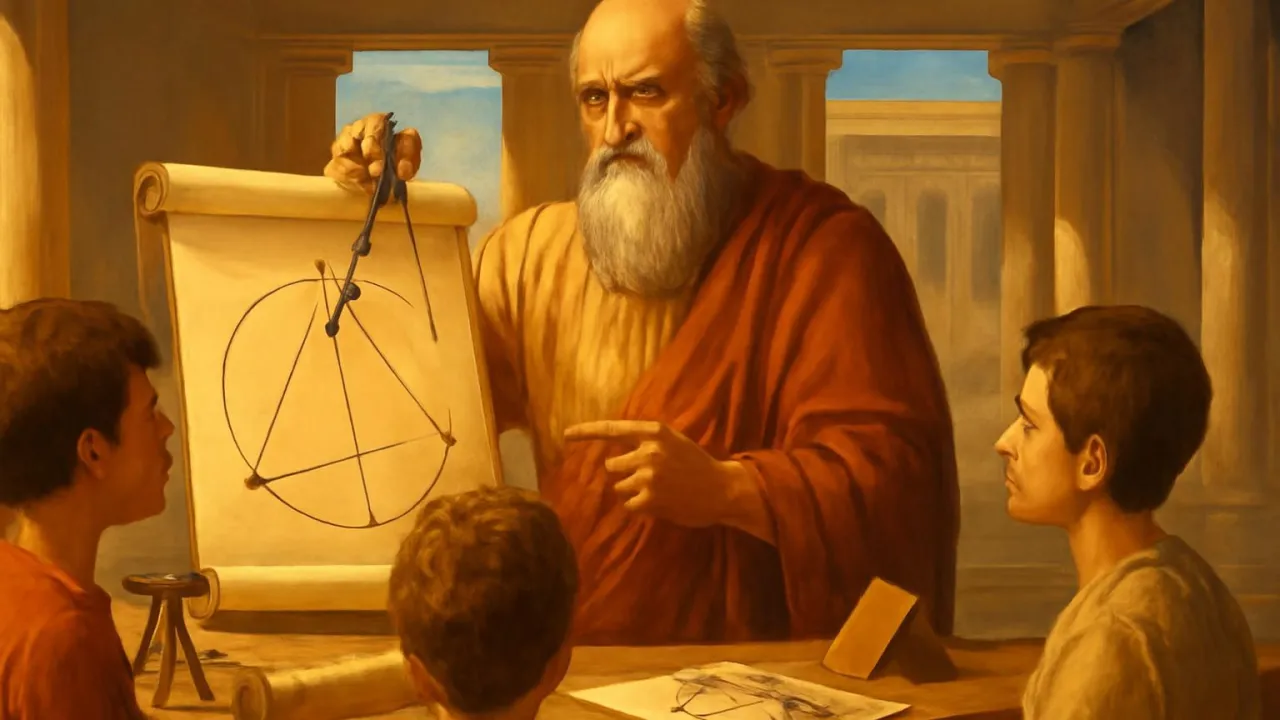
Euclid’s 'Elements' was the main math textbook for over 2,000 years!
✨ Word Sparks (Grade 2 Glossary)
Tap 🔊 to hear
compass
A tool to draw circles
proof
A way to show something is true
rules
Steps that tell how things work
🪝
How did one man’s math rules last for centuries?
1
The Shape Detective
Euclid loved to explore shapes and lines as a child. He wondered why triangles and squares were different. He used a ruler and to make perfect shapes. He asked questions about what makes shapes work.
2
Writing the Rules
Euclid wrote a giant book called 'Elements' with math inside. He explained how to build shapes and solve puzzles step by step. His book was used in schools for hundreds of years. People still learn from his clear ideas.
3
Teaching in Alexandria
Euclid taught students in the city of Alexandria, Egypt. He showed them how to use math tools and think carefully. His lessons made math fun and exciting for everyone. Euclid’s ideas are still important in math classrooms today.
Euclid’s 'Elements' was used in schools longer than any other math book ever!
✨ Word Sparks (Grade 3 Glossary)
Tap 🔊 to hear
geometry
Math about shapes and space
proof
A way to show math is true
logic
Thinking step by step
🪝
Can you imagine solving shape puzzles from thousands of years ago?
1
Curious About Shapes
Euclid was fascinated by the way shapes fit together and form patterns. He spent hours drawing triangles, circles, and squares with his ruler and compass. He always asked, 'How can I prove this shape is special?' His curiosity made him a master of .
2
The Book of 'Elements'
Euclid wrote a famous book called 'Elements,' filled with rules and . He organized math ideas so anyone could follow them step by step. His book taught people how to use to solve math puzzles. For centuries, students learned geometry from Euclid’s clear writing.
3
Teaching in Ancient Egypt
Euclid taught in Alexandria, a city known for its great library and learning. He showed students how to use tools like rulers and compasses to explore shapes. His lessons made math both challenging and fun for his students. Many future mathematicians learned from his careful methods.
4
A Lasting Legacy
Euclid’s ideas shaped math for over two thousand years. His logical way of thinking helped people build bridges, design buildings, and understand the world. Today, we still use his rules in classrooms everywhere. Euclid’s work proves that math can last forever.
2. What city was famous for learning in Euclid’s time?
🤯 Mind-Blowing Fact • Grade 4
Euclid’s 'Elements' was second only to the Bible in number of editions printed before 1900!
✨ Word Sparks (Grade 4 Glossary)
Tap 🔊 to hear
proof
A step-by-step math explanation
theorem
A math rule that is proven
Alexandria
A famous ancient city in Egypt
🪝
What if you could invent rules that shape how the world learns math?
1
A Young Mind Full of Questions
Long ago in ancient Greece, Euclid became fascinated with the mysteries of shapes and lines. He spent his youth carefully drawing triangles and circles, always asking why certain patterns appeared. Using only a ruler and compass, he explored the secrets of geometry. His endless curiosity set him on the path to become a legendary mathematician.
2
The Making of 'Elements'
After moving to , Egypt, Euclid gathered all the known ideas about geometry into one giant book. He called it 'Elements,' and it included hundreds of logical and clear explanations. Euclid organized the book so each idea built on the last, making math easier to understand. This book became the foundation for teaching math for over two thousand years.
3
Teaching and Inspiration
Euclid taught in ’s famous library, inspiring students from many lands to think logically. He encouraged them to use math tools to discover new patterns and solve tricky problems. His lessons were so well explained that even today, students follow his steps to learn geometry. Many famous thinkers, from ancient times to now, were influenced by Euclid’s careful methods.
4
A Legacy That Shaped the World
Euclid’s logical approach changed how people learned, built, and even thought about the world around them. His geometry rules helped architects design temples and scientists explore nature’s patterns. The book 'Elements' was translated into many languages and used in schools for centuries. Euclid’s work is still the starting point for anyone studying geometry today.
Euclid’s 'Elements' has been printed in over 1,000 editions and translated into many languages since ancient times!
✨ Word Sparks (Grade 5 Glossary)
Tap 🔊 to hear
postulate
A math idea you accept as true
theorem
A math rule that is proven
proof
A step-by-step way to show something is true
🪝
Imagine creating a set of rules so powerful that students still use them after two thousand years—how did Euclid do it?
1
A Curious Child in Ancient Greece
Picture a young boy in ancient Greece, tracing lines in the sand and wondering why shapes fit together the way they do. Euclid’s curiosity about triangles, circles, and squares grew into a lifelong fascination with geometry. Using only simple tools like a ruler and compass, he experimented with patterns and asked deep questions about how the world works. His early passion for problem-solving set the stage for one of history’s greatest mathematical journeys. Euclid believed that every shape had secrets waiting to be uncovered through careful observation and logical thinking.
2
Building the Foundations of Geometry
As an adult, Euclid traveled to Alexandria, Egypt, a center for learning and discovery in the ancient world. There, he gathered all the known knowledge about geometry and organized it into a single, remarkable book called 'Elements.' This book contained thirteen volumes, each filled with definitions, , and logical that built upon each other. Euclid’s method was revolutionary because he started with simple ideas and used them to prove more complex step by step. His careful structure made geometry understandable for students and scholars alike, setting a new standard for how math could be taught.
3
Teaching and Influence Across Centuries
Euclid became a respected teacher at Alexandria’s famous library, where he inspired students from many cultures to think logically and ask questions. He encouraged his pupils to use tools like rulers and compasses to explore geometry hands-on, making abstract ideas come alive. His clear explanations and logical approach influenced not only mathematicians but also scientists, engineers, and philosophers for generations. Even great thinkers like Isaac Newton and Albert Einstein studied Euclid’s work as the basis for their own discoveries. Euclid’s approach to teaching helped shape the way people learn and use math all over the world.
4
The Enduring Legacy of 'Elements'
Euclid’s 'Elements' became the most widely used math textbook in history, second only to the Bible in the number of editions printed before 1900. For over two thousand years, it was the standard text for teaching geometry in schools and universities across Europe, the Middle East, and beyond. The book’s logical structure and clear helped architects design buildings, navigators map the seas, and scientists unlock the secrets of nature. Today, the basic ideas from 'Elements' still form the foundation of geometry classes everywhere, proving the lasting power of Euclid’s vision.
5
Why Euclid Still Matters Today
Euclid’s legacy is not just about shapes and numbers—it’s about the power of logical thinking and careful reasoning. By showing how to build complex ideas from simple truths, he taught the world a method for solving problems that goes far beyond math. His work reminds us that curiosity, patience, and clear thinking can help us understand even the greatest mysteries. Whether you’re designing a bridge, coding a computer, or just solving a tricky puzzle, you’re using the tools Euclid helped invent. That’s why he’s still called the 'father of geometry'—and why his lessons continue to inspire new generations of thinkers.