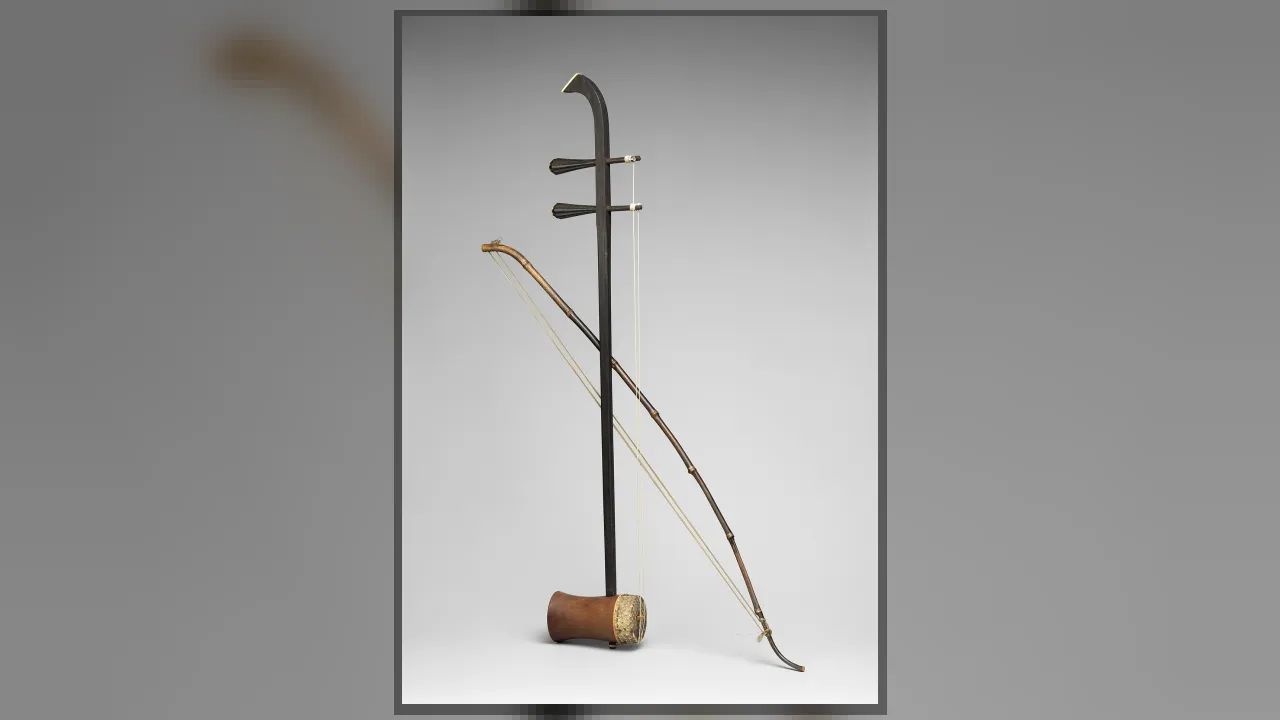
1. Where is the horsehair bow placed on a Chinese erhu?
2. How many strings does an erhu have in total?
🤯 Mind-Blowing Fact • Grade 2
A tiny piece of felt or sponge tucked under the strings below the bridge filters out squeaks so the erhu sounds silky smooth!
✨ Word Sparks (Grade 2 Glossary)
Tap 🔊 to hear
hexagonal
Shaped with six straight sides and six corners.
horsehair
Tail hair stretched on bows to grip strings.
fiddle
A stringed instrument played by rubbing a bow.
🪝
How do you play violin-like melodies when there is no wooden fingerboard behind the strings?
1
Songs That Laugh and Cry
Wail—chirp—gallop! Close your eyes and you might swear a human voice is singing beside a racing horse! Across China, musicians stand a slender wooden pole upright on their left thigh to play the two-stringed erhu.
2
Pushing Out and Pulling In
Because the bamboo bow's threads permanently between the two steel strings, it never leaves the instrument. Pushing the hair outward bows the outer string, and curling fingers inward pulls the hair against the inner string!
3
Touching Strings in Open Air
Unlike a violin, an erhu has no fingerboard for pressing strings down against wood. Instead, fingertips touch the floating strings in mid-air while vibrations travel into a small drum covered in tight skin.
1. How does an erhu player switch from bowing one string to bowing the other?
2. What is missing behind an erhu's strings compared to a Western violin?
🤯 Mind-Blowing Fact • Grade 3
In the 1950s, blind street musician Abing recorded 'Moon Reflected on Second Spring'—a masterpiece so moving it is treasured around the world!
✨ Word Sparks (Grade 3 Glossary)
Tap 🔊 to hear
huqin
The family of traditional Chinese bowed spike fiddles.
qianjin
A tied cord loop acting as the erhu's nut.
lattice
Carved crisscross wooden strips covering an open soundhole.
🪝
How did a grassland horseback fiddle become the soulful singing voice of Chinese orchestras?
1
Hoofbeats Across the Steppe
Whinny—gallop—sigh! In the famous showpiece 'Horse Racing,' rapid bow strokes drum like thunderous hooves before soaring into a realistic neigh! More than a thousand years ago during China's Tang and Song dynasties, bowed spike fiddles called traveled along northern grasslands into Chinese music.
2
Hexagonal Soundbox and Lattice Back
Standing about thirty-one inches tall, a rosewood or ebony spike neck pierces a small six-sided or eight-sided wooden cylinder. Tightly stretched python skin—or modern eco-friendly synthetic membrane—covers the front like a drumhead, while a carved wooden graces the open back.
3
Strings Tuned a Fifth Apart
Two steel strings pass through a movable thread loop called the —meaning 'thousand-pound hook'—that sets the active string length. Tuned a perfect fifth apart to D and A, just like the middle two strings of a violin, they span over three octaves!
4
Mid-Air Vibrato
With no fingerboard beneath the strings, rolling or pressing a fingertip ever so slightly changes string tension right away. That sensitivity lets masters produce weeping slides, chirping birdsong, and human-like vibrato.
1. What job does the tied cord loop called the 'qianjin' perform on an erhu?
2. To which two notes are a standard erhu's strings tuned?
🤯 Mind-Blowing Fact • Grade 4
Modern acousticians in Hong Kong and Beijing developed eco-friendly synthetic membranes that copy python skin's exact stiffness while staying perfectly in tune during humid summer concerts!
✨ Word Sparks (Grade 4 Glossary)
Tap 🔊 to hear
timbre
The unique tone color of a musical voice.
damper
Soft felt pad that tames harsh high squeaks.
oscillate
To swing steadily back and forth in waves.
🪝
Why does removing the fingerboard and using a tiny drumhead give the erhu such startlingly vocal emotion?
1
Moonlight Reflected in Two Strings
What would happen if you stripped a violin down to a slender wooden rod, a teacup-sized drum, and two suspended wires—yet gained a voice that sounds uncannily human? When the opening sigh of 'Erquan Yingyue' floats across a darkened hall, listeners lean forward in hush. That haunting belongs to the erhu, the leading soprano bowed voice of traditional Chinese ensembles.
2
Acoustic Chain: Bridge, Damper, and Membrane
Every vibration follows a finely tuned path. Rosined bamboo-bow horsehair—permanently threaded between the inner D4 and outer A4 strings—sets a string oscillating in stick-slip cycles. Those vibrations pass through a dime-sized wooden bridge resting at the center of a taut python-skin or synthetic membrane, while a small felt pad tucked just below the bridge absorbs harsh metallic overtones.
3
Regional Shapes and Open-Back Projection
Look closely at the resonator and you can spot regional traditions: southern makers in Suzhou and Shanghai favor six-sided hexagonal barrels, whereas northern Beijing builders craft eight-sided octagonal bodies. Out back, a carved wooden lattice called the sound window regulates air pressure inside the short chamber, focusing sound forward like an acoustic lens.
4
Fretless, Fingerboard-Free Micro-Control
Because a cord nut (qianjin) holds the strings suspended several millimetres away from the rosewood shaft, left-hand fingertips never press strings down onto solid wood. Instead, rolling a finger pad alters string length while pressing inward increases tension—allowing musicians to blend rolling violin vibrato with subtle tension vibrato in the very same breath.
1. Why is a small felt pad wedged between the strings and the membrane right below the erhu's bridge?
2. How can you tell a southern Suzhou erhu apart from a northern Beijing erhu at a glance?
🤯 Mind-Blowing Fact • Grade 5
An erhu's wooden bridge weighs less than a penny—about two grams—and swapping a dense ebony bridge for light pine or bamboo noticeably darkens or brightens the entire instrument's voice!
✨ Word Sparks (Grade 5 Glossary)
Tap 🔊 to hear
attenuate
To reduce or soften unwanted sound frequencies.
lutherie
The craft of building stringed musical instruments.
etude
A musical study piece designed to build skill.
🪝
How do Helmholtz stick-slip bowing, coupled membrane acoustics, and dual-mode vibrato make two suspended steel wires sound like a human soprano?
1
Two Strings Spanning Three and a Half Octaves
Hovering on a musician's left thigh with zero chinrest, zero frets, and zero fingerboard, the Chinese erhu defies almost every structural assumption of European string . Yet from just two steel strings tuned to D4 (293.7 hertz) and A4 (440 hertz), concert virtuosos command up to three and a half octaves—leaping from dark alto sighs to stratospheric harmonics above D7.
2
Tang-Dynasty Roots and Liu Tianhua's Conservatory Reform
Classified under Hornbostel-Sachs 321.311 as a two-stringed spike tubular fiddle, the erhu descends from the xiqin, a friction-bowed lute played by nomadic Xi tribes along China's northern frontiers over a millennium ago. Long confined to folk opera accompaniment and street ballads, the instrument entered conservatory solo prestige in the 1920s when composer-educator Liu Tianhua standardized tuning, adapted multi-position violin shifting, and composed ten foundational concert études.
3
Helmholtz Motion Through a Coupled Skin Resonator
Threading an eighty-centimetre flexible bamboo bow permanently between the inner and outer strings transforms right-hand mechanics: outward wrist pronation bows the A string while ring-and-middle finger traction pulls horsehair inward against the D string. Stick-slip Helmholtz motion drives a tiny maple or rosewood bridge—weighing barely two grams—perched dead center on a taut thirteen-centimetre membrane. Below the bridge, an acoustical sponge or wool felt filter wolf tones and abrasive upper partials above four kilohertz.
4
Dual Vibrato Physics Without a Fingerboard
Suspended freely beneath a tied silk qianjin nut along an eighty-one-centimetre red sandalwood (zitan) or ebony shaft, erhu strings respond simultaneously to length and tension modulation. Performers interleave gunrou (rolling fingertip oscillation that shifts nodal length) with yarou (radial inward pressure that stretches tension sharp), mirroring the pitch-and-formant glides of Mandarin tonal speech and operatic singing.
5
Modern Orchestral Huqin Families and Eco-Innovation
In contemporary Chinese national orchestras, the erhu leads a full bowed choir—paired with the higher-pitched gaohu, mellow alto zhonghu, and cello-sized gehu—functioning much like orchestral first and second violins while adopting sustainable engineered polymer membranes for global touring.