You shed about thirty thousand to forty thousand microscopic dead skin cells every single minute without even noticing!
✨ Word Sparks (Grade 2 Glossary)
Tap 🔊 to hear
flexible
able to bend and stretch without cracking
armor
a tough outer layer that prevents harm
surface
the outside top part of something
🪝
Why is the skin on your heels tough while the skin on your eyelids is paper-thin?
1
Stacked Like Tiny Bricks
Tap your knuckles gently on a wooden desk! Your outer skin layer, the epidermis, protects your hands like . Millions of flat skin cells stack together like tidy bricks with waterproof glue between them.
2
Thin Here, Thick There
On your blinking eyelids, the epidermis is thinner than a sheet of notebook paper. On the soles of your feet, it grows much thicker so you can run and jump comfortably.
3
Zero Blood Vessels Here
Surprisingly, your epidermis has no blood vessels at all! That is why a tiny scratch on your top skin does not even bleed.
2. Why does a tiny scratch on just the epidermis not bleed?
🤯 Mind-Blowing Fact • Grade 3
A huge portion of ordinary indoor dust sitting on bookshelves is actually made of microscopic epidermis flakes shed by people and pets!
✨ Word Sparks (Grade 3 Glossary)
Tap 🔊 to hear
keratinocyte
main epidermis cell that makes tough keratin
stratum corneum
tough waterproof top layer of flat cells
evaporate
turn from liquid water into invisible vapor
🪝
How do living skin cells at the bottom of your epidermis turn into tough armor at the top?
1
An Upward Escalator of Cells
Rub your palms together quickly and feel the warm friction! Every rub brushes away microscopic surface flakes while new ones take their place. Your epidermis works like a slow upward escalator that takes about four weeks from bottom to top.
2
Filling Up With Keratin
Down at the deepest row, plump stem cells divide nonstop to make new . As older cells get pushed upward, they pack themselves full of keratin—the same tough, fibrous protein found in fingernails and rhino horns.
3
The Tough Stratum Corneum
By the time reach the top surface, they have flattened into overlapping waterproof scales coated with natural oils. Scientists call this top shield the , and it keeps bacteria out while stopping body moisture from evaporating.
4
Built-In Helper Cells
Tucked among the live color-making melanocytes that block harsh ultraviolet sun rays and watchful Langerhans immune cells that alert your body if germs sneak in.
1. What tough protein fills epidermis cells as they rise toward the surface?
2. What job do watchful Langerhans cells perform inside your epidermis?
🤯 Mind-Blowing Fact • Grade 4
Why do fingertips wrinkle in a long bath? It is not simply water soaking into your epidermis—nerves actively narrow tiny blood vessels underneath to give wet fingers better grip like rain-tire treads!
✨ Word Sparks (Grade 4 Glossary)
Tap 🔊 to hear
avascular
containing no blood vessels inside the tissue
diffusion
natural spreading of nutrients from rich to needy areas
lipid
natural fat or oil that repels water
🪝
How can your epidermis stay alive and keep growing when it contains zero blood vessels?
1
Fed From Below by Diffusion
Trace the lines across your palm—you are touching a living fortress thinner than a dime! Unlike most organs, the epidermis is completely , meaning not a single blood capillary runs through it. Instead, oxygen and nutrients seep upward by from rich blood vessels in the underlying dermis, nourishing the deepest dividing cells.
2
Four—Sometimes Five—Distinct Strata
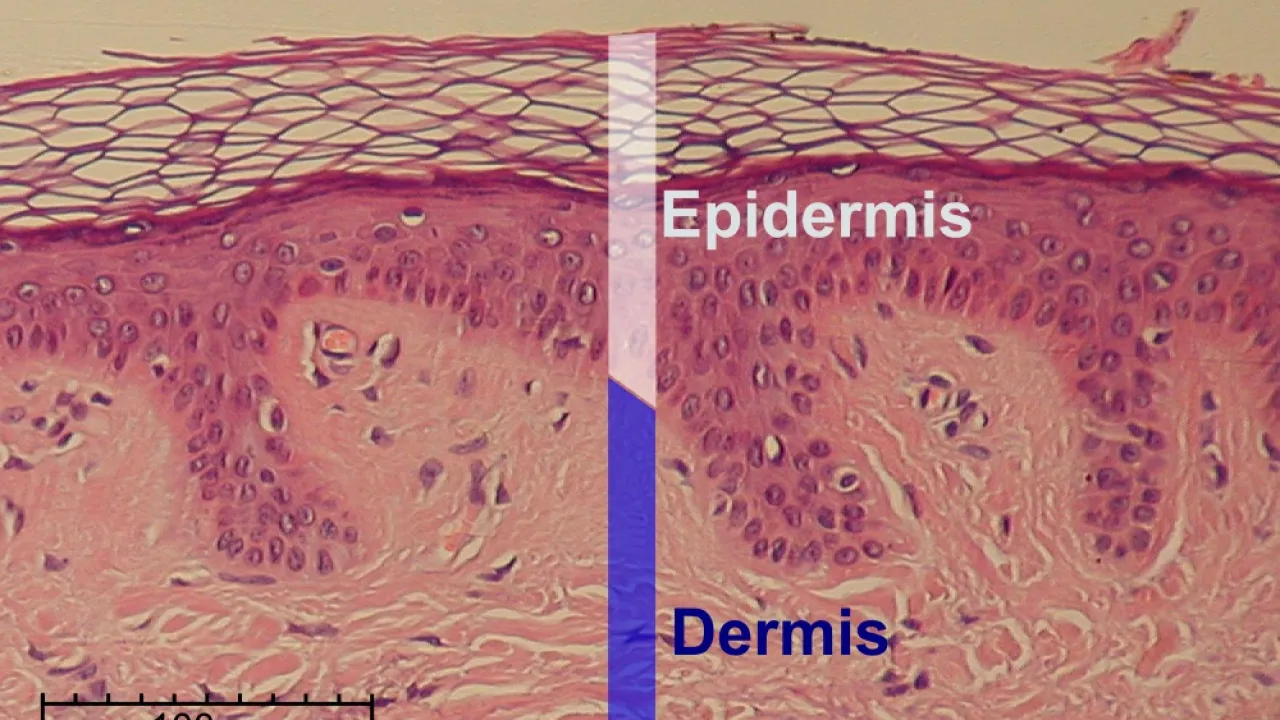
Under a microscope, the epidermis reveals neat horizontal layers called strata. At the bottom sits the stratum basale, a single row of rapidly dividing stem cells anchored to a wavy basement membrane. Above it lie the prickly stratum spinosum and grainy stratum granulosum, where cells weave keratin bundles and release waxy cement into the spaces around them.
3
Brick-and-Mortar Waterproofing
As rising cells move farther from dermal nutrients, they dismantle their nuclei and transform into flat, tough corneocytes in the outer stratum corneum. Dermatologists compare this top barrier to a brick-and-mortar wall: keratin-packed corneocytes form the bricks, while waterproof form the mortar that prevents dehydration.
4
Bonus Armor on Palms and Soles
Most of your body wears four epidermal strata, measuring just 0.05 millimeters on eyelids. High-friction zones like palms and heels add an extra translucent fifth layer—the stratum lucidum—boosting thickness up to 1.5 millimeters.
1. How do bottom cells in the bloodless epidermis get oxygen and food?
2. In the 'brick-and-mortar' model of the top epidermis, what acts as the waterproof mortar?
🤯 Mind-Blowing Fact • Grade 5
Over an average human lifetime, your self-renewing epidermis manufactures and sheds roughly 40 to 80 pounds (18 to 36 kilograms) of outer skin cells!
✨ Word Sparks (Grade 5 Glossary)
Tap 🔊 to hear
desmosomes
protein rivets locking neighboring skin cells tightly together
corneocytes
tough flattened dead cells forming outermost skin shield
acid mantle
mildly acidic surface film discouraging harmful microbes
🪝
How does a paper-thin sheet of dead surface cells keep trillions of microbes out and liters of body water in?
1
Stratified Squamous Engineering
Stretch your fingers wide and watch your skin flex effortlessly over every knuckle without tearing or leaking a single drop of fluid. This outer boundary—the epidermis—is a stratified squamous epithelium ranging from 0.05 millimeters over the eyelids to 1.5 millimeters across weight-bearing soles. Though thinner than a postcard across most of your body, it forms humanity's primary defense against dehydration, ultraviolet radiation, and microbial invasion.
2
A Twenty-Eight-Day Journey of Keratinization
Roughly ninety-five percent of epidermal cells are keratinocytes born via mitosis in the deepest layer, the stratum basale. Pushed upward into the stratum spinosum, neighboring cells lock together with molecular rivets called that resist shearing forces. Higher in the stratum granulosum, cells manufacture filaggrin proteins to bundle keratin filaments tightly while secreting lamellar bodies packed with ceramides, cholesterol, and fatty acids.
3
The Acid Mantle and Stratum Corneum
Upon entering the outermost stratum corneum—fifteen to thirty layers of flattened, anucleate —cells lock into a lipid-sealed barrier topped by a slightly acidic film (pH 4.5 to 5.5) called the . Friendly skin bacteria thrive in this mild acidity while harmful pathogens struggle to multiply, and controlled enzyme activity sheds roughly forty thousand worn corneocytes every minute.
4
Four Specialized Cell Teams
Sharing space with keratinocytes are three crucial partners: basal melanocytes that distribute UV-absorbing melanin umbrellas, star-shaped Langerhans cells (discovered by medical student Paul Langerhans in 1868) that capture foreign antigens for the immune system, and basal Merkel cells wired to nerve endings for fine light-touch sensation.
5
Solar Vitamin Synthesis
Beyond defense, epidermal keratinocytes act as solar-powered factories: when ultraviolet-B rays strike 7-dehydrocholesterol molecules inside lower epidermal layers, they spark vitamin D3 production essential for building strong calcium-rich bones.