🇺🇸 U.S. HISTORY
🏛️ Presidential Wartime Proclamation • January 1, 1863
VA History & Social Science SOL K.1, 1.2, 2.4, VS.1–VS.10, USI & USII
Emancipation Proclamation
New Year's Day Ink That Proclaimed Freedom
Grade 5 • Advanced • 350 words
⏳ Era / StatehoodIssued: January 1, 1863 (Preliminary: September 22, 1862)
🗺️ Region / CapitalSigned at the White House, Washington, D.C. (Celebrated Under Virginia's Emancipation Oak)
📜 Key MilestoneDeclared Enslaved People in Confederate Territory Forever Free & Opened Union Enlistment
⚡ Historical SparkTurned the Civil War into a decisive fight for human liberty
🤯 Mind-Blowing Fact • Grade 1
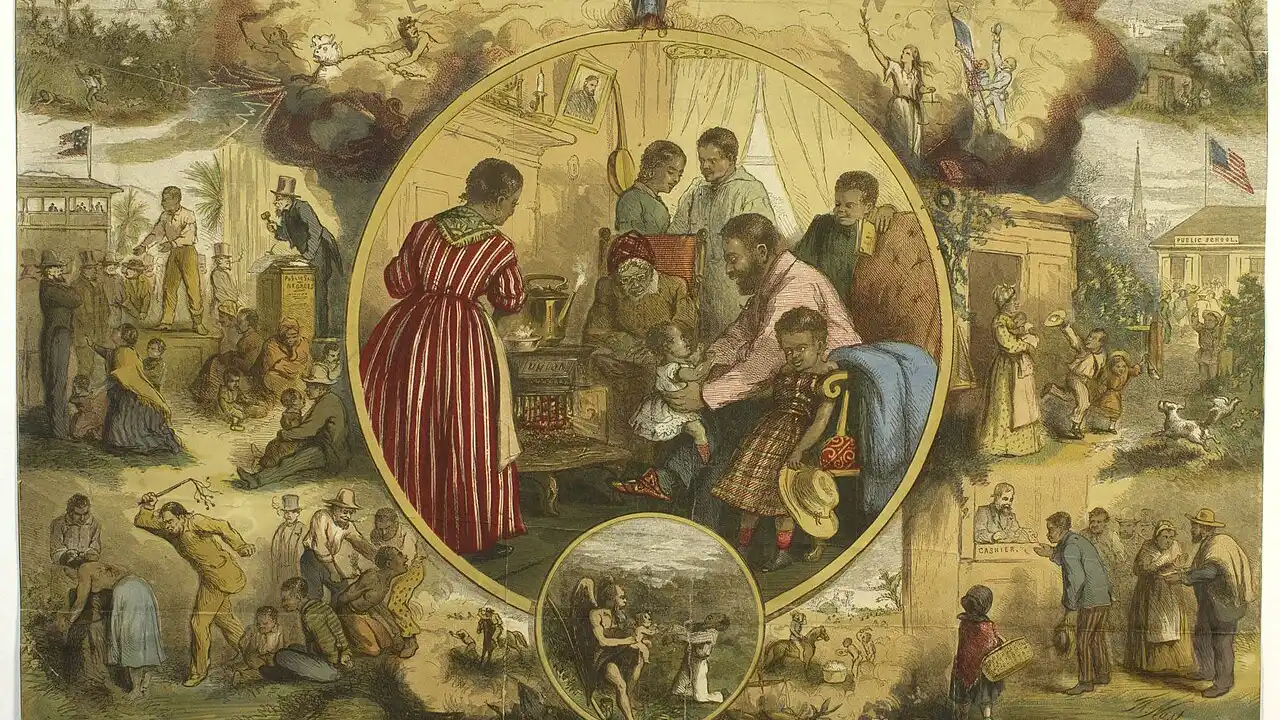
In Hampton, Virginia, families gathered beneath a giant spreading tree still standing today—called the Emancipation Oak—to hear the Emancipation Proclamation read aloud in 1863!
✨ Word Sparks (Grade 1 Glossary)
Tap 🔊 to hear
emancipation
Setting people free from unfair bondage
proclamation
Official public announcement made by a leader
Union
The United States government during the Civil War
🪝
How did one signature on New Year's Day bring joy across America?
1
Bells Ring at Midnight
Ding-dong ring church bells on New Year's Day, 1863! Families sing and cheer with happy tears. A big promise has arrived!
2
Lincoln Signs With a Steady Hand
During the Civil War, President Abraham Lincoln signed the . It declared that enslaved people in rebelling states were now free!
3
Brave New Soldiers
The order also welcomed Black men to join the Army and Navy to help win freedom for all.
1. On what holiday date did President Abraham Lincoln sign the final Emancipation Proclamation?
2. Under what famous Virginia tree did families gather in 1863 to hear the Proclamation read aloud?
🤯 Mind-Blowing Fact • Grade 2
Abolitionist leader Frederick Douglass waited excitedly beside a telegraph office in Boston on January 1, 1863, leading joyful cheers the moment word flashed across the wires that Lincoln had signed!
✨ Word Sparks (Grade 2 Glossary)
Tap 🔊 to hear
abolitionist
Person who worked to end slavery completely
liberation
The joyful act of gaining freedom
enlist
To join the military to serve your country
🪝
Why did Abraham Lincoln pause to rest his sore right hand right before signing the most important paper of his life?
1
Three Hours of Handshakes
Imagine shaking hands with hundreds of New Year's Day visitors at the White House on January 1, 1863! When President Abraham Lincoln walked upstairs to sign the Emancipation Proclamation, his fingers trembled from tiredness, so he paused until his hand steadied—saying his whole soul was in it.
2
A Turning Point in the Civil War
At first, the Civil War focused on keeping the United States together. With the Emancipation Proclamation, Lincoln declared enslaved people in Confederate-held areas 'forever free,' making every Union advance a march of .
3
Two Hundred Thousand Heroes
Newly opened military ranks allowed nearly 200,000 Black soldiers and sailors to serve bravely in the Union Army and Navy!
1. Why did President Lincoln pause for a moment before signing his full name on the Emancipation Proclamation?
2. About how many African American soldiers and sailors served in the Union military by the end of the Civil War?
🤯 Mind-Blowing Fact • Grade 3
Unlike usual brief notes signed simply 'A. Lincoln,' the President wrote out his full name—'Abraham Lincoln'—on the official Emancipation Proclamation!
✨ Word Sparks (Grade 3 Glossary)
Tap 🔊 to hear
preliminary
Coming first to prepare for a final action
Commander-in-Chief
Constitutional role of the President leading armed forces
Juneteenth
June 19, 1865 celebration when Texas heard freedom news
🪝
Why did Abraham Lincoln wait for a key Union battlefield stand in Maryland before announcing the Emancipation Proclamation?
1
Waiting for Victory at Antietam
By July 1862, President Abraham Lincoln had already written a draft of the Emancipation Proclamation, yet Secretary of State William H. Seward advised waiting for a Union victory so the announcement would look strong rather than desperate. That moment arrived in September 1862 after Union forces halted Confederate General Robert E. Lee at Antietam Creek in Maryland.
2
Watch Night to New Year's Day
On September 22, 1862, Lincoln issued a 100-day warning. On December 31—remembered as 'Watch Night'—enslaved and free African Americans gathered in churches from Boston to Fort Monroe, Virginia, praying for midnight and January 1, 1863.
3
Wartime Power of the Commander-in-Chief
Acting under his constitutional authority as during rebellion, Lincoln declared enslaved people in rebellious states forever free and invited Black men into U.S. armed service, including the famous 54th Massachusetts Regiment.
4
Leading Toward the Thirteenth Amendment
Because a wartime order applied only to rebellious areas—and freedom arrived later in places like Galveston, Texas, on 1865—Lincoln pushed for the Thirteenth Amendment to end slavery everywhere permanently.
1. Which September 1862 battle gave President Lincoln the Union stand he needed to announce the preliminary Emancipation Proclamation?
2. Why did Lincoln still work to pass the Thirteenth Amendment after signing the Emancipation Proclamation?
🤯 Mind-Blowing Fact • Grade 4
Sergeant William H. Carney of the 54th Massachusetts Infantry—born in Norfolk, Virginia—became the first African American recipient of the Medal of Honor for protecting the U.S. flag at Fort Wagner in July 1863!
✨ Word Sparks (Grade 4 Glossary)
Tap 🔊 to hear
border states
Slaveholding states that stayed loyal to the Union
war powers
Emergency military authority given to the Commander-in-Chief
self-emancipating
Taking bold personal action to claim one's freedom
🪝
How did brave self-emancipating families at Virginia's 'Freedom's Fortress' help pave the way for Lincoln's Emancipation Proclamation?
1
Fort Monroe Lights the Spark in Virginia
Before Abraham Lincoln ever dipped his pen on January 1, 1863, enslaved Virginians began claiming freedom with their own feet. In May 1861, Frank Baker, Shepard Mallory, and James Townsend rowed across Hampton Roads to Union-held Fort Monroe in Hampton, Virginia. When General Benjamin Butler refused to return them, thousands of families flocked to 'Freedom's Fortress,' showing Congress and the President that ending slavery weakened the rebellion and strengthened the Union.
2
Constitutional Strategy After Antietam
Although Lincoln personally despised slavery as a moral wrong, the peacetime Constitution gave presidents no authority to overturn state laws in loyal like Maryland, Kentucky, Delaware, and Missouri. As Commander-in-Chief during armed rebellion, however, Lincoln held constitutional . Five days after Union forces checked Lee at Antietam on September 17, 1862, Lincoln issued his Preliminary Proclamation.
3
Transforming Purpose at Home and Abroad
Signed on January 1, 1863, the final Emancipation Proclamation declared over 3.5 million enslaved people in Confederate territory 'thenceforward, and forever free.' Overnight, Great Britain and France—whose citizens opposed slavery—abandoned any thought of recognizing the Confederacy. Simultaneously, nearly 180,000 Black soldiers in the United States Colored Troops and 20,000 Black sailors surged into Union ranks.
4
From Emancipation Oak to Juneteenth
From Virginia's historic Emancipation Oak in 1863 to General Gordon Granger's General Order No. 3 in Galveston, Texas, on June 19, 1865 (Juneteenth), Union troops carried liberation forward until the Thirteenth Amendment sealed universal freedom.
1. Which historic fort in Hampton, Virginia, earned the nickname 'Freedom's Fortress' starting in May 1861?
2. How did the Emancipation Proclamation affect European countries like Great Britain and France?
🤯 Mind-Blowing Fact • Grade 5
Abraham Lincoln donated his own original handwritten draft of the final Emancipation Proclamation to raise funds for wounded soldiers in Chicago in 1863; although the Great Chicago Fire of 1871 destroyed that draft, the official signed State Department parchment survives safely in the National Archives!
✨ Word Sparks (Grade 5 Glossary)
Tap 🔊 to hear
ultimatum
Final warning with a deadline before action follows
invalidation
Being struck down by a court as unlawful
precluding
Making an unwanted outcome impossible ahead of time
🪝
Why did a carefully tailored military proclamation written in legal prose become one of the most revolutionary human-rights documents in modern history?
1
Self-Emancipation and Congressional Groundwork (1861–1862)
From the opening months of the Civil War in May 1861—when Frank Baker, Shepard Mallory, and James Townsend sought sanctuary inside Union-held Fort Monroe in Hampton, Virginia—enslaved African Americans forced emancipation onto the national agenda. Congress responded by passing the First and Second Confiscation Acts, abolishing slavery in Washington, D.C., and the western territories in spring 1862, and forbidding Union officers from returning fugitives. Meanwhile, abolitionists led by Frederick Douglass urged President Abraham Lincoln to pair Union preservation with universal liberation.
2
Constitutional Calibration and the Antietam Pivot
Bound by oath to the Constitution, Lincoln recognized that peacetime executive orders could not abolish slavery inside loyal border states—Delaware, Maryland, Kentucky, and Missouri—without risking judicial or driving critical border states into secession. Framing emancipation strictly as 'a fit and necessary war measure for suppressing said rebellion' under Article II Commander-in-Chief authority, Lincoln read his initial draft to the Cabinet on July 22, 1862, accepted Secretary of State William H. Seward's counsel to await military success, and issued the Preliminary Proclamation on September 22—five days after George McClellan halted Robert E. Lee at Antietam.
3
January 1, 1863: Signing 'An Act of Justice'
After rebellious states ignored the hundred-day , 'Watch Night' vigils filled African American churches nationwide on December 31, 1862. Following a three-hour New Year's Day reception, Lincoln rested his stiff right hand so no tremor would suggest hesitation, then affixed his full signature— declaring enslaved persons across ten rebellious states (exempting Union-occupied parishes and counties, including forty-eight counties soon admitted as West Virginia) 'forever free,' calling the measure 'sincerely believed to be an act of justice, warranted by the Constitution, upon military necessity.'
4
Black Military Service and Diplomatic Impact
Crucially, the Proclamation authorized recruiting African American men into federal armed forces. Nearly 179,000 Black soldiers in 175 United States Colored Troops regiments—such as the 54th Massachusetts at Fort Wagner—and roughly 19,000 Black sailors provided essential manpower Lincoln called indispensable to victory, while simultaneously British or French diplomatic intervention.
5
From Battlefield Liberation to Constitutional Permanence
Read aloud beneath Hampton, Virginia's Emancipation Oak in 1863 and enforced all the way to Galveston, Texas, on June 19, 1865 (Juneteenth), wartime emancipation still risked postwar legal challenge—motivating Lincoln to champion the Thirteenth Amendment so freedom stood etched permanently into the Constitution.