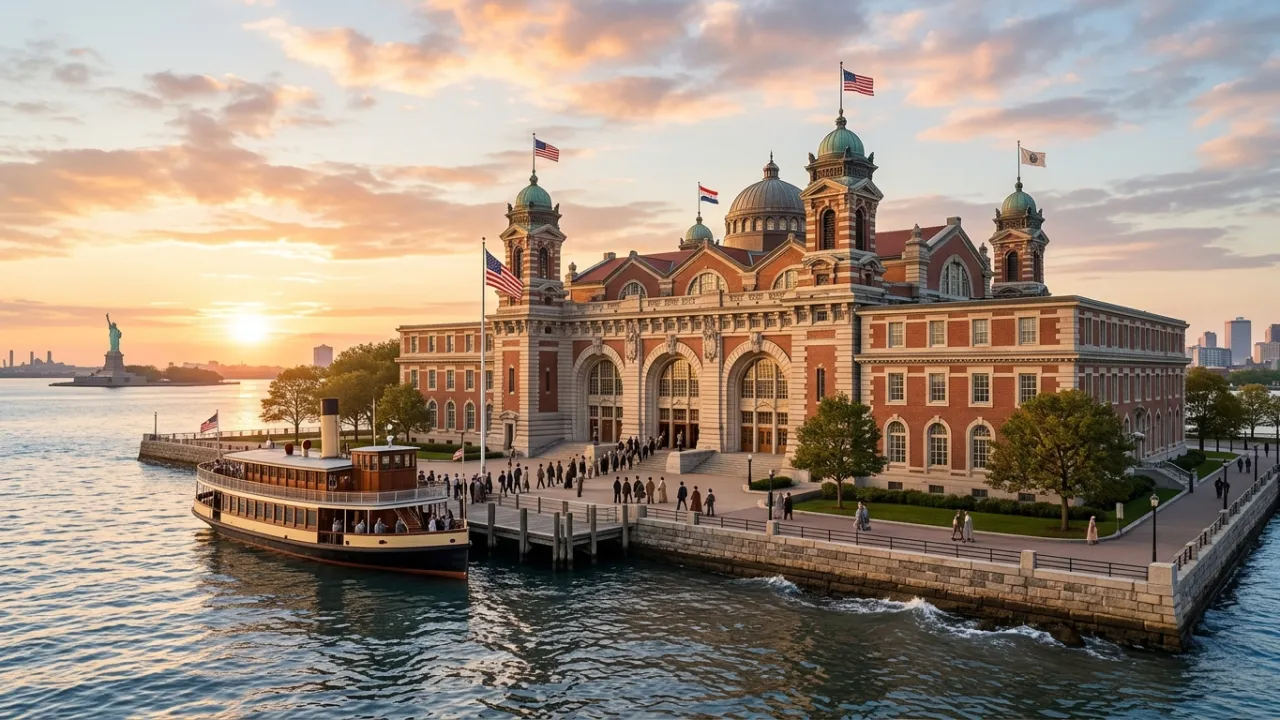
1. Which famous statue did travelers pass right before reaching Ellis Island?
2. About how many newcomers entered America through Ellis Island?
🤯 Mind-Blowing Fact • Grade 2
On Ellis Island's busiest single day in April 1907, clerks welcomed 11,747 newcomers before sunset!
✨ Word Sparks (Grade 2 Glossary)
Tap 🔊 to hear
interpreter
Helper who translates words between two languages
registry
Official place where names and records stay
steamship
Large ocean vessel powered by hot steam
🪝
How could clerks talk to travelers who spoke dozens of different languages every single day?
1
Crossing the Atlantic
Imagine standing on the windy deck of a crowded after weeks at sea. As mist clears over New York Harbor, passengers cheer at the Statue of Liberty. Moments later, ferries guide everyone toward the red brick buildings of Ellis Island.
2
Checks and Translators
Inside the huge Room, thousands of travelers waited in neat lines. Doctors checked passengers for illnesses, and friendly spoke more than thirty languages to help clerks read ship lists.
3
The Kissing Post
Most newcomers finished their checkups in just three to five hours! At a wooden column nicknamed the Kissing Post, excited relatives hugged loved ones they had not seen in years before boarding trains across America.
1. How long did most healthy newcomers spend being checked at Ellis Island?
2. Why was one spot at Ellis Island nicknamed the Kissing Post?
🤯 Mind-Blowing Fact • Grade 3
Future famous Americans—including composer Irving Berlin and legendary Notre Dame coach Knute Rockne—entered the country through Ellis Island as children!
✨ Word Sparks (Grade 3 Glossary)
Tap 🔊 to hear
manifest
Official list of passengers aboard a ship
vaulted
Built with high arched ceilings overhead
inspection
Careful check to make sure everything works
🪝
Why did the United States build a giant brick station on a tiny island in New York Bay?
1
Opening America's Busiest Doorway
Listen to the echo of footsteps and thirty different languages filling a tiled hall! On January 1, 1892, the federal government opened Ellis Island in Upper New York Bay to welcome the growing wave of immigrants arriving from Europe and beyond.
2
Rebuilding With Fireproof Brick
The first wooden station burned down in 1897, though thankfully nobody was hurt. Architects quickly designed a grand Beaux-Arts building made of red brick, limestone, and tiled arches that reopened in December 1900.
3
The Six-Second Medical Inspection
Doctors watched carefully as travelers climbed the steep stairs to the Great Hall carrying trunks and bundles. Simply seeing whether someone puffed or limped helped physicians spot heart or breathing troubles in seconds.
4
Building Communities Nationwide
After clerks verified names against ship , newcomers exchanged foreign coins for dollars and bought railroad tickets. From New York to Virginia mining towns and Midwest farms, these families enriched American communities.
1. Why did architects rebuild Ellis Island using brick, stone, and tile in 1900?
2. What record book did clerks use to verify each traveler's name and hometown?
🤯 Mind-Blowing Fact • Grade 4
Master stonemason Rafael Guastavino tiled the Registry Room ceiling so sturdily that only seventeen tiles needed replacement during the massive 1980s restoration!
✨ Word Sparks (Grade 4 Glossary)
Tap 🔊 to hear
steerage
Crowded lower ship deck with cheap tickets
contagious
Able to spread sickness from person to person
multilingual
Speaking and understanding several different languages
🪝
How did a tiny three-acre oyster bank grow into a twenty-seven-acre symbol of American heritage?
1
From Oyster Bank to Federal Gateway
Picture thousands of hopeful passengers crowding the rails of an ocean liner after spending ten stormy days in third-class ! Before 1890, individual states handled immigration, but surging arrivals convinced Congress to build a unified federal station on Ellis Island in Upper New York Bay.
2
Expanding the Island With Subway Rock
When Ellis Island opened in 1892, it covered barely three acres. As millions more families sought economic opportunity and religious freedom, engineers enlarged the island ninefold to 27.5 acres using rock and soil dug from New York City's brand-new subway tunnels!
3
Inside the Registry Room
Inside the sunlit Registry Room, Public Health Service doctors and inspectors—including future New York Mayor Fiorello La Guardia—guided up to five thousand people daily. Only about two percent of arrivals were denied entry because of illnesses or legal rules, while sick travelers received free care in the island's hospital ward.
4
Tracing Family Roots Today
New laws in the 1920s shifted visa checks to overseas embassies, and Ellis Island closed in 1954. Restored as part of Statue of Liberty National Monument in 1990, the museum lets visitors search millions of ship manifests—connecting nearly forty percent of living Americans to an Ellis Island ancestor.
1. Where did engineers get much of the rock and soil used to expand Ellis Island to 27.5 acres?
2. Roughly what percentage of newcomers at Ellis Island were turned away?
🤯 Mind-Blowing Fact • Grade 5
In 1998, the U.S. Supreme Court settled a century-old border dispute by ruling that Ellis Island is shared between New York (the original island) and New Jersey (the surrounding landfill)!
✨ Word Sparks (Grade 5 Glossary)
Tap 🔊 to hear
industrialization
Growth of factories machines and large industries
consular
Relating to government offices in foreign countries
disembark
Leave a ship aircraft or vehicle ashore
🪝
Why did ninety-eight percent of Ellis Island arrivals call it an 'Island of Hope,' while two percent knew it as an 'Island of Tears'?
1
Industrial Growth and Global Migration
Between 1892 and 1924, rapid across the United States created an enormous demand for workers in steel mills, garment factories, railroads, and Appalachian coalfields. Drawn by democratic ideals, religious liberty, and steady wages, millions of families from Italy, Eastern Europe, Ireland, Scandinavia, and the Mediterranean boarded transatlantic steamships bound for New York Harbor.
2
Steerage Versus Cabin Class
Not every passenger stepped onto Ellis Island. Wealthier first- and second-class travelers underwent brief inspections right aboard their ships and disembarked directly onto Manhattan piers. Third-class steerage passengers—who traveled in crowded lower decks—boarded harbor barges to Ellis Island for thorough medical and legal screening.
3
Science, Compassion, and Law
Inside the cavernous Beaux-Arts Main Building, U.S. Public Health Service physicians conducted rapid visual screenings and checked eyelids for trachoma, a blinding eye infection. Inspectors then cross-referenced twenty-nine manifest questions, aided by interpreters fluent in Yiddish, Italian, Polish, Greek, and Arabic. Detained patients recovered in a twenty-two-building hospital complex on Islands 2 and 3, where over 350 babies were born.
4
Changing Laws and Supreme Court Boundaries
After Congress passed the Immigration Act of 1924 establishing national quotas and overseas visas, Ellis Island's role shrank dramatically until it closed in November 1954. Even the island's geography sparked civic debate: in 1998, the U.S. Supreme Court ruled that the original 3.3-acre island belongs to New York while the 24.2 acres of landfill belong to New Jersey!
5
An Enduring Mosaic of Citizenship
Following the largest historic restoration in American history, the Ellis Island National Museum of Immigration opened in 1990. Its American Family Immigration History Center preserves over sixty-five million arrival records, honoring the courage and resilience that shaped modern American civic life.