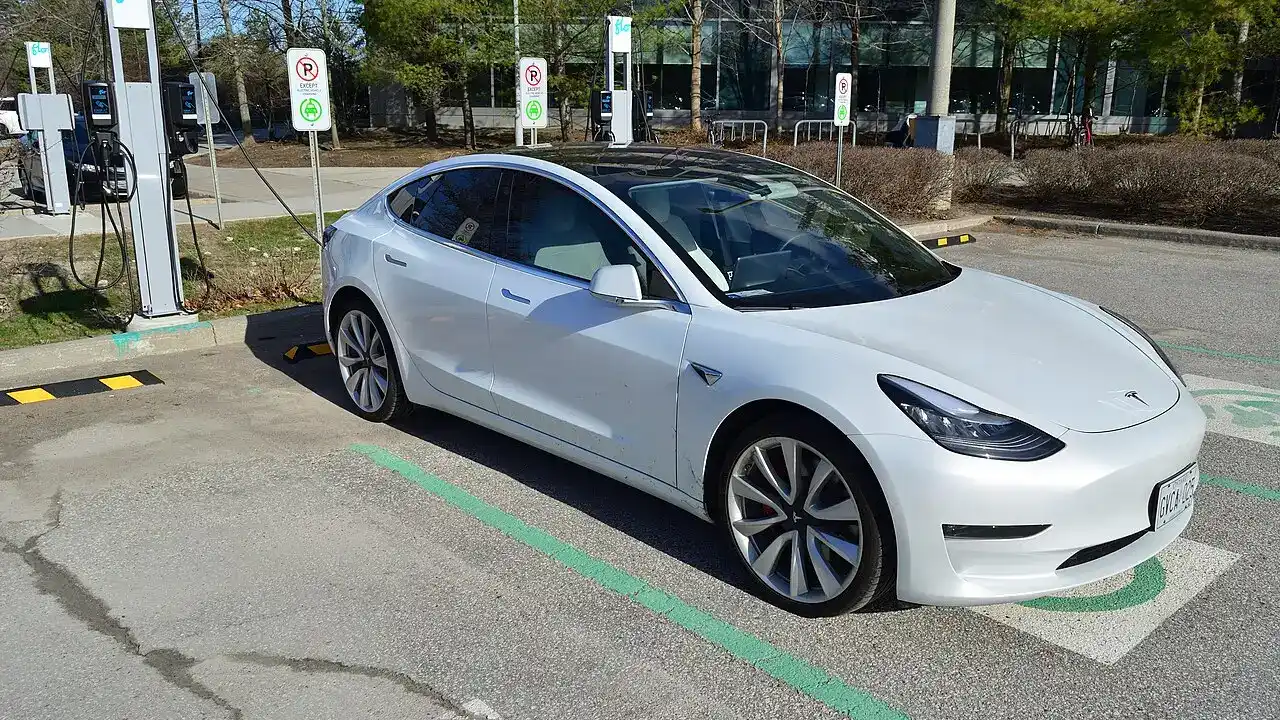
2. What comes out of the back of an all-electric car while it drives?
🤯 Mind-Blowing Fact • Grade 2
Without a bulky gasoline engine under the hood, many electric cars have an extra front trunk that drivers playfully call a 'frunk'!
✨ Word Sparks (Grade 2 Glossary)
Tap 🔊 to hear
rechargeable
Able to be filled with electricity again
generator
A machine that turns motion into electricity
fumes
Smelly smoke gases from burning fuel
🪝
Would you believe electric cars ruled city streets before gas stations even existed?
1
Surprise From the Past
Whirrr! People often think battery cars are brand new, yet inventors in Scotland, Europe, and America built electric carriages way back in the 1800s. Early drivers loved them because gas cars needed hard hand cranks and puffed noisy .
2
Why They Came Back
Cheap gasoline and longer highways made gas cars take over for many decades. Then scientists invented lightweight lithium-ion batteries that store huge amounts of energy, bringing electric cars roaring—or whispering—back!
3
Saving Energy When Stopping
Flat battery packs sit low under the car floor to power compact electric motors. Whenever the driver slows down, the motor runs in reverse like a and puts electricity right back into the battery!
1. Why did many drivers in 1900 prefer electric carriages over early gasoline cars?
2. What happens when an electric car slows down using regenerative braking?
🤯 Mind-Blowing Fact • Grade 3
NASA astronauts drove four-wheeled battery electric Moon buggies across craters on the Moon during the Apollo missions of 1971 and 1972!
✨ Word Sparks (Grade 3 Glossary)
Tap 🔊 to hear
efficiency
Doing work without wasting lots of energy
lithium
A very light metal used in batteries
emissions
Gases released into the air by engines
🪝
Why does an electric car use three times less energy than a gasoline car to drive the exact same mile?
1
The First Speed Record
On April 29, 1899, Belgian driver Camille Jenatzy climbed inside a torpedo-shaped car near Paris and became the first human to pass 62 miles per hour on land! Amazingly, his record-breaking racer ran entirely on electric batteries.
2
Heat Versus Motion
Gasoline engines burn fuel in thousands of tiny explosions, losing about seventy percent of that energy as wasted heat and noise. Electric motors use spinning magnetic fields instead, turning nearly ninety percent of battery energy directly into wheel motion!
3
Skateboard Battery Packs
Modern EVs arrange thousands of rechargeable -ion cells inside a flat protective tray beneath the passenger cabin. Placing that heavy pack down low keeps the car stable around corners while leaving roomy space inside.
4
Cleaner Air for Cities
An electronic controller called an inverter feeds smooth alternating current to the motor for instant acceleration. As solar panels and wind turbines supply more grid power, electric vehicles cut greenhouse gases even further.
1. What kind of car was the first vehicle in history to drive faster than 62 miles per hour (100 km/h) in 1899?
2. Why are electric motors so much more efficient than gasoline engines?
🤯 Mind-Blowing Fact • Grade 4
Whereas a gasoline car engine contains over two thousand moving parts like pistons, valves, and timing chains, an electric car's drive unit has only about twenty!
✨ Word Sparks (Grade 4 Glossary)
Tap 🔊 to hear
torque
Twisting force that spins wheels from rest
direct current
Electricity flowing steadily in one single direction
bidirectional
Able to flow smoothly in both directions
🪝
How did a nineteenth-century invention lose to gasoline for eighty years and then return through Nobel Prize chemistry?
1
Pioneers of the Electric Carriage
Long before Karl Benz patented his gasoline motorwagen in 1886, tinkerers like Scotland's Robert Anderson in the 1830s and French physicist Gaston Planté—who invented the rechargeable lead-acid battery in 1859—laid the groundwork for electric driving. By 1890, chemist William Morrison rolled a six-passenger electric wagon through Des Moines, Iowa, sparking an urban EV boom.
2
Why Gasoline Won Round One
Two breakthroughs sidelined early electric cars after 1912: Charles Kettering's electric starter motor eliminated dangerous hand-cranking on gas engines, and abundant Texas oil paired with Henry Ford's assembly-line Model T offered cheap cross-country range that heavy lead-acid batteries could not match.
3
The Lithium-Ion Revolution
Everything changed when chemists M. Stanley Whittingham, John Goodenough, and Akira Yoshino developed rechargeable lithium-ion batteries—earning the 2019 Nobel Prize in Chemistry. Because lithium is the lightest metal on the periodic table, lithium-ion packs store four to five times more energy per kilogram than lead-acid batteries.
4
Inverters, Torque, and Grid Synergy
Inside a modern EV, power electronics convert the battery's (DC) into three-phase alternating current (AC), delivering full twisting force——from zero revolutions per minute without a multi-gear transmission. chargers can even let parked EVs power homes during blackouts.
1. Which 1912 invention removed one of the biggest annoyances of early gasoline cars?
2. Why don't most electric vehicles need a complex multi-speed gear transmission?
🤯 Mind-Blowing Fact • Grade 5
Moving to 800-volt EV electrical systems lets fast chargers deliver hundreds of miles of highway range in about fifteen minutes without needing thicker, heavier copper charging cables!
✨ Word Sparks (Grade 5 Glossary)
Tap 🔊 to hear
intercalation
Slipping ions reversibly between layered crystal sheets
electrolyte
A liquid or gel carrying ions inside batteries
thermodynamic
Relating to heat conversion into mechanical energy
🪝
How do lithium-ion intercalation, silicon-carbide inverters, and thermodynamic efficiency enable modern EVs to reshape transport and power grids?
1
Thermodynamics of Electric Traction
Press an electric vehicle's accelerator and silent electromagnetic torque presses you into the seat instantaneously. Internal combustion engines obey Carnot limits, converting only 20 to 35 percent of gasoline's chemical energy into axle work; battery-electric powertrains achieve 85 to 90 percent battery-to-wheel efficiency while recapturing 60 to 70 percent of braking energy.
2
Nineteenth-Century Roots and Twentieth-Century Dormancy
Following non-rechargeable electric carriages built by Robert Anderson, Sibrandus Stratingh, and Thomas Davenport in the 1830s, Gaston Planté's 1859 lead-acid accumulator enabled practical EVs by Thomas Parker (1884), Andreas Flocken (1888), and William Morrison (1890). Yet gasoline's superior energy density—roughly 12,000 watt-hours per kilogram versus 35 watt-hours per kilogram in lead-acid cells—confined EVs to niche fleets until electrochemistry caught up.
3
Lithium-Ion Intercalation Chemistry
Modern EV packs rely on Nobel-winning chemistry: during charging, external voltage drives positively charged lithium ions out of a metal-oxide or lithium-iron-phosphate (LFP) cathode through liquid to nest neatly between layers of a graphite anode. During driving, those ions migrate back while electrons flow through the traction inverter to power the motor.
4
Silicon-Carbide Inverters and Reluctance Motors
High-voltage 400-to-800-volt battery architectures pair with silicon-carbide (SiC) semiconductor switches pulsing thousands of times per second. These inverters synthesize rotating magnetic fields inside permanent-magnet synchronous or induction motors spinning up to 20,000 RPM, managed by liquid thermal loops that keep cells near an ideal 20 to 35 degrees Celsius.
5
Lifecycle Emissions and Vehicle-to-Grid Storage
Even accounting for mineral mining and cell manufacturing, lifecycle analyses confirm EVs emit far less carbon dioxide than combustion cars across virtually all power grids—and approach near-zero operational carbon on wind, solar, hydro, or nuclear electricity. Closed-loop hydrometallurgical recycling now recovers over 95 percent of battery lithium, nickel, cobalt, and copper.