1. In the phrase 'Electoral College,' what does the word 'college' mean?
2. How many electoral votes does a candidate need to win the presidency?
🤯 Mind-Blowing Fact • Grade 2
Electors do not all travel to one room—they meet inside their own fifty state capitals in December to cast their official ballots!
✨ Word Sparks (Grade 2 Glossary)
Tap 🔊 to hear
Senator
One of two national lawmakers from each state
population
Total number of people living in a place
total
The full amount when numbers are added
🪝
How do fifty separate state elections add up to choose one American President?
1
A Smart Math Formula
Grab your calculator for some presidential math! Every four years in November, Americans cast ballots for President and Vice President. Instead of one single national count, the Constitution uses a state-by-state system called the Electoral College.
2
Counting Each State's Electors
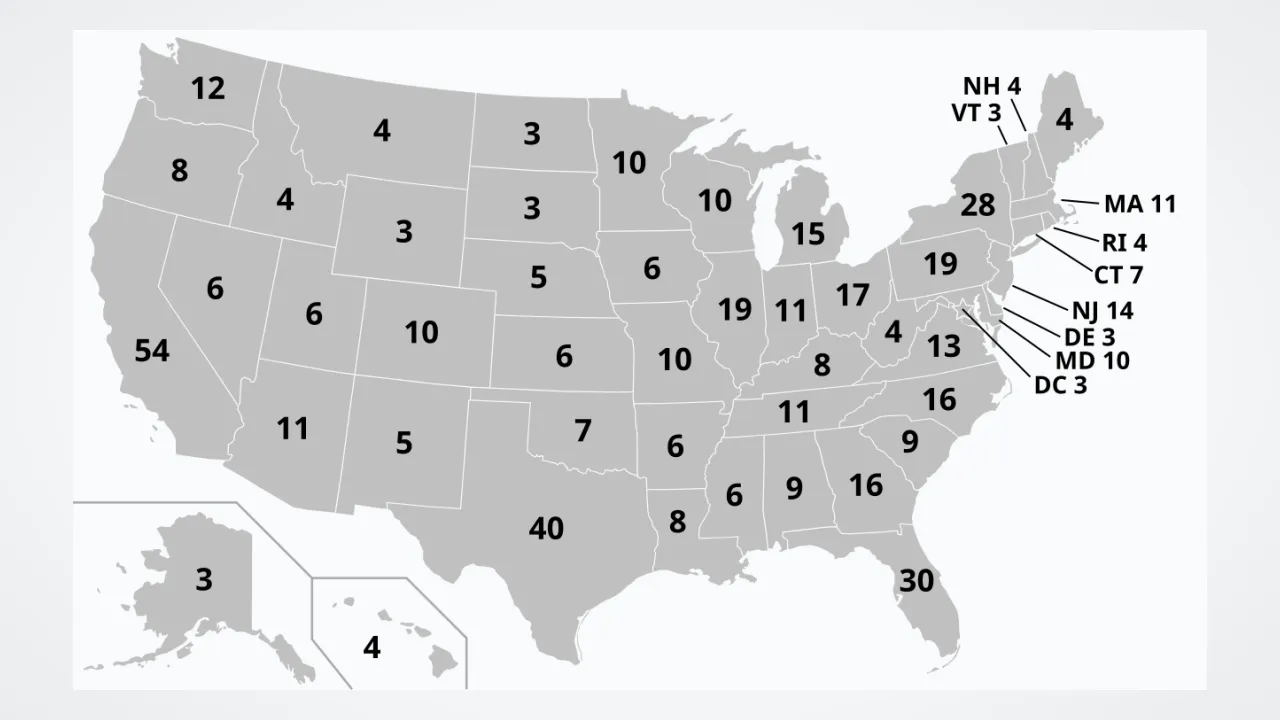
Each state gets one elector for every member it has in Congress: two plus its House Representatives. For example, Virginia has two Senators and eleven Representatives, giving Virginia thirteen electoral votes!
3
Adding Up to 538
Across all fifty states plus three votes for Washington, D.C., there are 538 electors in . The first candidate to reach a majority of 270 electoral votes becomes the next President.
1. How is a state's number of electoral votes calculated?
2. How many electoral votes are there in all across the fifty states and Washington, D.C.?
🤯 Mind-Blowing Fact • Grade 3
California currently holds the most electoral votes with 54, while six states—including Wyoming, Vermont, and Alaska—plus Washington, D.C., each hold 3!
✨ Word Sparks (Grade 3 Glossary)
Tap 🔊 to hear
compromise
An agreement where each side gives a little
slate
A group of candidates or electors running together
popular
Relating to ballots cast directly by everyday voters
🪝
Why did the authors of the U.S. Constitution invent the Electoral College in 1787?
1
A Compromise in Philadelphia
Picture delegates debating through a hot Philadelphia summer in 1787! Some Founders wanted Congress to pick the President, while others wanted a direct national vote. Big states and small states also worried about having a fair voice, so they compromised by creating the Electoral College in Article II.
2
Where 538 Comes From
Every state receives electors equal to its two Senators plus its House Representatives—which adjust every ten years after the U.S. Census. In 1961, the Twenty-Third Amendment gave Washington, D.C., three electors, bringing the national total to 538.
3
Winner-Take-All in Most States
When citizens vote on Election Day in November, they are actually choosing their state's of electors. In forty-eight states and D.C., whichever candidate wins the state's vote receives all of that state's electoral votes.
4
Two Exceptions and Counting Day
Only Maine and Nebraska divide electors by congressional district. Electors cast ballots in December, and Congress officially counts them on January 6 to confirm who reached at least 270!
1. Which two states award some electoral votes by congressional district instead of using a statewide winner-take-all rule?
2. Which constitutional amendment gave residents of Washington, D.C., three electoral votes?
🤯 Mind-Blowing Fact • Grade 4
Only twice in American history—for Thomas Jefferson in 1801 and John Quincy Adams in 1825—has the U.S. House of Representatives had to choose the President after no candidate won an Electoral College majority!
✨ Word Sparks (Grade 4 Glossary)
Tap 🔊 to hear
federalism
Sharing power between national and state governments
ratify
To formally approve a constitution or amendment
contingent
Happening only if a certain condition occurs
🪝
What happens if no presidential candidate reaches 270 electoral votes—or if two candidates tie at 269 to 269?
1
Federalism Built Into Elections
Imagine designing an election system for thirteen proud states in 1787 when news traveled by horseback! Under —the sharing of power between national and state governments—the Framers designed Article II so states conduct presidential elections. Giving every state two Senate-based electors plus population-based House electors ensured candidates had to build broad support across diverse regions rather than campaigning in just a few crowded cities.
2
Fixing a Glitch With the Twelfth Amendment
Originally, each elector cast two votes for President, and the runner-up became Vice President. After an awkward 1800 tie between running mates Thomas Jefferson and Aaron Burr, states ratified the Twelfth Amendment in 1804 so electors cast one distinct ballot for President and another for Vice President.
3
From November Ballots to January 6
Following the U.S. Census every decade, House seats—and thus electoral votes—shift as state populations grow or shrink; today Virginia holds thirteen electoral votes. Voters cast ballots on the Tuesday after the first Monday in November, electors meet in their state capitals in mid-December, and a joint session of Congress tallies the certified certificates on January 6.
4
The Tiebreaker Rule
If nobody wins at least 270 votes, the Twelfth Amendment triggers a ' election': the U.S. House of Representatives chooses the President—with each state delegation casting one single vote—while the Senate chooses the Vice President!
1. Why was the Twelfth Amendment added to the Constitution in 1804?
2. If two candidates tie at 269 electoral votes each, who chooses the President under the Constitution?
🤯 Mind-Blowing Fact • Grade 5
Article II of the U.S. Constitution never actually uses the phrase 'Electoral College'—that name entered popular speech in the early 1800s and first appeared in federal law in 1845!
✨ Word Sparks (Grade 5 Glossary)
Tap 🔊 to hear
apportionment
Dividing legislative seats among states by population
plurality
Winning the most votes among several choices
decennial
Happening regularly once every ten years
🪝
How does the Electoral College balance direct citizen participation with the federal structure of fifty distinct states?
1
Constitutional Origins in 1787
Transport yourself to Independence Hall in September 1787, where the Committee on Postponed Parts tackled one of the Convention's thorniest puzzles: how to select a chief executive independent of Congress yet accountable to the nation! Rejecting selection by the national legislature lest the President become Congress's puppet, and bridging disagreements between high-population and low-population states, the Framers crafted Article II, Section 1. Notably, Article II bars Senators, Representatives, and federal officeholders from serving as electors, preserving separation of powers.
2
Apportionment Math and the Census
Every ten years, the U.S. Census reapportions the 435 seats of the House of Representatives among the fifty states by population. Adding each state's two Senators plus three electors granted to the District of Columbia by the Twenty-Third Amendment (1961) yields 538 electors—requiring an absolute majority of 270 to win. Virginia, home to eight U.S. Presidents, currently casts thirteen electoral votes (two Senators plus eleven Representatives).
3
How Popular Votes Translate Into Electors
Although early state legislatures sometimes appointed electors directly, by the 1830s nearly every state tied its electors to the statewide popular vote. Today, forty-eight states and D.C. allocate electors on a winner-take-all basis, whereas Maine (since 1972) and Nebraska (since 1992) employ the Congressional District Method, awarding two votes to the statewide winner and one to each district winner.
4
Timeline From November to Inauguration
Voters cast ballots on the Tuesday after the first Monday in November. Certified electors convene in their respective state capitals in mid-December to sign Certificates of Vote for President and Vice President—separated since the Twelfth Amendment of 1804. On January 6, the Vice President presides over a joint session of Congress to tally the votes ahead of Inauguration Day on January 20.
5
Ongoing Civic Discussion
Because winner-take-all allocation makes it mathematically possible—as occurred five times in U.S. history—for a candidate to win 270 electoral votes without winning the national popular , students and constitutional scholars thoughtfully examine both how the system encourages geographic breadth and how electoral math shapes American democracy.