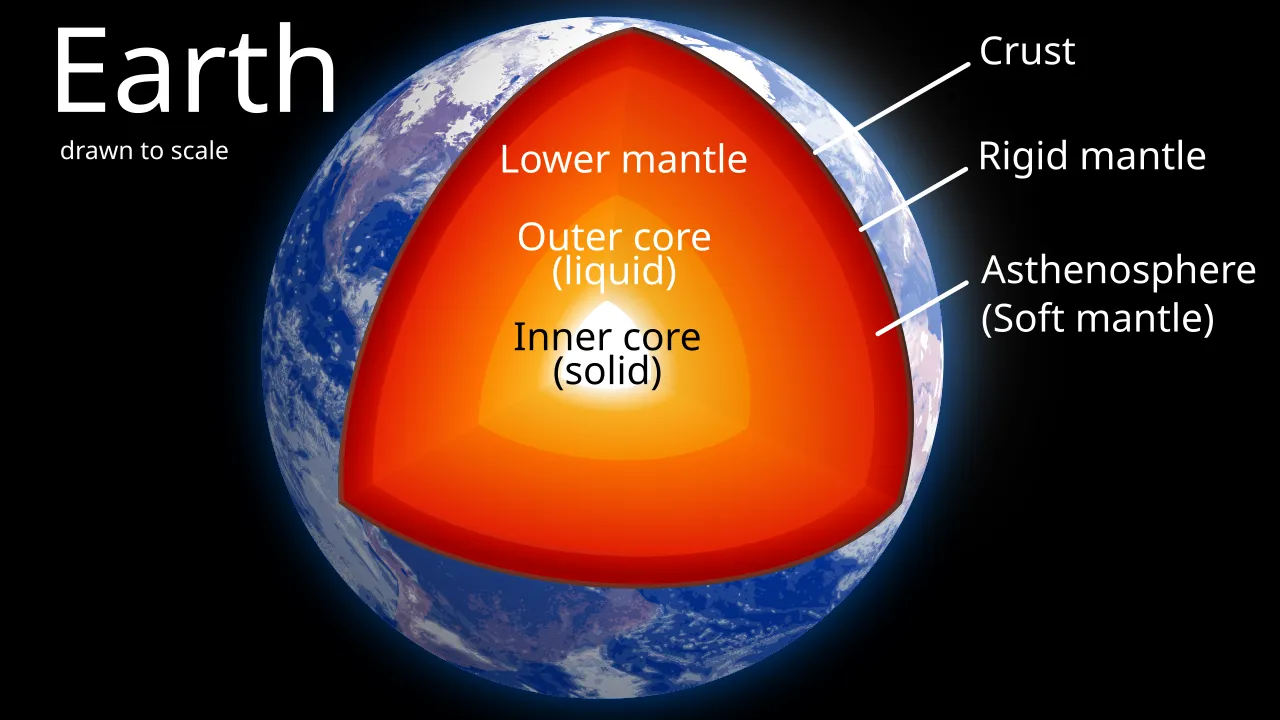
2. Why does the super-hot inner core stay solid instead of melting?
🤯 Mind-Blowing Fact • Grade 2
The deepest hole humans ever drilled reached only 7.6 miles down—less than a tiny scratch on an apple skin compared to the 3,200-mile trip to the inner core!
✨ Word Sparks (Grade 2 Glossary)
Tap 🔊 to hear
Nickel
Silvery metal mixed with iron inside Earth
Sphere
A 3D round ball shape
Seismic Wave
Vibration traveling through Earth from an earthquake
🪝
How can metal hotter than volcano lava stay completely solid at Earth's center?
1
Four Miles? Try Four Thousand!
Point straight down past your shoes—nearly 4,000 miles beneath your classroom sits the bullseye of our planet! Earth's inner core is a spinning of solid iron and metal about 1,500 miles wide.
2
Temperature Versus Pressure
Temperatures in the inner core reach nearly 9,800°F—just as blazing hot as the surface of the Sun! Normally iron melts long before that, yet the crushing weight of every ocean, continent, and layer above squeezes iron atoms so tightly they cannot spread out into liquid.
3
Listening With Earthquakes
No drill has ever reached the core! Instead, scientists listen to earthquake waves echoing through Earth like a doctor's ultrasound to map the solid ball inside.
1. How did scientists discover Earth's solid inner core without drilling down to see it?
2. How big is Earth's solid inner core compared to our Moon?
🤯 Mind-Blowing Fact • Grade 3
Danish scientist Inge Lehmann lived to be 104 years old—celebrated worldwide as the brilliant detective who discovered Earth's solid inner core using only math, pencils, and seismograph charts!
✨ Word Sparks (Grade 3 Glossary)
Tap 🔊 to hear
Seismologist
Scientist who studies earthquakes and Earth's interior
Alloy
A blend of two or more metals
P-Wave
Fastest earthquake wave, traveling through solids and liquids
🪝
How did a sharp-eyed mathematician in Denmark discover a giant solid ball hidden inside Earth's liquid center?
1
Inge Lehmann's Big Discovery
Until 1936, geologists thought Earth's entire metal core was one big ball of liquid iron! Then Danish Inge Lehmann studied squiggly paper charts from a massive New Zealand earthquake. She noticed surprise showing up in Europe where a pure liquid core should have deflected them—proving a solid inner core sat right in the middle, bouncing waves back!
2
Crushing Pressure Wins the Tug-of-War
Beginning about 5,150 kilometers (3,200 miles) underground, the inner core endures pressures over 3.5 million times stronger than the air around you at sea level! In the tug-of-war between 5,400°C heat trying to melt iron and immense gravity pressure squeezing atoms together, pressure wins.
3
Slowly Growing Bigger Every Year
As Earth very slowly cools over billions of years, liquid iron at the bottom of the outer core freezes onto the outside of the inner core—making the solid inner core grow wider by roughly one millimeter every year!
4
Floating Inside Liquid Metal
Because a sea of liquid outer-core iron surrounds it completely, the solid inner core can even spin at a slightly changing pace compared to the rocky crust under your feet!
1. What clue helped seismologist Inge Lehmann discover the solid inner core in 1936?
2. What is slowly happening to the size of Earth's inner core as our planet gradually cools?
🤯 Mind-Blowing Fact • Grade 4
Earth's solid inner core hasn't been there forever—paleomagnetic clues in ancient rocks suggest the inner core only began crystallizing between 550 million and 1 billion years ago, rescuing Earth's fading magnetic shield just before complex animal life blossomed!
✨ Word Sparks (Grade 4 Glossary)
Tap 🔊 to hear
Differentiation
Gravity sorting heavy metals below lighter rocks
Diamond Anvil
Lab tool squeezing tiny samples to core pressures
Latent Heat
Heat energy released when liquid freezes solid
🪝
How does the slow 'freezing' of white-hot iron onto Earth's inner core help power the invisible shield protecting all life above?
1
Planetary Differentiation: Why Iron Sank
Travel back 4.5 billion years to newborn Earth, when asteroid impacts and radioactive decay turned our young world into a glowing magma ocean! Heavy metallic elements—mostly iron and about 5 to 10 percent nickel—sank downward by gravity toward the planet's center while lighter silicate minerals floated upward to build the mantle and crust. Geologists call this density sorting planetary , and it created Earth's layered interior.
2
Fueling the Geodynamo From Below
At the boundary 5,150 kilometers down—called the Lehmann Discontinuity—temperatures hover near 5,400°C (9,800°F) while pressure reaches 330 to 360 gigapascals. As Earth slowly loses heat, iron atoms crystallize onto the solid inner core (radius ~1,220 km), releasing and expelling lighter elements like sulfur, oxygen, and silicon upward into the liquid outer core. Those rising buoyant plumes stir powerful churning currents in the liquid outer core, supercharging Earth's protective magnetic field!
3
Giant Aligned Iron Crystals
Remarkably, earthquake P-waves travel about three percent faster straight from pole to pole through the inner core than they do side-to-side parallel to the equator! Geophysicists conclude that gigantic iron-nickel crystals inside the inner core are aligned preferentially along Earth's spin axis.
4
Simulating the Core in a Diamond Vise
To study inner-core metal in the lab, physicists squeeze microscopic specks of iron between the tips of two flawless diamonds—a cell—while zapping the sample to 5,500°C with infrared lasers!
1. How does the slow crystallization of Earth's solid inner core help keep the liquid outer core churning?
2. What clue made geophysicists realize that iron crystals inside the inner core are aligned in a preferred direction?
🤯 Mind-Blowing Fact • Grade 5
By tracking earthquake waves that bounced five times straight back and forth across Earth's center like a pinball, seismologists discovered a hidden 800-mile-wide 'innermost inner core' with differently tilted iron crystals!
✨ Word Sparks (Grade 5 Glossary)
Tap 🔊 to hear
Anisotropy
Seismic waves moving faster in one crystal direction
Superionic
State where light atoms flow inside solid crystal
Geodynamo
Core engine generating Earth's protective magnetic field
🪝
Why did seismologists recently discover an 'innermost inner core' tucked inside Earth's inner core—and how does iron behave in a bizarre 'superionic' state?
1
Seismic Shadow Zones, PKIKP Phases, and Shear Softening
When a major earthquake ruptures a subduction zone, compressional P-waves diving straight through Earth's center—labeled PKIKP waves by seismologists—arrive at antipodal stations on the opposite side of the globe several seconds faster than if the core were entirely molten! Spanning depths from 5,150 km (the Bullen/Lehmann inner-core boundary) to 6,371 km at Earth's center, the solid inner core comprises ~1.7 percent of Earth's mass with densities climbing from 12.8 to 13.1 g/cm³. Intriguingly, inner-core shear waves (PKJKP) travel unexpectedly slowly (~3.5 km/s), indicating that solid hexagonal-close-packed (hcp) iron-nickel crystals near their melting point behave in a surprisingly 'mushy' or shear-softened manner—likely because light interstitial atoms (hydrogen, carbon, oxygen) zip like liquids through a rigid solid iron lattice in a '' state!
2
Seismic Anisotropy and the 'Innermost Inner Core'
Detailed analysis of reverberating seismic waves bouncing back and forth across Earth's diameter up to five times recently revealed a hidden nested structure: an 'innermost inner core' roughly 650 kilometers in radius! While outer layers of the solid inner core exhibit polar seismic aligned parallel to Earth's rotation axis, the innermost 650-km sphere shows a distinct fast-wave direction tilted ~50 degrees—preserving a fossilized record of an ancient shift in core crystallization hundreds of millions of years ago.
3
Nucleation Paradox and Ediacaran Magnetic Revival
For decades, thermal models calculated that if Earth's inner core had existed for 4.5 billion years, it would already be far larger than 1,220 km! Paleomagnetic intensity measurements trapped inside 565-million-year-old feldspar and silicate crystals solved the mystery: Earth's magnetic field dropped to less than 10 percent of its modern strength right before the Ediacaran-Cambrian transition, then surged dramatically as the solid inner core finally nucleated—injecting compositional buoyancy that saved Earth's magnetosphere!
4
Differential Rotation Oscillations
Coupled gravitationally to the rocky mantle yet electromagnetically torqued by swirling currents in the liquid outer core, the solid inner core does not spin at one permanently faster rate. Multi-decade seismic doublet studies from the South Sandwich Islands to Alaska show that the inner core gently oscillates—edging fractionally faster (super-rotation) for a few decades, pausing in sync with the mantle, and edging fractionally slower over roughly a 70-year cycle that subtly tweaks Earth's length of day by fractions of a millisecond!
5
Laser-Heated Diamond Anvils and Psyche Mission Clues
Because humans can never sample 360-GPa core metal directly, mineral physicists combine X-ray free-electron lasers with diamond anvil cells—while NASA's Psyche spacecraft visits the metal-rich asteroid 16 Psyche to inspect the exposed frozen core of a shattered protoplanet!