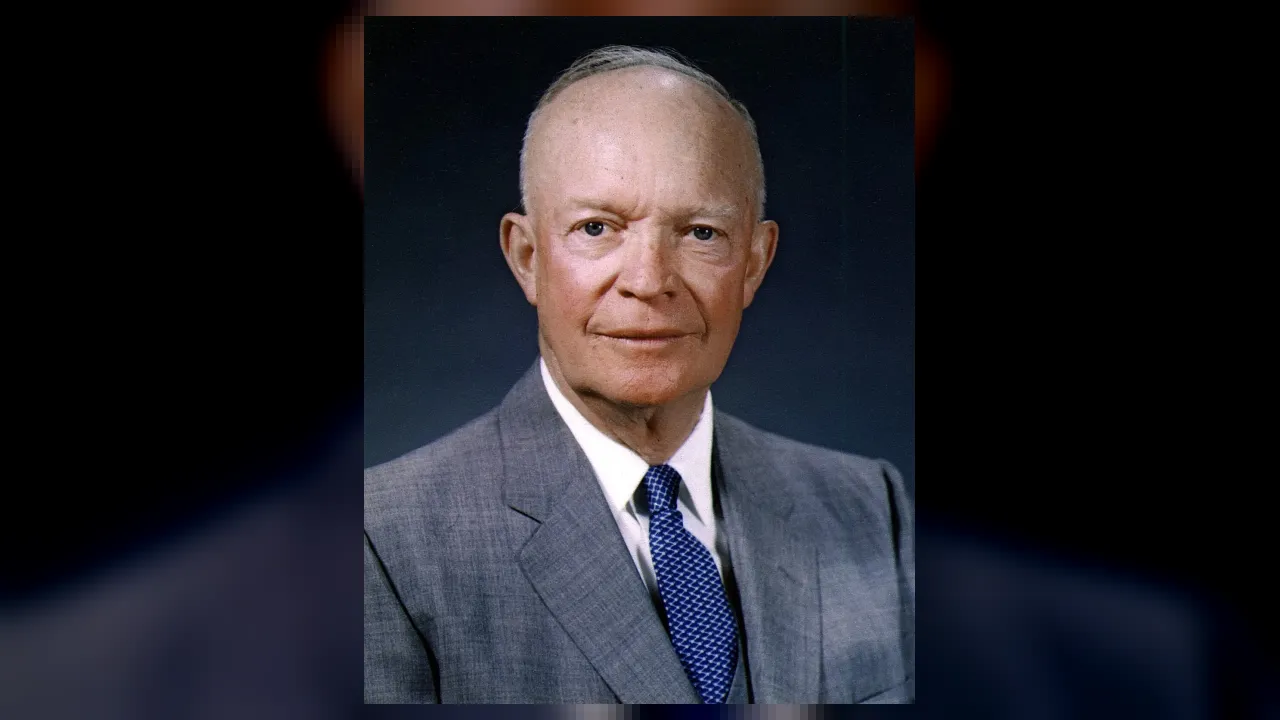
🇺🇸 U.S. HISTORY
🏛️ 34th President of the United States (1953–1961)
VA History & Social Science SOL K.1, 1.2, 2.4, VS.1–VS.10, USI & USII
Dwight D. Eisenhower
Five-Star Peacemaker Who Built America's Highways
Grade 5 • Advanced • 387 words
⏳ Era / StatehoodPresidential Term: 1953–1961 (D-Day Commander: June 6, 1944)
🗺️ Region / CapitalAbilene, Kansas; Gettysburg, Pennsylvania & Washington, D.C.
📜 Key MilestoneAllied WWII Victory, Interstate Highway System, NASA & 50 U.S. States
⚡ Historical SparkLed D-Day to liberate Europe, launched NASA, and connected America with Interstate Highways
🤯 Mind-Blowing Fact • Grade 1
Dwight D. Eisenhower was the very first president to serve over all fifty U.S. states after Alaska and Hawaii joined the Union in 1959!
✨ Word Sparks (Grade 1 Glossary)
Tap 🔊 to hear
highway
A wide main road built for fast travel
teamwork
Working smoothly together to reach a shared goal
explore
To travel into unknown places to learn new things
🪝
Have you ever ridden on a big multi-lane Interstate highway with your family?
1
Everybody Liked Ike
Vroom, zoom! Wide connect cities all across America today! Growing up in Kansas with five lively brothers, Dwight had a sunny grin and the nickname 'Ike.'
2
Leading Teamwork for Freedom
During World War II, General Ike led soldiers, sailors, and pilots from many friendly nations. Working together on D-Day, his giant team helped free Europe!
3
Highways, Space, and Fifty States
As our thirty-fourth president, Ike built the Interstate System, started NASA to space, and welcomed Alaska and Hawaii as our forty-ninth and fiftieth states!
1. What friendly three-letter nickname did millions of Americans call Dwight D. Eisenhower?
2. Which two states joined the United States in 1959 while Eisenhower was president?
🤯 Mind-Blowing Fact • Grade 2
President Eisenhower renamed the presidential woodland retreat in Maryland 'Camp David' in honor of his young grandson, David Eisenhower!
✨ Word Sparks (Grade 2 Glossary)
Tap 🔊 to hear
convoy
A line of trucks or ships traveling together
supreme
Highest in rank, leadership, or authority
satellite
A craft launched to orbit high around Earth
🪝
Why did a slow, muddy cross-country road trip in 1919 inspire a future president to build America's modern highways?
1
Stuck in the Mud!
Splat, spin! In 1919, young Army officer Dwight 'Ike' Eisenhower rode in a truck from Washington, D.C., to California. Cracked bridges and deep mud slowed the trip to sixty-two days—planting an idea he never forgot!
2
Five-Star General on D-Day
Raised in Abilene, Kansas, Ike excelled at uniting people from different backgrounds. During World War II, as Allied Commander, he planned the giant D-Day landings in France on June 6, 1944, helping liberate Western Europe.
3
Connecting Roads and Reaching Space
Elected thirty-fourth president in 1952, Ike helped end fighting in Korea and kept America peaceful. Remembering that muddy 1919 trip, he signed the 1956 law building 41,000 miles of Interstate Highways and founded NASA in 1958!
1. What early experience convinced Eisenhower that America needed smooth coast-to-coast highways?
2. Which U.S. space agency did President Eisenhower sign into law in 1958?
🤯 Mind-Blowing Fact • Grade 3
Before D-Day launched on June 6, 1944, General Eisenhower secretly wrote a short note in his pocket taking 100 percent of the blame himself just in case the landing failed!
✨ Word Sparks (Grade 3 Glossary)
Tap 🔊 to hear
logistics
Planning how supplies and people reach the right place
truce
An agreement to stop active fighting
integrate
To open schools and public places equally to everyone
🪝
Why did a five-star general who commanded millions of soldiers care most of all about keeping peace?
1
From Kansas Heartland to West Point
Imagine coordinating 156,000 troops, 5,000 ships, and 11,000 airplanes across stormy seas on a single June morning! Growing up in a hardworking family in Abilene, Kansas, Dwight David Eisenhower graduated from West Point in 1915 and became a master of and teamwork.
2
Supreme Commander on D-Day
In World War II, General George C. Marshall and President Roosevelt chose 'Ike' to lead Allied forces in Europe. Checking weather charts carefully, Eisenhower gave the famous 'OK, let's go!' order for D-Day—June 6, 1944—launching the liberation of Normandy, France.
3
Interstates, NASA, and Peace
Campaigning with the cheerful slogan 'I Like Ike,' Eisenhower served two peaceful, prosperous terms as thirty-fourth president (1953–1961). He negotiated the 1953 ending Korean War combat, signed the 1956 Interstate Highway Act, and founded NASA in 1958.
4
Upholding Law and Fifty Stars
Eisenhower also signed the Civil Rights Acts of 1957 and 1960 and enforced Supreme Court rulings when nine brave Black students integrated Little Rock Central High School in Arkansas. In 1959, he proudly welcomed Alaska and Hawaii into our fifty-state Union!
1. What did General Eisenhower keep in his coat pocket on D-Day in case the Normandy landing did not succeed?
2. Why did President Eisenhower act in Little Rock, Arkansas, in 1957?
🤯 Mind-Blowing Fact • Grade 4
On April 16, 1953, former five-star General Eisenhower reminded the world why peace matters in his 'Chance for Peace' speech, noting that every warship or bomber built meant fewer schools, hospitals, and homes for families!
✨ Word Sparks (Grade 4 Glossary)
Tap 🔊 to hear
coalition
Different nations or groups joining forces together
restraint
Calm self-control instead of acting rashly
civilian
Run by everyday citizens rather than the military
🪝
How did Dwight D. Eisenhower combine five-star military experience with calm restraint to keep peace and modernize America?
1
Architect of Allied Coalition Victory
Raised in Abilene, Kansas, after his birth in Denison, Texas, in 1890, Dwight D. Eisenhower learned early how to turn rivals into teammates. During World War II, as Supreme Commander of the Allied Expeditionary Force, he united American, British, Canadian, Free French, and other Allied troops behind Operation Overlord—the June 6, 1944 D-Day landings in Normandy, France (commemorated across Virginia at Bedford's National D-Day Memorial). Earning five-star General of the Army rank, Ike later served as NATO's first Supreme Commander.
2
Waging Peace in the Cold War
Elected thirty-fourth president in 1952, Eisenhower brought deep firsthand knowledge of war's human cost to the Oval Office. Within six months, he fulfilled his pledge to secure the July 1953 Korean Armistice, halting active combat. Throughout eight Cold War years, he practiced calm crisis management, proposed 'Atoms for Peace' at the United Nations to harness nuclear energy for medicine and electricity, and boosted science and math classrooms through the 1958 National Defense Education Act.
3
Transforming Everyday American Geography
Recalling both his grueling 1919 cross-country Army truck convoy and the four-lane highways he had seen in Europe, Eisenhower championed the Federal-Aid Highway Act of 1956. The largest public-works project in U.S. history, it built over 41,000 miles of controlled-access Interstate Highways—reshaping commerce, family travel, and cities across every state. Alongside Britain and Canada, he also opened the St. Lawrence Seaway in 1959 and welcomed Alaska and Hawaii as our forty-ninth and fiftieth states.
4
Constitutional Duty, NASA, and Wise Warnings
In 1957, Eisenhower appointed federal judges who advanced civil rights, signed the first federal civil-rights legislation since Reconstruction, and dispatched federal troops to enforce Brown v. Board of Education desegregation orders in Little Rock, Arkansas. In 1958, he signed the law establishing NASA as a space agency, and in his famous 1961 Farewell Address urged citizens to stay balanced, alert, and peaceful.
1. Why did President Eisenhower insist in 1958 that NASA be created as a civilian agency rather than a military branch?
2. Which 1956 law signed by Eisenhower launched the largest public-works construction project in American history?
🤯 Mind-Blowing Fact • Grade 5
Following the 1957 Sputnik satellite launch, Eisenhower's 1958 National Defense Education Act provided student loans and science labs that trained a whole generation of future Apollo engineers, doctors, and teachers!
✨ Word Sparks (Grade 5 Glossary)
Tap 🔊 to hear
amphibious
Combining naval ships and land troops at once
deliberation
Careful, thoughtful discussion before making a big choice
vigilance
Watchful attention to protect rights and safety
🪝
How did Dwight D. Eisenhower's 'Middle Way' leadership unite postwar America, build lasting infrastructure, and preserve eight years of peace?
1
Strategic Organizer and Operation Overlord
Few commanders in military history mastered multinational diplomacy as seamlessly as Dwight David Eisenhower. Raised in Abilene, Kansas, and graduating from West Point's famed 1915 'class the stars fell on,' Eisenhower caught the eye of Army Chief of Staff George C. Marshall through brilliant war-plans work in early 1942. Appointed Supreme Commander of the Allied Expeditionary Force, he forged British, American, Canadian, and Allied units into a unified team that executed Operation Overlord on June 6, 1944—history's largest landing—liberating Western Europe by May 1945.
2
'Hidden-Hand' Leadership and the Middle Way
After serving as Columbia University president and NATO's inaugural Supreme Commander, Eisenhower won landslides in 1952 and 1956. Governing through what political scientist Fred Greenstein later termed 'hidden-hand leadership'—calm public demeanor paired with rigorous National Security Council behind the scenes—Eisenhower pursued a bipartisan 'Middle Way.' He preserved and expanded Social Security to ten million additional workers, created the Department of Health, Education, and Welfare, balanced three federal budgets, and oversaw broad 1950s economic growth.
3
Infrastructure, Science, and Fifty States
Drawing directly on lessons from his 1919 Transcontinental Motor Convoy and wartime German autobahns, Eisenhower championed the Federal-Aid Highway Act of 1956, financing 41,000 miles of uniform, limited-access Interstate highways through a dedicated Highway Trust Fund. Following the Soviet Union's October 1957 Sputnik launch, Eisenhower resisted panic while enacting long-term scientific investments: launching America's Explorer I satellite (January 1958), founding civilian NASA (July 1958), and signing the National Defense Education Act to strengthen K–12 and university STEM and foreign-language education.
4
Constitutional Enforcement and Civil Rights
Eisenhower appointed Chief Justice Earl Warren and four other Supreme Court justices, plus courageous Fifth Circuit judges who dismantled legal segregation across the South. When Arkansas officials defied federal court orders integrating Little Rock Central High School in September 1957, Eisenhower federalized the Arkansas National Guard and deployed units of the 101st Airborne Division—affirming that constitutional rule of law binds every state—and signed the Civil Rights Acts of 1957 and 1960 establishing the Civil Rights Division of the Justice Department.
5
Waging Peace and the Farewell Address
Having ended Korean combat in July 1953, Eisenhower refused repeated pressures to intervene militarily in Indochina or escalate Cold War flashpoints, remarking near retirement that after January 1953 not a single soldier died in combat under his orders. In his landmark January 17, 1961 Farewell Address—before retiring to his farm adjacent to the Gettysburg battlefield—the five-star general wisely counseled citizens to balance national security with fiscal stewardship, civic , and 'an alert and knowledgeable citizenry' democracy requires.