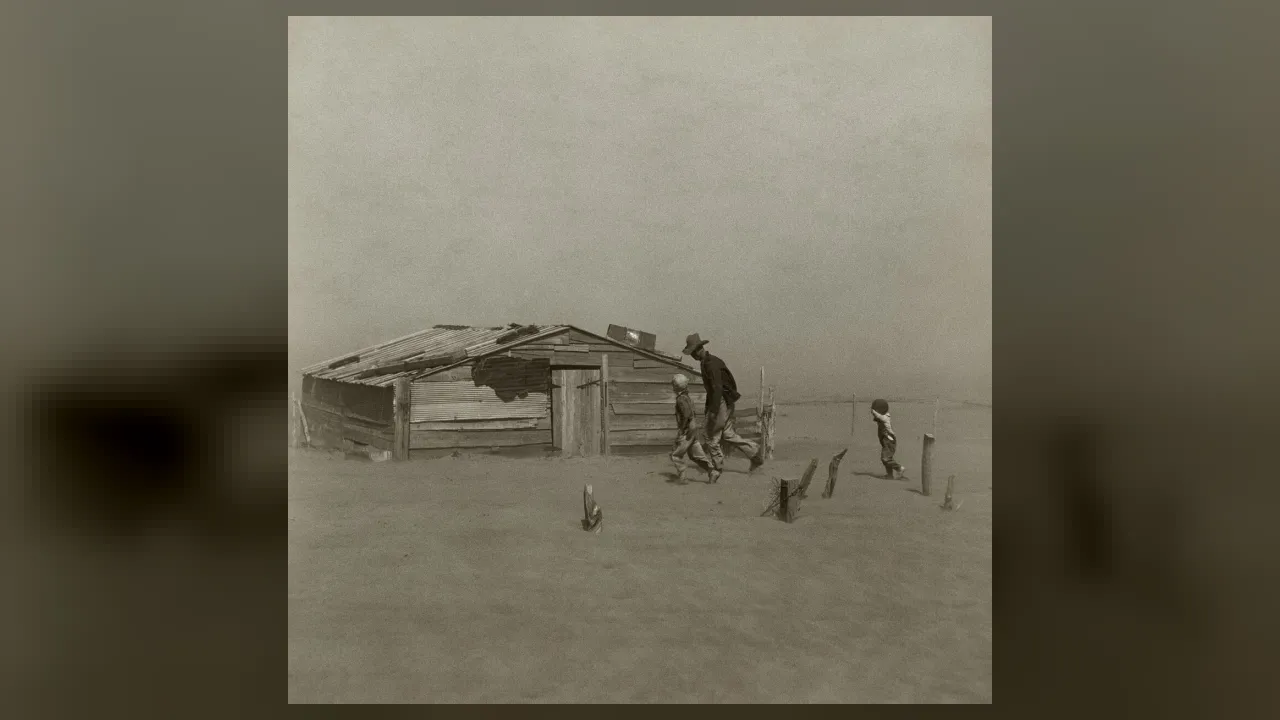
1. Why couldn't farmers grow wheat on the Great Plains during the Dust Bowl?
2. Which western state did many Dust Bowl families drive toward to find farm work?
🤯 Mind-Blowing Fact • Grade 2
On April 14, 1935—remembered as 'Black Sunday'—a single giant dust wall swept three hundred million tons of prairie topsoil into the sky!
✨ Word Sparks (Grade 2 Glossary)
Tap 🔊 to hear
windbreak
Row of trees planted to slow wind
migrant
Worker moving from place to place harvesting
blizzard
Fierce blinding storm blown by strong winds
🪝
Why did sunny afternoons on the Great Plains suddenly turn dark as midnight in 1935?
1
Missing the Prairie Grass
Feel the grit of dry dust whistling through window cracks on an Oklahoma farm! For centuries, deep native prairie grasses held Great Plains dirt tightly in place, until tractors plowed millions of acres for wheat.
2
Black Blizzards Roll In
When a long drought struck in 1931, bare soil turned to powder. Towering windstorms nicknamed 'black ' blotted out the noon sun, burying fences and tractors under drifts of dirt.
3
Heading West on Route 66
Unable to grow crops, hundreds of thousands of families packed trunks onto trucks and followed Highway 66 west to California. Meanwhile, conservation workers planted millions of trees to heal the Plains.
1. What had originally held Great Plains soil safely in place before tractors plowed so much land?
2. Which famous highway carried many Dust Bowl families westward toward California?
🤯 Mind-Blowing Fact • Grade 3
As a cloud of Great Plains dust darkened the sky right outside the U.S. Capitol in spring 1935, Congress unanimously voted to create the Soil Conservation Service!
✨ Word Sparks (Grade 3 Glossary)
Tap 🔊 to hear
sod
Thick mat of grass and tangled roots
contour plowing
Plowing curved rows following a hill's shape
shelterbelt
Long belt of trees blocking prairie wind
🪝
How did plowing up prairie grass help trigger the biggest environmental migration in U.S. history?
1
When Grasslands Became Wheat Fields
Imagine standing in a Kansas schoolyard on a bright spring day when a thousand-foot wall of swirling black dirt races across the horizon! During the 1910s and 1920s, high wheat prices encouraged farmers across Oklahoma, Texas, Kansas, Colorado, and New Mexico to plow up millions of acres of native prairie .
2
Drought and 'Black Sunday'
Without deep grass roots to anchor moisture, severe drought in the 1930s baked the soil into fine dust. Fierce winds whipped up 'black blizzards,' hanging wet sheets over doorways could barely keep grit off kitchen tables.
3
Journey Along the Mother Road
Roughly 2.5 million people left the Plains states during the 1930s, with several hundred thousand driving west along Route 66 to pick cotton, grapes, and peaches in California's San Joaquin Valley.
4
Hugh Hammond Bennett Rescues the Land
Soil scientist Hugh Hammond Bennett led the new U.S. Soil Conservation Service in 1935. By teaching , crop rotation, and planting 220 million trees, farmers restored the prairie.
1. Which five states formed the heart of the 1930s Dust Bowl?
2. How did soil scientist Hugh Hammond Bennett help heal the Great Plains?
🤯 Mind-Blowing Fact • Grade 4
Civilian Conservation Corps and WPA crews planted a 100-mile-wide 'Great Plains Shelterbelt' of 220 million trees stretching 1,150 miles from northern Texas all the way to the Canadian border!
✨ Word Sparks (Grade 4 Glossary)
Tap 🔊 to hear
semi-arid
Climate receiving light rainfall and dry summers
ecosystem
Living plants animals and environment working together
crop rotation
Switching plant types yearly to enrich soil
🪝
How did human farming choices and natural climate patterns collide to reshape American agriculture and culture?
1
An Ecological Balance Broken
Picture static electricity crackling along barbed-wire fences so strongly during a 1935 Texas dust storm that automobile engines stalled right on the road! For thousands of years, shortgrass prairie thrived on the Southern Plains because drought-hardy roots reached six feet underground. Mechanized steel plows in the 1920s stripped away that protective sod across more than thirty million acres.
2
Four Waves of Drought
Beginning in 1930, four back-to-back droughts scorched nearly one hundred million acres centered on the Oklahoma and Texas panhandles. Exposed soil blew eastward in choking 'black rollers' that darkened Chicago and Washington, D.C., ruining harvests right in the middle of the Great Depression.
3
Resilience on the Road West
Approximately 2.5 million Plains residents moved away by 1940—many relocating to neighboring towns, while around 300,000 to 400,000 traveled Route 66 to California, Arizona, and Oregon. Though newcomers faced crowded migrant camps and low picking wages, photographers like Dorothea Lange, folk songwriter Woody Guthrie, and author John Steinbeck brought national empathy and federal relief camps to their aid.
4
The Birth of Modern Soil Science
Guided by Hugh Hammond Bennett's Soil Conservation Service and Civilian Conservation Corps crews, farmers adopted strip cropping, stubble mulching, and the Great Plains Shelterbelt—stretching 220 million trees from Texas to North Dakota and cutting wind erosion by more than sixty percent.
1. Which folk singer and photographer helped Americans across the nation understand the daily lives of Dust Bowl migrants?
2. What was the main purpose of the 1,150-mile Great Plains Shelterbelt?
🤯 Mind-Blowing Fact • Grade 5
Modern NASA climate computer models discovered that the giant airborne dust clouds themselves reflected sunlight and blocked rising moisture, making the 1930s drought hotter and longer than ocean temperatures alone would have caused!
✨ Word Sparks (Grade 5 Glossary)
Tap 🔊 to hear
meteorological
Relating to atmosphere weather and climate patterns
tillage
Preparing and plowing farm soil for planting
foreclosure
Losing a farm when loan payments stop
🪝
Why do Earth scientists and historians still study the 1930s Dust Bowl as the classic lesson in sustainable land stewardship?
1
The 'Great Plow-Up' Meets Atmospheric Feedback
During World War I and the 1920s, surging grain demand and gasoline-powered tractors spurred the 'Great Plow-Up' across the Southern Great Plains, converting over thirty-two million acres of drought-resistant buffalo grass into bare wheat furrows. When cooler Pacific sea-surface temperatures and warmer Atlantic waters shifted jet-stream rain tracks away from the Plains after 1930, exposed soil heated the air further—intensifying a decade-long feedback loop.
2
Black Sunday and the Dust Bowl's Reach
Associated Press reporter Robert Geiger coined the term 'Dust Bowl' right after April 14, 1935 ('Black Sunday'), when sixty-mile-per-hour winds lofted 300 million tons of topsoil across twenty states. Fine silt sifted through tightly caulked windows, caused 'dust pneumonia' in rural clinics, and drifted 1,500 miles east to coat the decks of ships off New England.
3
Demographic Shifts and Cultural Imprint
Combined with Great Depression , ecological collapse drove roughly 2.5 million people from Plains counties by 1940—the largest rapid internal migration in American history. Nearly 400,000 migrants settled in California's Central Valley and coastal cities, permanently enriching Western music, agriculture, and literature through works documented by the Farm Security Administration.
4
Federal Science and Cooperative Districts
Demonstrating dramatic dust skies outside a Senate hearing in April 1935, pedologist Hugh Hammond Bennett persuaded Congress to pass the Soil Conservation Act. Rather than imposing top-down mandates alone, federal scientists partnered with local farmer-led Soil Conservation Districts to pay landowners for re-seeding marginal grasslands, terracing slopes, and leaving crop residue over winter.
5
Enduring Lessons for Modern Agriculture
By 1938, conservation and the 18,600-mile Prairie States Forestry Project reduced blowing soil volume by sixty-five percent before normal rains returned in 1940. Today's no-till farming, cover-cropping, and satellite drought monitoring descend directly from lessons forged during the Dust Bowl.