1. What everyday object twisted into a spiral does a DNA double helix look like?
2. Which four letters spell out every single instruction along your DNA rungs?
🤯 Mind-Blowing Fact • Grade 2
Every single human shares about 99.9 percent of the exact same DNA letters—that tiny 0.1 percent difference helps make each of us unique!
✨ Word Sparks (Grade 2 Glossary)
Tap 🔊 to hear
Base Pair
Two matching DNA letters forming one rung
Gene
Section of DNA spelling one specific recipe
Trait
Feature like eye color or dimples inherited
🪝
How can just four chemical letters write recipes for strawberries, elephants, oak trees, and you?
1
Handrails and Matching Rungs
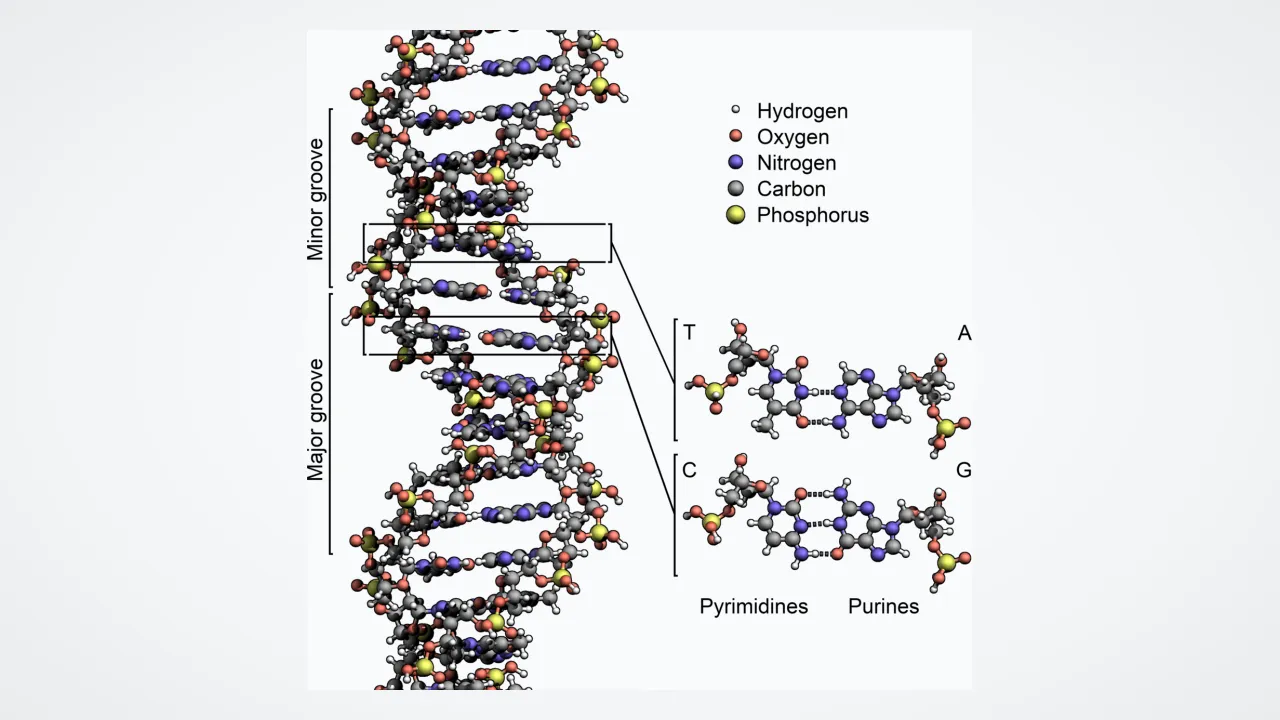
Zoom inside your cell nucleus to inspect the DNA double helix up close! Its two outer handrails are built from sugar and phosphate molecules, while pairs of chemical bases reach across the middle to form each rung.
2
Best-Friend Letter Pairs
DNA's four base letters—A, T, C, and G—are super picky about partners! Letter A always holds hands with T, and letter C always holds hands with G. Because of that rule, one side of the ladder is an exact mirror clue to the other side!
3
Unzipping to Copy
Whenever your body grows new skin cells, the DNA ladder unzips right down the middle and builds a fresh matching partner along each half!
1. Along a DNA ladder, which letter ALWAYS pairs up with letter A?
2. What happens when a cell gets ready to divide into two new cells?
🤯 Mind-Blowing Fact • Grade 3
Scientists surprisingly share about sixty percent of the same core housekeeping genes between humans and ordinary yellow bananas because all cells need basic energy enzymes!
✨ Word Sparks (Grade 3 Glossary)
Tap 🔊 to hear
Nucleotide
Building block with sugar, phosphate, and base
Adenine
DNA base letter A pairing with Thymine
Hydrogen Bond
Gentle attraction zipping matching DNA bases together
🪝
If one cell's DNA stretches taller than an adult human, how does it fit inside a speck smaller than the period at the end of this sentence?
1
Meet the Four Nucleotides
DNA stands for deoxyribonucleic acid, and it is built from repeating three-part blocks called . Each nucleotide links a deoxyribose sugar, a phosphate group, and one of four nitrogen bases: (A), Thymine (T), Cytosine (C), or Guanine (G).
2
Three Billion Rungs of Code
Weak chemical attractions called hold to Thymine and Cytosine to Guanine down the center of the spiral. One human cell holds over three billion base pairs! Specific stretches along that ladder—called genes—spell out recipes for proteins like collagen, antibodies, and eye pigments.
3
Photograph 51
In the early 1950s, British chemist Rosalind Franklin aimed X-rays through tiny DNA fibers to capture 'Photograph 51'—a crisp X-shaped shadow pattern that helped James Watson and Francis Crick model the famous twisted double helix in 1953!
4
Proofreading Champions
When enzymes copy DNA, built-in proofreaders check every rung and fix typos automatically so your recipes stay crystal clear.
1. Whose famous X-ray image 'Photograph 51' provided key evidence that DNA twists into a helix?
2. Why is it helpful that hydrogen bonds down the middle of DNA are gentle rather than super-permanent?
🤯 Mind-Blowing Fact • Grade 4
One tiny gram of pure DNA—weighing about as much as a single paperclip—can theoretically store over two hundred million gigabytes of digital data!
✨ Word Sparks (Grade 4 Glossary)
Tap 🔊 to hear
Antiparallel
Running side by side in opposite directions
Helicase
Enzyme unzipping the DNA double helix
DNA Polymerase
Builder enzyme assembling new matching DNA strands
🪝
Why do the two side rails of a DNA double helix point in opposite directions like a two-way highway?
1
Antiparallel Rails and Chargaff's Rule
Look closely at the sugar-phosphate backbones of DNA and you will spot a clever twist: the two strands run —pointing in opposite chemical directions, like northbound and southbound lanes on a highway! Biochemist Erwin Chargaff noticed in 1950 that in any creature's DNA, the amount of Adenine always equals Thymine and Cytosine always equals Guanine. Why? Double-ring purines (A and G) always pair with single-ring pyrimidines (T and C), keeping the ladder an exact two nanometers wide from end to end!
2
Helicase, Polymerase, and Semiconservative Copying
During DNA replication, an enzyme called unzips the double helix—breaking two hydrogen bonds between A-T pairs and three slightly stronger hydrogen bonds between C-G pairs. Next, speedy races along each parent strand snapping new complementary nucleotides into place at fifty letters per second! Because each daughter helix keeps one original strand and one brand-new strand, scientists call replication semiconservative.
3
The Central Dogma of Biology
Francis Crick summarized information flow in cells as DNA to RNA to Protein: DNA stores the master archive, transcription copies active genes into single-stranded RNA (using Uracil 'U' in place of Thymine), and ribosomes translate that RNA into folded proteins.
4
Repair Crews on 24/7 Duty
Specialized repair enzymes patrol your double helix non-stop, snipping out sun-warmed kinks or copying slips so fewer than one error per billion letters survives!
1. Why does pairing one double-ring purine base with one single-ring pyrimidine base matter for the DNA ladder?
2. Why is DNA copying called 'semiconservative replication'?
🤯 Mind-Blowing Fact • Grade 5
Protein-coding genes take up only about 1.5 percent of your 3.2-billion-letter DNA genome—much of the remaining 98.5 percent acts as a sophisticated control panel of dimmer switches and timers!
✨ Word Sparks (Grade 5 Glossary)
Tap 🔊 to hear
Phosphodiester Bond
Strong chemical link forming DNA's side rails
Okazaki Fragment
Short DNA piece stitched along lagging strands
Topoisomerase
Enzyme untwisting tight coils ahead of replication
🪝
How did scientists go from Friedrich Miescher finding mysterious 'nuclein' in 1869 to reading all three billion letters of the Human Genome Project?
1
Right-Handed B-DNA Geometry
Inside living cells, deoxyribonucleic acid adopts a sleek right-handed spiral known as B-DNA, measuring precisely 2.0 nanometers across. Alternating 5'-to-3' phosphodiester covalent bonds forge two antiparallel sugar-phosphate backbones, completing one full 360-degree turn every 10.5 base pairs (3.4 nanometers). This geometry carves a wider Major Groove and narrower Minor Groove along the exterior—allowing transcription factors to 'read' base-pair edges chemically without even unzipping the helix!
2
Hydrogen Bonding, Stacking, and Replication Forks
While two hydrogen bonds link Adenine to Thymine and three link Guanine to Cytosine, vertical pi-stacking interactions between flat aromatic rings actually contribute much of the double helix's thermodynamic stability. At a replication fork, relieves ahead-of-the-fork supercoiling while helicase separates strands; because DNA polymerase synthesizes strictly in the 5'-to-3' direction, the leading strand builds continuously while the lagging strand stitches short sealed by DNA ligase!
3
Coding Exons and Regulatory Dark Matter
When the international Human Genome Project completed its landmark reference map in 2003—joined by complete telomere-to-telomere sequencing in 2022—scientists were astonished to find that protein-coding exons make up barely 1.5 percent of our 3.2-billion-base-pair haploid genome! Far from useless 'junk,' huge expanses of non-coding DNA function as enhancers, silencers, insulators, and structural RNA templates orchestrating when and where genes awaken.
4
High-Fidelity Repair and Nobel Recognition
Polymerase exonuclease proofreading plus mismatch, base-excision, and nucleotide-excision repair pathways—honored with the 2015 Nobel Prize to Tomas Lindahl, Paul Modrich, and Aziz Sancar—hold replication error rates near one mistake in ten billion nucleotides.
5
A Century of Genetic Discovery
Swiss physician Friedrich Miescher isolated phosphorus-rich 'nuclein' from white blood cells in 1869, and Oswald Avery, Colin MacLeod, and Maclyn McCarty proved in 1944 that DNA—not protein—carries heredity. Guided by Erwin Chargaff's base ratios and Rosalind Franklin and Maurice Wilkins's X-ray crystallography, James Watson and Francis Crick published their iconic one-page double-helix paper in April 1953, inaugurating modern molecular biology.