2. About how many Suns could line up across Deneb?
🤯 Mind-Blowing Fact • Grade 2
The starlight you see from Deneb tonight actually left that star back when ancient Greeks were building temples!
✨ Word Sparks (Grade 2 Glossary)
Tap 🔊 to hear
Summer Triangle
A big star pattern seen in summer
orbit
The curved path a planet travels
ancient
From a very long time ago
🪝
What happens when a star grows big enough to swallow Earth's orbit?
1
Corner of the Summer Triangle
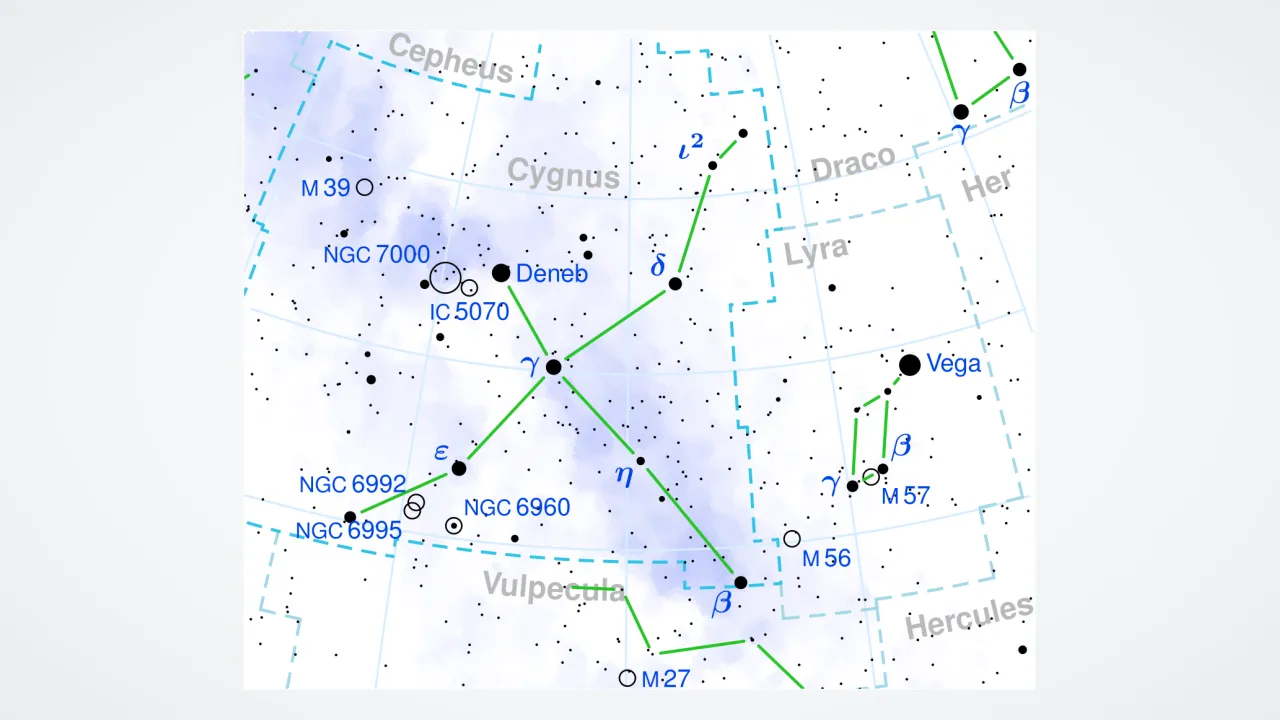
Step outside on a clear July evening and tilt your head high. Three bright stars form a huge shape called the . Deneb sparkles at one corner, marking the tail of Cygnus the Swan. Its name comes from an Arabic word that means tail.
2
Swallowing Inner Planets
Deneb is a blue-white supergiant of unbelievable size. If you placed Deneb where our Sun sits today, it would swallow Mercury and Venus whole. Its glowing edge would almost touch Earth!
3
A Champion of Distance
Light from Deneb travels about 2,600 years to reach Earth. Even from that huge distance, Deneb shines nearly 200,000 times brighter than our Sun.
2. If Deneb replaced our Sun, how far out would its glowing surface reach?
🤯 Mind-Blowing Fact • Grade 3
Deneb loses as much mass in a single year as Earth's entire rocky globe weighs every few centuries!
✨ Word Sparks (Grade 3 Glossary)
Tap 🔊 to hear
Milky Way
Our home galaxy of billions of stars
stellar wind
Fast gas streaming off a hot star
North Star
A star aligned above Earth's north pole
🪝
Why does Deneb look slightly dimmer than Vega even though Deneb is thousands of times more powerful?
1
High Overhead in Cygnus
Look straight up on an August night to spot Cygnus the Swan gliding down the . At the swan's tail blazes Deneb, one of the three bright corners of the famous Summer Triangle alongside Vega and Altair. It also crowns the top of the Northern Cross.
2
A Distant Cosmic Searchlight
Altair sits fewer than 17 light-years from Earth, and Vega is only 25 light-years away. Deneb, however, shines across roughly 2,600 light-years of space! It holds its own beside nearby stars only because it blasts out around 196,000 times more light than our Sun.
3
Fierce Stellar Winds
Weighing about nineteen times as much as our Sun, Deneb burns its nuclear fuel at a furious pace. Its searing 8,525-kelvin surface blows gas outward in a roaring forty million times stronger than our Sun's solar wind.
4
Future North Star
Earth wobbles slowly like a spinning top over thousands of years. Around the year 9800, Earth's North Pole will point near Deneb, making it our temporary !
1. How does Deneb's distance compare to its Summer Triangle partners Vega and Altair?
2. Why will Deneb serve as Earth's North Star around the year 9800?
🤯 Mind-Blowing Fact • Grade 4
If Deneb sat just 25 light-years away where Vega is located, it would shine as brightly as a waxing crescent Moon and cast crisp shadows at night!
✨ Word Sparks (Grade 4 Glossary)
Tap 🔊 to hear
photosphere
Visible glowing surface layer of a star
supernova
Colossal explosion of a massive dying star
spectral type
Code classifying star temperature and light
🪝
How can one blue-white star outshine nearly two hundred thousand Suns combined?
1
Hidden Titan of the Summer Sky
Stargazers tracing the Summer Triangle often notice that Vega appears brightest, Altair ranks second, and Deneb looks slightly softer in third place. Yet appearances in astronomy can be wonderfully deceptive. While Vega and Altair sit right in our local stellar neighborhood, Deneb blazes across an immense gulf of roughly 2,600 light-years, making it one of the farthest stars easily visible to the unaided human eye.
2
Anatomy of an A2 Ia Supergiant
Astronomers classify Alpha Cygni—Deneb—as a A2 Ia blue-white supergiant, the benchmark star for its entire class. Swollen to 203 solar radii, its diameter spans roughly 175 million miles (282 million kilometers). If transported to the center of our Solar System, Deneb's shimmering would engulf Mercury and Venus and reach nearly all the way to Earth's orbital path.
3
Pulsations and Roaring Winds
Deneb's outer atmosphere never sits completely still. Subtle gravity and pressure waves ripple continuously through its low-density glowing gas layers, causing its brightness and surface speed to pulse gently over cycles of days and weeks. Meanwhile, intense outward radiation pressure drives a hurricane-force stellar wind screaming at hundreds of miles per second, shedding nearly a millionth of a solar mass into space every single year.
4
Countdown to a Supernova
Because Deneb packs roughly nineteen solar masses, it burns through nuclear fuel at breakneck speed, living fast and dying young compared to yellow stars like our Sun. Within the next few million years, fusion in its core will forge solid iron and trigger a brilliant core-collapse visible even in Earth's daytime sky.
1. Why is Deneb considered one of the most impressive stars visible without a telescope?
2. How will Deneb eventually end its life in a few million years?
🤯 Mind-Blowing Fact • Grade 5
Giant convection plumes boiling across Deneb's vast photosphere are so huge that they actually shift the star's apparent center of light in space telescopes!
✨ Word Sparks (Grade 5 Glossary)
Tap 🔊 to hear
non-radial pulsations
Uneven surface waves rippling across a star
precession
Slow circular wobble of a planet's axis
ionize
Strip electrons from gas using fierce light
🪝
Why is measuring the exact distance to one of the sky's brightest stars still a thrilling astronomical challenge?
1
The Benchmark Alpha Cygni Variable
High along the glowing starry band of the northern Milky Way, Alpha Cygni—Deneb—anchors both the Northern Cross asterism and the famous Summer Triangle. Astronomers revere Deneb not only as a spectral standard for A2 Ia blue-white supergiants, but also as the prototype for Alpha Cygni variable stars: evolved supergiants whose extended, tenuous atmospheres quiver with dozens of overlapping , shifting their brightness and Doppler spectral lines over irregular cycles of days to weeks.
2
The Parallax Puzzle
Measuring Deneb's exact distance pushes modern astrometry to its physical limits. At roughly 2,600 light-years (around 800 parsecs), Deneb's annual parallax shift is barely 1.25 milliarcseconds—comparable to measuring the width of a dime from two thousand miles away! Furthermore, because Deneb dazzles spacecraft detectors with first-magnitude glare while giant convection plumes boil across its sprawling 282-million-kilometer disk, its apparent center of light jitters slightly, requiring astrophysicists to combine Hipparcos astrometry with spectroscopic stellar-atmosphere models.
3
Extreme Luminosity and Mass Loss
Formed fewer than ten million years ago as a scorching O-type main-sequence star of roughly twenty-three solar masses, Deneb has already exhausted its core hydrogen and expanded to 203 solar radii as it transitions toward red-supergiant territory. Today it radiates approximately 196,000 solar luminosities at 8,525 kelvins while shedding 0.8 millionths of a solar mass annually in a 240-kilometer-per-second wind—forty million times our Sun's mass-loss rate.
4
Sculpting Interstellar Space
Intense ultraviolet radiation and supersonic winds pouring from Deneb and neighboring massive stars in the Cygnus OB7 association sweep up and vast clouds of interstellar hydrogen nearby, helping illuminate landmarks such as the North America and Pelican Nebulae.
5
Precession and Supernova Destiny
Because Earth's rotational axis precesses like a gyroscope over a 25,772-year cycle, Deneb will sweep within seven degrees of the North Celestial Pole around 9800 CE—serving as humanity's pole star long before its iron core collapses in a spectacular Type II supernova.