🇺🇸 U.S. HISTORY
🏛️ Foundational Civic Milestone • Philadelphia (May–September 1787)
VA History & Social Science SOL K.1, 1.2, 2.4, VS.1–VS.10, USI & USII
Constitutional Convention (1787)
One Hot Summer That Built We the People
Grade 5 • Advanced • 344 words
⏳ Era / StatehoodConvened: May 25 – September 17, 1787
🗺️ Region / CapitalIndependence Hall, Philadelphia, Pennsylvania
📜 Key MilestoneDrafted the United States Constitution with Three Balanced Branches
⚡ Historical SparkUnited large and small states under the world's oldest written national constitution
🤯 Mind-Blowing Fact • Grade 1
Benjamin Franklin was eighty-one years old at the 1787 Convention, making him the oldest helper in the room!
✨ Word Sparks (Grade 1 Glossary)
Tap 🔊 to hear
Constitution
The main written rulebook for our nation's government
delegate
A person chosen to speak for a state
compromise
Each side giving a little to reach agreement
🪝
How do thirteen states agree on one fair rulebook together?
1
Warm Summer Days in Brick Hall
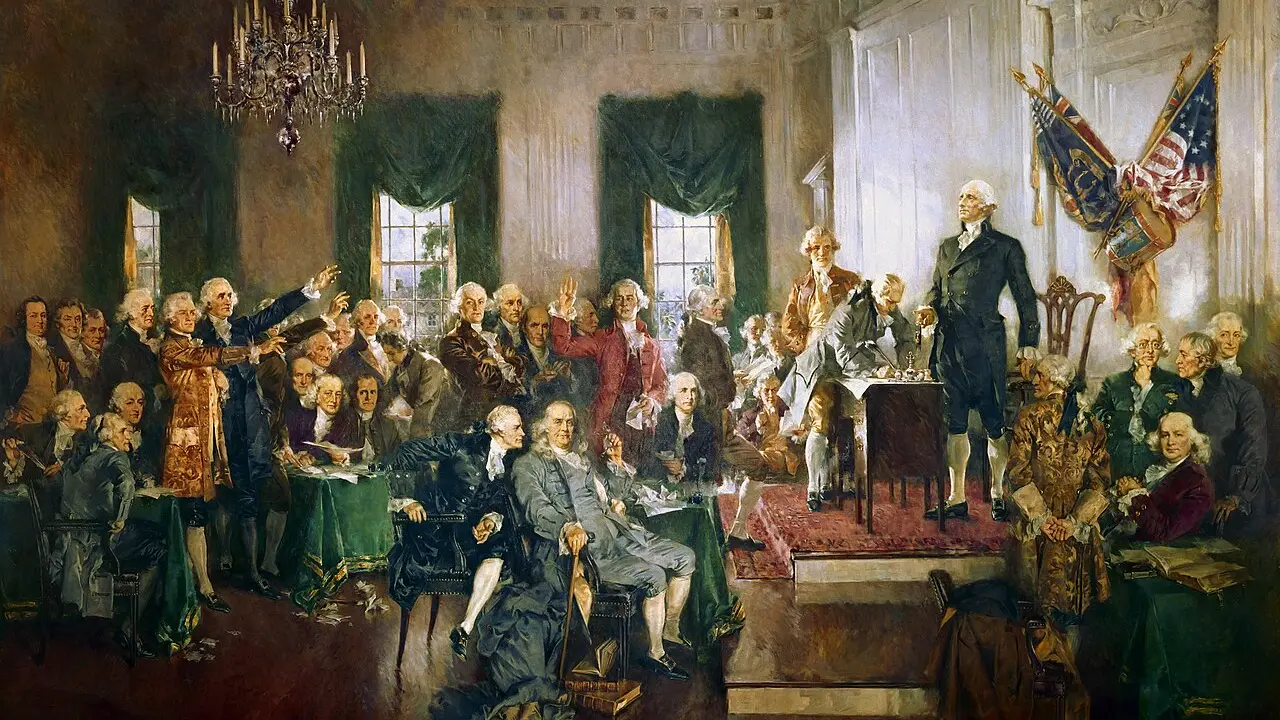
Tap goes the wooden gavel! Inside a red brick hall in Philadelphia, leaders sit around green tables. Windows stay shut so they can talk freely.
2
Writing a Stronger Plan
In the summer of 1787, America needed stronger national rules. George Washington led the meeting, and James Madison brought smart plans.
3
We the People
On September 17, 1787, they signed the United States . It still guides our country today!
1. In which city did leaders meet in 1787 to write the U.S. Constitution?
2. Who was chosen to lead the meetings at the Constitutional Convention?
🤯 Mind-Blowing Fact • Grade 2
Workers spread soft dirt over the cobblestone street outside Independence Hall so noisy wagon wheels would not interrupt the delegates' thinking!
✨ Word Sparks (Grade 2 Glossary)
Tap 🔊 to hear
branches
Separate parts of government sharing national jobs
debate
Discussing different ideas carefully before voting
Preamble
Opening sentence explaining the Constitution's big goals
🪝
Why did fifty-five leaders keep all the windows shut during a sizzling Philadelphia summer?
1
Secret Talks in Independence Hall
Whew, it was hot inside Independence Hall in Philadelphia during the summer of 1787! Fifty-five delegates from twelve states shut the tall windows so they could openly and change their minds without outside rumors.
2
Washington Leads and Madison Plans
After winning independence, America's first rulebook—the Articles of Confederation—proved too weak to unite the states. Delegates chose Virginian George Washington to lead the Convention while James Madison arrived early with notebooks full of ideas for three balanced .
3
A Rising Sun on September 17
Through patient compromise, thirty-nine delegates signed the new Constitution on September 17, 1787, beginning with 'We the People'!
1. Which Virginian came prepared with detailed plans and earned the nickname 'Father of the Constitution'?
2. What are the famous first three words of the U.S. Constitution?
🤯 Mind-Blowing Fact • Grade 3
Every year on September 17, schools and citizens across America celebrate Constitution Day on the exact anniversary of the 1787 signing!
✨ Word Sparks (Grade 3 Glossary)
Tap 🔊 to hear
bicameral
Having two lawmaking chambers inside Congress
republic
Government where citizens elect representatives to make laws
preside
To lead a formal meeting fairly and calmly
🪝
How did big states like Virginia and small states like Delaware solve an argument that nearly broke up the Convention?
1
Why the Articles Needed Fixing
Four years after winning the Revolutionary War, the young United States faced trouble under its first government, the Articles of Confederation. Congress could not collect taxes, settle trade arguments between states, or maintain a unified currency, so delegates gathered at Philadelphia's Independence Hall in May 1787.
2
Virginia Leadership in the Room
Every single state present voted for George Washington to over the Convention. Meanwhile, fellow Virginian James Madison studied ancient and modern for months, shaping the Virginia Plan for three branches—legislative, executive, and judicial—and taking careful daily notes.
3
The Great Compromise
Large states wanted representation in Congress based on population, while small states demanded equal votes so they would not be outvoted. Connecticut's Roger Sherman proposed the Great Compromise: a two-house Congress with a House of Representatives based on population and a Senate giving every state two senators.
4
Signed on Constitution Day
On September 17, 1787, Benjamin Franklin pointed to the half-sun carved on Washington's chair, calling it a rising sun for a united .
1. How did Roger Sherman's Great Compromise satisfy both large states and small states?
2. What did Benjamin Franklin say about the carved sun on the back of George Washington's chair?
🤯 Mind-Blowing Fact • Grade 4
James Madison promised fellow delegates not to publish his secret handwritten notes until every framer had passed away—and as the last surviving delegate, his notes finally appeared after 1836!
✨ Word Sparks (Grade 4 Glossary)
Tap 🔊 to hear
checks and balances
Rules letting each government branch limit the others
proportional
Matched in number to a state's population size
ratify
To approve a document officially by voting
🪝
How did four months of intense debate in Philadelphia invent a system of checks and balances that still operates more than two centuries later?
1
From Weak Confederation to Bold Blueprint
Step into the Assembly Room of the Pennsylvania State House—now Independence Hall—on May 25, 1787, Window panes rattled as rain drummed against tall multipaned windows. Twelve states—all except Rhode Island—sent fifty-five delegates originally authorized to revise the Articles of Confederation, which lacked an executive branch, national courts, or power to regulate interstate commerce. Realizing patchwork fixes would fail, the delegates boldly set out to frame an entirely new Constitution.
2
George Washington and the Father of the Constitution
Virginia's delegation anchored the Convention's leadership. George Washington's quiet dignity in the presiding chair reminded competing states of their shared Revolutionary sacrifice. Thirty-six-year-old James Madison arrived eleven days early carrying trunks of history books sent from Paris by Thomas Jefferson. Presented by Governor Edmund Randolph, Madison's Virginia Plan proposed dividing federal authority among legislative, executive, and judicial branches equipped with so no single branch could grow tyrannical.
3
Deadlock and the Connecticut Compromise
Sweltering July heat matched heated arguments when William Paterson introduced the New Jersey Plan favoring equal state votes. Just as talks neared collapse, Roger Sherman and Oliver Ellsworth championed the Connecticut—or Great—Compromise: representation in the House of Representatives balanced by two equal seats per state in the Senate. Painful compromises over trade and slavery left unresolved moral contradictions that later generations had to confront through constitutional amendments.
4
Committee of Style and Ratification
Gouverneur Morris polished the final parchment into clear prose opening with 'We the People of the United States.' Signed by thirty-nine delegates on September 17, 1787, the Constitution took effect after nine states ratified it in 1788.
1. Which three branches of government were proposed in James Madison's Virginia Plan?
2. Which delegate polished the final wording of the Preamble beginning 'We the People of the United States'?
🤯 Mind-Blowing Fact • Grade 5
Written across just four sheets of parchment totaling roughly 4,543 words, the original 1787 U.S. Constitution is the shortest—and oldest—written national constitution still in force anywhere in the world!
✨ Word Sparks (Grade 5 Glossary)
Tap 🔊 to hear
federalism
Sharing government power between national and state levels
sovereignty
Supreme authority of people or states to govern
unicameral
Having only one single lawmaking chamber
🪝
How did fifty-five delegates balance energetic national governance against state sovereignty to create the world's longest-surviving written national constitution?
1
Crisis of the Confederation Era
Following the 1783 Treaty of Paris, the thirteen sovereign states struggled under the Articles of Confederation—a loose league lacking a national executive, a federal judiciary, taxation authority, or power to prevent interstate tariff wars. Alarmed by economic stagnation and Shays' Rebellion in Massachusetts, reform-minded leaders including James Madison and Alexander Hamilton met first at Mount Vernon and Annapolis before calling a federal convention at Philadelphia's Pennsylvania State House in May 1787.
2
Deliberation Behind Closed Doors
Between May 25 and September 17, 1787, fifty-five delegates from twelve states (Rhode Island declined to attend) convened for 89 working days. Unanimously electing George Washington presiding officer lent indispensable national legitimacy, while adopting a strict rule of confidentiality enabled delegates to modify positions on principle rather than political posturing. Seated directly below the dais, Virginian James Madison recorded speeches almost verbatim, earning lasting recognition as 'Father of the Constitution.'
3
Federalism, Separation of Powers, and Compromise
Introduced by Virginia Governor Edmund Randolph on May 29, Madison's Virginia Plan replaced confederation with —sharing between national and state governments—and separated federal powers across legislative, executive, and judicial branches linked by mutual checks and balances. When small states countered with William Paterson's New Jersey Plan, Roger Sherman's July 16 Connecticut Compromise averted dissolution by apportioning the House of Representatives by population and granting each state two senators. Delegates also devised the Electoral College and a painful Three-Fifths and slave-trade compromise—flaws later abolished only by the Civil War Amendments.
4
We the People and Dissenters of Principle
In September, the five-member Committee of Style, led by Gouverneur Morris, condensed twenty-three articles into seven streamlined articles of roughly 4,500 words, anchoring not in separate states, as drafts initially read, but in 'We the People of the United States.' Three delegates present on September 17—including Virginians George Mason and Edmund Randolph—declined to sign without an explicit Bill of Rights.
5
Ratification and Living Constitutional Framework
Submitted to specially elected state ratifying conventions under Article VII, the Constitution inspired The Federalist Papers by Hamilton, Madison, and John Jay, won ratification upon New Hampshire's ninth vote in June 1788, and incorporated Article V's amendment mechanism—allowing future generations to expand liberty and fulfill its promise of 'a more perfect Union.'