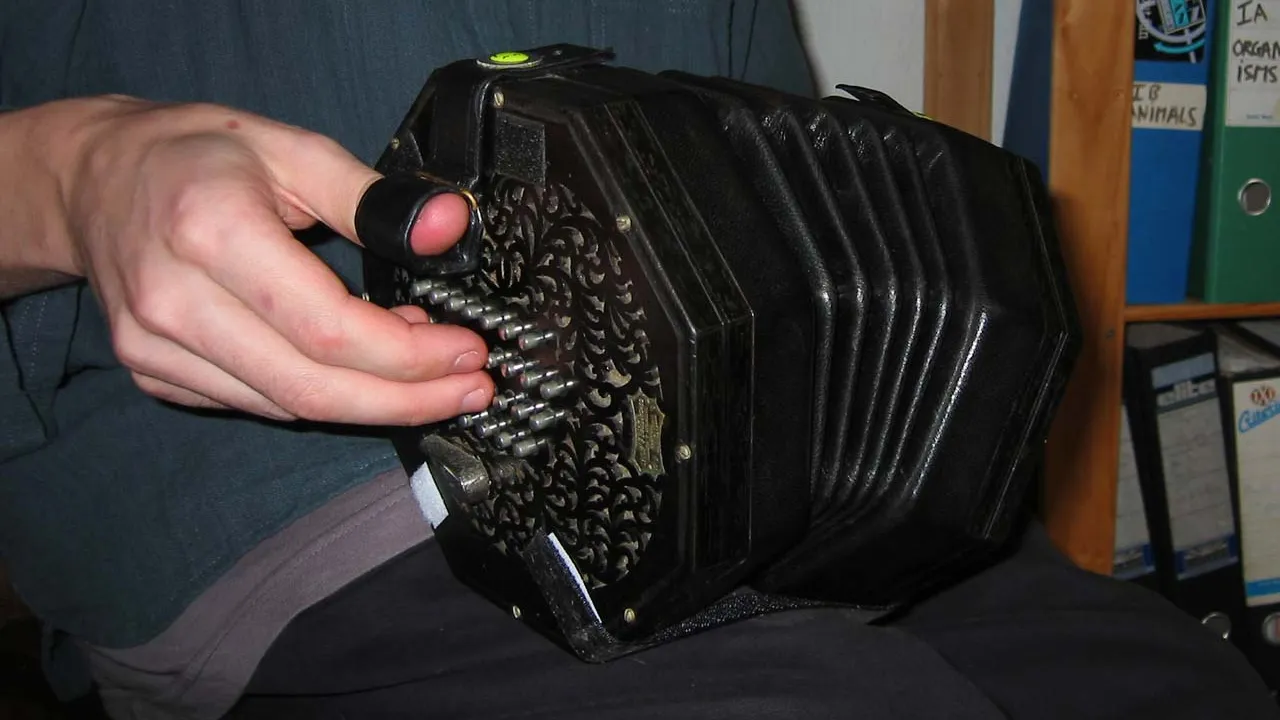
1. What special geometric shape are the flat ends of most concertinas?
2. Where are the buttons located on a concertina?
🤯 Mind-Blowing Fact • Grade 2
Arctic explorer Ernest Shackleton's crew kept spirits bright on frozen polar ice in 1915 accompanied by meteorologist Leonard Hussey's treasured concertina!
✨ Word Sparks (Grade 2 Glossary)
Tap 🔊 to hear
physicist
Scientist studying energy, motion, and sound
fretwork
Lacy carved patterns letting sound escape
alternate
Take turns back and forth evenly
🪝
What happens when a famous electricity scientist decides to invent a musical instrument?
1
Invented in a Science Lab
In 1829 London, Sir Charles Wheatstone was studying how sound waves and electricity travel. Fascinated by vibrating metal reeds, he designed a tiny six-sided squeezebox delicate enough for drawing-room concerts!
2
Pushing Straight Inward
How can you tell a concertina apart from an accordion or bandoneon? Look at the buttons! Accordion keys sit along the front edge, whereas concertina buttons sit flat on the outer ends and push straight in toward the bellows.
3
Trading Notes Left and Right
On Wheatstone's English model, the notes of a scale bounce back and forth—left hand, right hand, left hand, right hand—so fingers never trip over each other during speedy songs and cheerful sea shanties!
1. How does button direction distinguish a concertina from an accordion?
2. Who patented the English concertina while researching acoustics in London?
🤯 Mind-Blowing Fact • Grade 3
In Victorian England, Classical composers wrote concertos for whole concertina quartets—treble, tenor, bass, and contrabass!
✨ Word Sparks (Grade 3 Glossary)
Tap 🔊 to hear
reed pan
Wheel-shaped wooden disc holding concertina reeds
hornpipe
Lively sailor and Irish folk dance tune
quartet
Musical group of four matching performers
🪝
Why do concertina players choose between two cousin designs—English and Anglo—that look nearly identical on the outside?
1
Twin Cousins Inside Six Sides
Hold up two hexagonal concertinas side by side and even sharp-eyed listeners might think they are twins. Yet start squeezing and you will discover two clever cousin systems: the English concertina and the Anglo-German concertina!
2
English: Built for Violin Music
Wheatstone's English concertina is unisonoric, meaning each button sounds the same pitch whether pushing or pulling. Even better, scale notes alternate neatly—staff lines on one hand, staff spaces on the other—letting classical soloists zip through dazzling violin concertos!
3
Anglo: Built for Bouncy Dance Rhythms
Blending German push-pull bisonoric reeds with compact English six-sided cases created the thirty-button Anglo concertina. Changing bellows direction on every note gives Irish reels, jigs, and sailor an irresistible rhythmic lift!
4
Radial Reed Pan
Inside each polished endplate, forty-eight or sixty individual steel reeds sit arranged like wheel spokes around a circular wooden disc called a , keeping every chamber compact, airtight, and crystal clear.
1. How did Sir Charles Wheatstone divide musical notes between the two hands on an English concertina?
2. Why do traditional Irish dance musicians love the thirty-button Anglo concertina?
🤯 Mind-Blowing Fact • Grade 4
On an English concertina, the thumbs stay looped into straps while the pinky fingers prop under metal rests—leaving just six middle fingers to play four full chromatic octaves!
✨ Word Sparks (Grade 4 Glossary)
Tap 🔊 to hear
pallet
Padded valve flap sealing an air hole
axial
Moving straight along the main center line
lag
Tiny delay between action and response
🪝
How do forty-eight steel reeds fit inside a six-inch hexagon without tangling their levers together?
1
Parallel Action Mechanics
Peer behind the pierced nickel-silver or rosewood fretwork of a concertina and you see miniature watchmaker precision. Because buttons travel parallel to the axis of the bellows rather than at right angles, short direct pins lift leather-faced right off radial chambers with almost zero mechanical —yielding crisp, feather-light finger response.
2
Clamped vs. Riveted Reeds
High-grade concertinas differ internally from harmonicas and accordions in one prized detail: instead of riveting reeds permanently onto shared long plates, traditional English makers screw or clamp each individual steel tongue into its own separate brass frame slotted into the radial reed pan! If one reed ever goes flat during a tour, a craftsperson slides out that single frame in seconds.
3
Three Branches: English, Anglo, and Duet
Alongside the unisonoric English and bisonoric thirty-button Jeffries- or Lachenal-style Anglo sits a third marvel: the Duet concertina—including Maccann, Crane, and Hayden systems—which separates unisonoric bass ranges on the left from overlapping treble ranges on the right for solo two-hand harmony.
4
Clare Farmhouse Sessions and Sea Voyages
Carried from Victorian parlors and tall-ship forecastles to rural farmhouses in County Clare on Ireland's west coast, masters like Elizabeth Crotty and Noel Hill turned the three-row C/G Anglo concertina into an enduring icon of Celtic chamber tradition.
1. Why does parallel button action make concertina keys respond so lightly and instantaneously?
2. How are reeds mounted inside a fine traditional concertina compared to a standard harmonica?
🤯 Mind-Blowing Fact • Grade 5
Early Victorian English concertinas were tuned so precisely in meantone temperament that they actually had separate buttons for G-sharp and A-flat—two different pitches that pianos merge into one black key!
✨ Word Sparks (Grade 5 Glossary)
Tap 🔊 to hear
coaxial
Aligned along the exact same central axis
enharmonic
Spelled differently in music like G-sharp/A-flat
meantone
Historical tuning prioritizing pure sweet major thirds
🪝
How did Sir Charles Wheatstone's acoustic experiments produce a palm-sized free-reed instrument that originally rivaled the concert violin in Victorian symphony halls?
1
Axial Ergonomics in Hornbostel-Sachs Taxonomy
From a compact six-inch hexagonal prism springs a crystalline cascade of sixteenth notes spanning three and a half chromatic octaves. Within free-reed organology (Hornbostel-Sachs 412.132), the concertina—independently conceptualized by Carl Friedrich Uhlig in Chemnitz (1834) and patented in London by physicist Sir Charles Wheatstone (1829, 1844)—distinguishes itself structurally by mounting finger pistons coaxially on polygonal endplates, moving strictly parallel to bellows expansion.
2
Aeroacoustics of Individual Radial Reed Chambers
Inside classic Wheatstone and Lachenal instruments, individual tempered-steel or phosphor-bronze tongues are clamped with miniature screws into machined brass shoes seated radially around a turned mahogany reed pan. Because each tiny wedge-shaped cavity matches the volume of its reed—ranging on a standard forty-eight-key treble English model from violin G3 (196 hertz) to C7 (2,093 hertz)—transient response is remarkably rapid and upper-partial purity approaches bowed string clarity.
3
Historical Temperament and Enharmonic Design
As an experimental acoustician, Wheatstone initially tuned early forty-eight-button English concertinas in quarter-comma temperament! Remarkably, his four-row layout provided separate buttons for D-sharp and E-flat (and G-sharp versus A-flat), allowing nineteenth-century child prodigy and virtuoso Giulio Regondi to perform with acoustically pure, beatless major thirds before twelve-tone equal temperament became universal.
4
Divergent Taxonomies: English, Anglo, and Duet
Whereas the unisonoric English layout alternates diatonic pitches bilaterally (staff lines left, spaces right) using the middle three fingers while thumbs and little fingers support the chassis, the bisonoric thirty-button C/G Anglo-German hybrid hooks four fingers per hand beneath a leather palm strap, exploiting bellows reversals for crisp rhythmic articulation in County Clare Irish traditional music. Meanwhile, Maccann, Crane, and Hayden Duet systems arrange unisonoric isomorphic grids for solo contrapuntal accompaniment.
5
Enduring Legacy Across Oceans
Whether inspiring Victorian orchestral concertos by Bernhard Molique and praises from Hector Berlioz, accompanying nineteenth-century whaling crews and Antarctic expeditions, or thriving in South African Boeremusiek and Zulu maskandi folk styles, the concertina packs extraordinary mechanical intelligence into minimal volume.