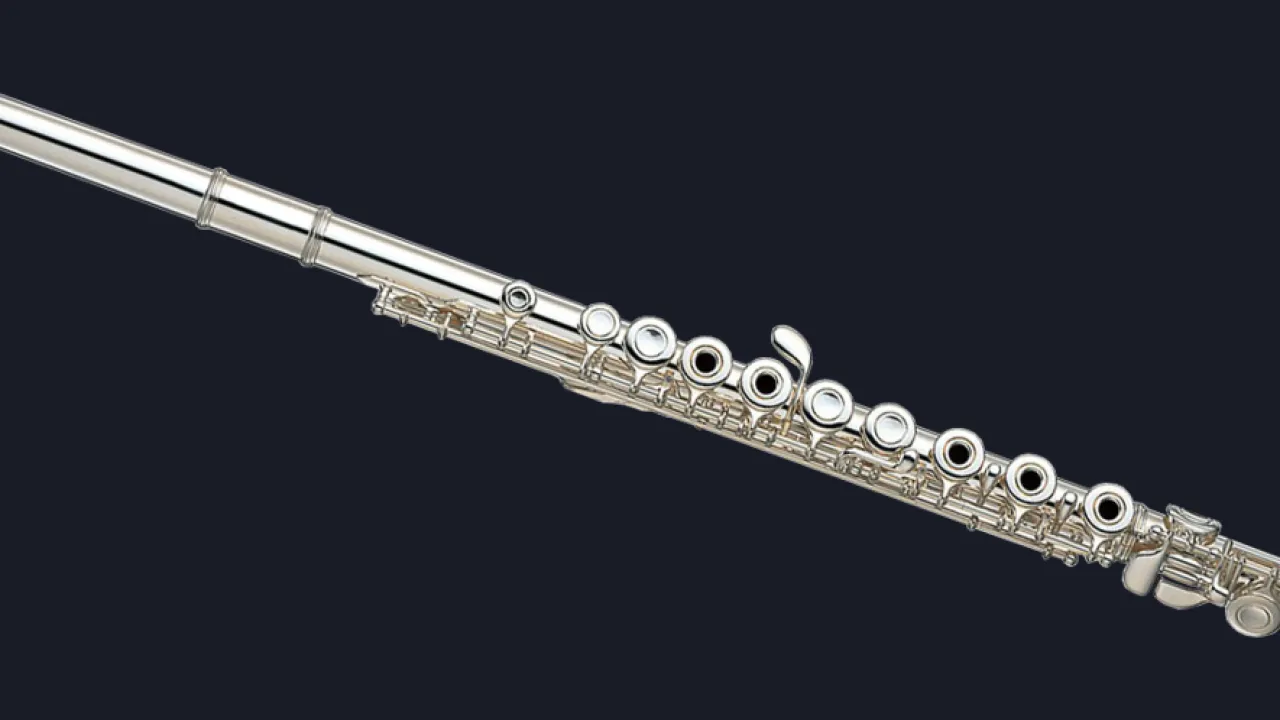
1. How does a flutist blow air to make the concert flute sing?
2. Why does a shiny metal concert flute belong to the 'woodwind' family?
🤯 Mind-Blowing Fact • Grade 2
Out of every wind instrument in the orchestra, the concert flute uses the most air because half the player's breath escapes right across the top of the lip plate!
✨ Word Sparks (Grade 2 Glossary)
Tap 🔊 to hear
trill
Rapidly wiggling between two neighboring musical notes.
joint
One of three sections forming a flute.
reed
Thin cane strip that clarinetists vibrate.
🪝
How can nine pressing fingers cover sixteen tone holes all at once?
1
Spinning Breath into Song
Breathe in—glide—! Without any strings to pluck or to buzz, pure air turns into sparkling melody! Held sideways to the right, a silver concert flute stretches just over two feet long after clicking three neat sections together.
2
Sixteen Holes for Nine Fingers
A concert flute needs sixteen wide tone holes to play clear, strong notes—yet our left thumb hangs underneath while our right thumb holds the tube up! That leaves only nine fingers free to press keys!
3
Clever Linked Metal Rods
In 1847, a German inventor named Theobald Boehm solved that puzzle with smart linked rods and padded silver cups. Pressing down just one key can quietly close two or three distant holes at the exact same moment!
1. Why does the concert flute require more breath than instruments like the oboe or clarinet?
2. Who invented the clever linked key-and-rod system on modern concert flutes in 1847?
🤯 Mind-Blowing Fact • Grade 3
Inside the top end of every concert flute's headjoint hides a movable cork stopper—and sliding it even one millimetre out of place throws high notes out of tune!
✨ Word Sparks (Grade 3 Glossary)
Tap 🔊 to hear
embouchure
Exact lip shape used on wind instruments.
transverse
Held sideways across rather than straight forward.
overblow
Speeding air up to jump an octave.
🪝
How does one silver tube leap up a whole octave without opening any extra keys?
1
Velvet Lows and Stratospheric Highs
Hoooo—flutter—tweet! In Claude Debussy's dreamy solos, low notes purr like warm velvet; seconds later, Peter and the Wolf's playful bird darts three octaves higher! Held horizontally—or —the concert flute shines at the very front of the woodwind section.
2
Three Precision Joints
Before warming up, a flutist twists together three gleaming silver or gold tubes: the headjoint carrying the curved lip plate, the long keyed body joint, and the short footjoint reaching down to middle C or low B.
3
Embouchure and Edge Tones
Shaping their lips into a focused smile-and-pout called an , the player aims a fast ribbon of air against the sharp outer edge of the embouchure hole. Rapidly flipping above and inside that edge, the air jet sets the whole air column vibrating!
4
Overblowing into Higher Octaves
Closing more tone holes lengthens the vibrating air column for lower pitches. To leap an octave higher using the same fingerings, the flutist narrows and speeds up their air stream—overblowing so the air column splits cleanly in half!
1. What happens inside the flute's tube when a player 'overblows' with a faster, narrower air stream?
2. Which three pieces twist together to form a complete concert flute?
🤯 Mind-Blowing Fact • Grade 4
Composer Edgard Varese wrote a famous three-minute solo piece called 'Density 21.5' in 1936 specifically to celebrate the density of a newly crafted platinum flute—21.5 grams per cubic centimetre!
✨ Word Sparks (Grade 4 Glossary)
Tap 🔊 to hear
cylindrical
Shaped like a straight, even-width round tube.
parabolic
Gently curving taper inside a flute's headjoint.
piccolo
Half-sized flute sounding one full octave higher.
🪝
Why did an 1847 Munich goldsmith turn an ancient conical wooden flute upside down in shape?
1
Sculpting Invisible Columns of Air
What would happen if your musical instrument contained zero vibrating strings, zero stretched drumskins, and zero cane reeds—relying solely on a ribbon of air dancing across a bevelled silver edge? Across symphonies, jazz combos, and film scores, the Western concert flute proves that vibrating air alone can rival any violin in agility and color.
2
Why Wooden Flutes Struggled Before 1847
For centuries, Baroque and Classical wooden transverse flutes had a conical body—wide at the head and tapering narrower toward the foot—with small holes spaced only where human fingers could stretch. Unfortunately, tiny, unevenly placed holes muffled volume and made certain keys sound stuffy and out of tune.
3
Theobald Boehm's Acoustic Revolution
After studying acoustics at the University of Munich, Bavarian virtuoso and royal goldsmith Theobald Boehm flipped flute geometry on its head in 1847! He made the main body purely while curving the headjoint inward in a subtle taper. Next, he cut large tone holes at their mathematically ideal acoustic spots—regardless of finger reach—and invented spring-loaded clutch keys on long steel rods to cover them.
4
Precious Metals and Flute Choirs
Today, concert flutes gleam in sterling silver, rose gold, platinum, or dense African grenadilla wood, anchoring an entire flute family from the sparkling half-size up to mellow alto, bass, and towering contrabass flutes!
1. How did Theobald Boehm reverse the bore shape of older wooden flutes in his 1847 breakthrough?
2. Why were older Baroque wooden flutes quieter and trickier to play in tune across all keys?
🤯 Mind-Blowing Fact • Grade 5
Because a concert flute behaves acoustically as a pipe open at *both* ends, overblowing unlocks *every* whole-number harmonic (2x, 3x, 4x)—unlike a cylindrical clarinet, which acts closed at one end and skips even harmonics!
✨ Word Sparks (Grade 5 Glossary)
Tap 🔊 to hear
aerophone
Instrument creating sound primarily through vibrating air.
labium
Sharp outer bevelled edge splitting blown air.
multiphonic
Advanced technique sounding two notes at once.
🪝
How do fluid-dynamic edge jets, open-pipe standing waves, and Boehm's parabolic-cylindrical bore unite across three and a half octaves?
1
Aerodynamic Virtuosity from 247 to 2,349 Hertz
Suspended horizontally across the performer's chin with zero reed and zero mouthpiece cup, the modern Western concert flute (in C) transforms human breath directly into luminous acoustic energy. Measuring roughly sixty-seven centimetres in assembled length with a nineteen-millimetre cylindrical bore, an orchestral flute fitted with a B-footjoint commands more than three chromatic octaves—from velvety B3 (246.9 hertz) to whistling D7 (2,349.3 hertz) and beyond.
2
Forty Millennia of Aerophones to 1847 Munich
Classified under Hornbostel-Sachs 421.121.12 as a side-blown open-tube edge with fingerholes and keys, transverse flutes trace roots to Paleolithic Swabian Jura bone flutes (~40,000 BCE) and ninth-century BCE Chinese chi and dizi flutes. Entering Europe via Byzantine and medieval German fife traditions, the Baroque one-keyed conical wooden traverso of Jacques-Martin Hotteterre reigned until Munich acoustician, flutist, and goldsmith Theobald Boehm unveiled his 1847 metal cylindrical flute after studying physics under Carl Emil von Schafhäutl.
3
Jet-Drive Fluid Dynamics and Open-Pipe Harmonics
Sound generation relies on a self-sustained fluid-dynamic oscillator. Shaping lips into a precise aperture (embouchure), the flutist directs a laminar air ribbon across the embouchure hole against its sharp opposite riser edge (). Acoustic pressure fluctuations inside the resonator deflect the air jet alternately into the tube and out into room air, locking into phase with longitudinal standing waves. Because both the embouchure hole and the first uncovered tone hole vent to atmospheric pressure, the flute behaves acoustically as an open-open pipe—supporting a complete harmonic series (1x, 2x, 3x, 4x) so jet velocity and lip-to-edge distance overblow cleanly into second- and third-octave registers.
4
Parabolic Headjoint Correction and Clutch Keywork
A purely cylindrical tube goes progressively flat in upper registers due to end-correction shifts at the embouchure hole. Boehm solved this by tapering the uppermost headjoint section subtly from nineteen down to seventeen millimetres in a parabolic curve sealed by a screw-adjustable tuning cork. Across the body, sixteen wide tone holes vented by open-standing padded cups and ring/plateau keys link via concentric rod-axles and pinless clutches.
5
Extended Timbres and Modern Consorts
From Claude Debussy's 'Syrinx' to twenty-first-century avant-garde scores, flutists expand expression with flutter-tonguing, whistle tones, percussive key clicks, and alongside piccolo, alto (in G), and bass flutes.
1. Why did Theobald Boehm add a subtle parabolic inward taper to the headjoint of his otherwise cylindrical 1847 flute?
2. Acoustically, why can a concert flute overblow up one single octave (2x frequency), whereas a cylindrical clarinet overblows a twelfth (3x frequency)?