2. How long could people see Comet Hale-Bopp in the sky without a telescope?
🤯 Mind-Blowing Fact • Grade 2
Comet Hale-Bopp won't swing back through the inner Solar System again until around the year 4385!
✨ Word Sparks (Grade 2 Glossary)
Tap 🔊 to hear
amateur
Someone who explores science for pure love
cluster
A close group of stars shining together
distinct
Clear and easy to tell apart
🪝
How could two skywatchers spot Comet Hale-Bopp when it was still farther away than Jupiter?
1
A Backyard Surprise
On July 23, 1995, astronomer Alan Hale in New Mexico and stargazer Thomas Bopp in Arizona both aimed telescopes at a star . Right beside it glowed a strange fuzzy smudge! Even though it was still past Jupiter's orbit, this incoming comet was already puffing out bright gas.
2
The Great Comet of 1997
Most comet cores measure just a few miles wide, yet Hale-Bopp's icy heart spans roughly 30 miles across! By spring 1997, it blazed brighter than almost every star in the night sky, even shining through bright city streetlights.
3
Two Colorful Tails
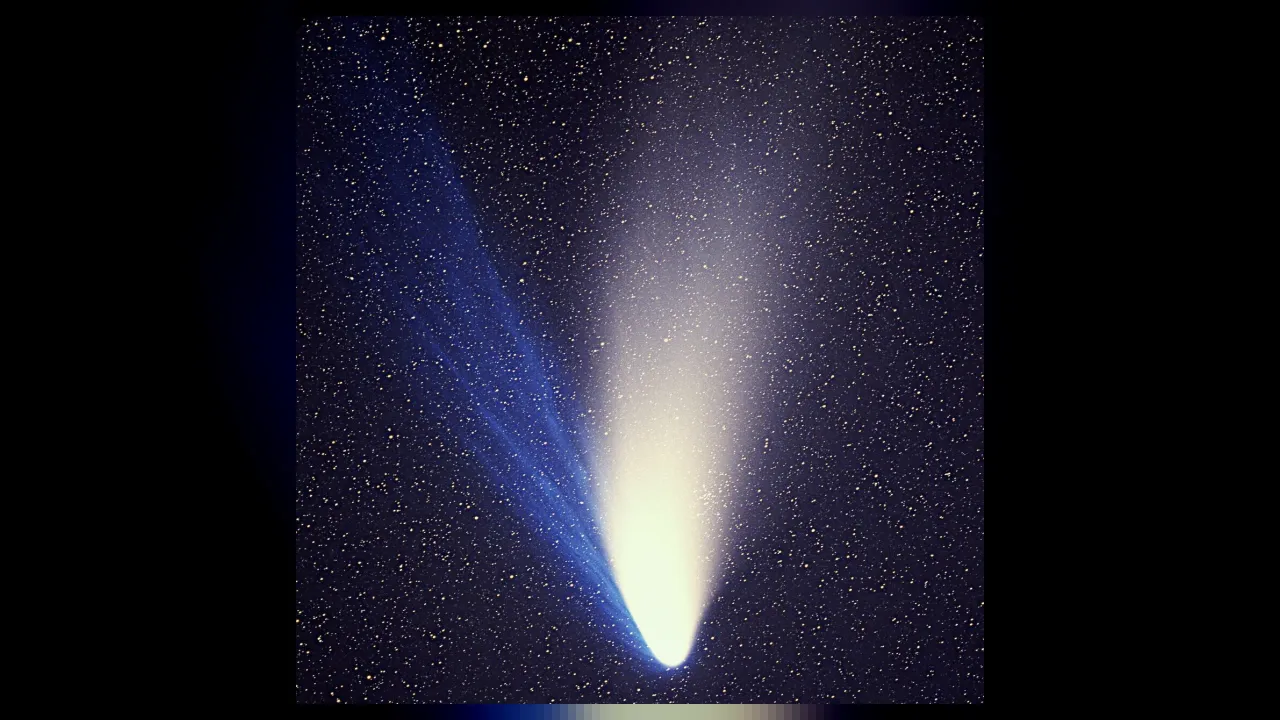
Skywatchers marveled at two tails side by side: a fan-shaped white dust tail and a straight, electric-blue gas tail!
1. Why was Comet Hale-Bopp already bright when it was still past Jupiter?
2. What two colors were Hale-Bopp's main visible tails in 1997?
🤯 Mind-Blowing Fact • Grade 3
During its previous visit around 4,200 years ago, ancient Egyptians were building pyramids along the Nile River!
✨ Word Sparks (Grade 3 Glossary)
Tap 🔊 to hear
plasma
Electrically charged gas glowing in space
sodium
A chemical element also found in salt
filter
Special lens layer blocking all but chosen light
🪝
How did scientists discover a secret THIRD tail hiding on Comet Hale-Bopp?
1
Spotted Seven Astronomical Units Out
Imagine looking at star cluster M70 on a summer night in 1995 and noticing an unmapped glowing cloud! Professional astronomer Alan Hale and factory worker Thomas Bopp independently reported comet C/1995 O1 while it was still 7.2 astronomical units from the Sun—between Jupiter and Saturn. Most comets stay completely frozen and invisible at that distance, warning astronomers that a monster was approaching.
2
A Mega-Nucleus from the Oort Cloud
Hubble Space Telescope measurements showed Hale-Bopp's icy nucleus spans 25 to 37 miles wide—nearly the size of Rhode Island! Spinning once every eleven hours, it sprayed pinwheel jets of carbon monoxide, water steam, and silicate dust.
3
The Surprise Sodium Tail
In spring 1997, millions of people admired its bright white dust tail and blue tail. Special camera in the Canary Islands then revealed a thin, 30-million-mile third tail made purely of glowing atoms!
4
Jupiter Shortens Its Schedule
Before 1997, Hale-Bopp last visited Earth around 2215 BCE during ancient Egypt's Old Kingdom. A gravitational tug from Jupiter trimmed its future loop down to about 2,530 years.
1. What surprising third tail did special telescope filters uncover on Comet Hale-Bopp?
2. How did Jupiter change Comet Hale-Bopp's orbit during its 1996–1997 pass?
🤯 Mind-Blowing Fact • Grade 4
Thomas Bopp didn't even own a telescope on the night he co-discovered the comet—he borrowed a friend's homemade telescope in the Arizona desert!
✨ Word Sparks (Grade 4 Glossary)
Tap 🔊 to hear
magnitude
Scale astronomers use to measure sky brightness
deuterium
Heavier form of hydrogen found in space ice
spectrograph
Instrument splitting starlight to read chemical clues
🪝
Why could Comet Hale-Bopp erupt with towering gas jets while still freezing past Jupiter's orbit?
1
Carbon Monoxide Super-Jets in the Deep Cold
Water ice stays frozen rock-hard out past Jupiter, which is why ordinary comets remain sleepy and dim until crossing Mars's orbit. Yet when Alan Hale and Thomas Bopp spotted C/1995 O1 at 7.2 astronomical units in July 1995, a vast dust coma already surrounded it! Radio telescopes soon solved the mystery: super-volatile carbon monoxide ice—which sublimates at temperatures near minus 400 degrees Fahrenheit—was roaring out of Hale-Bopp's 30-mile nucleus and blasting tons of ancient dust into space.
2
Shattering the 1811 Visibility Record
Even though Hale-Bopp's April 1, 1997 perihelion kept it 0.91 astronomical units from the Sun and 122 million miles from Earth, its colossal surface area made it shine at -1.8—outshining every star in the sky except Sirius! Observers tracked it with unaided eyes for 569 consecutive days, doubling the record set by the Great Comet of 1811.
3
Three Tails and Heavy Water Clues
Alongside its curving dust fan, blue ionized gas streamer, and newly discovered neutral sodium tail, detected complex organic molecules and -rich 'heavy water.' Because Hale-Bopp carried twice the heavy-water ratio of Earth's oceans, astronomers realized Oort Cloud comets alone could not have supplied all of Earth's water.
4
Still Active Beyond Pluto
Decades after perihelion, large telescopes still photograph Hale-Bopp beyond 30 AU, wrapped in a faint carbon monoxide coma as it heads toward its year-4385 return.
1. Which super-cold ice allowed Comet Hale-Bopp to spout dust jets while still past Jupiter?
2. What did Hale-Bopp's high ratio of deuterium ('heavy water') suggest about Earth's oceans?
🤯 Mind-Blowing Fact • Grade 5
Infrared spectra of Comet Hale-Bopp revealed tiny green crystals of olivine—the exact same mineral as the gemstone peridot—floating inside its dusty coma!
✨ Word Sparks (Grade 5 Glossary)
Tap 🔊 to hear
heliocentric
Measured outward from the center of the Sun
olivine
Green silicate mineral formed in high heat
isotope
Version of an element with extra neutrons
🪝
How did the 'Great Comet of 1997' transform modern cometary chemistry—from interstellar organics to noble gases?
1
Serendipity at Messier 70
Just before midnight on July 23, 1995, planetary PhD Alan Hale scanned globular cluster M70 in Sagittarius from his New Mexico driveway while construction materials manager Thomas Bopp peered through a friend's 17.5-inch Dobsonian reflector near Stanfield, Arizona. Within minutes of one another, both spotted an eleventh-magnitude fuzzball creeping against the stars. Orbit calculations stunned the International Astronomical Union: C/1995 O1 lay 7.2 astronomical units away yet shone a thousand times brighter than 1P/Halley had at the same distance.
2
Anatomy of a 60-Kilometer Cryogenic Engine
Submillimeter and Hubble imaging pinned Hale-Bopp's nucleus between 40 and 60 kilometers in diameter, packing roughly one hundred times Halley's mass and rotating every 11.4 hours. Driven initially by carbon monoxide sublimation and later by roaring water-vapor geysers inside 3 AU, the comet ejected over 100 metric tons of dust and gas every second near its April 1, 1997 perihelion (0.914 AU), sustaining naked-eye visibility for an unprecedented 18.5 months despite passing no closer than 1.315 AU to Earth.
3
Sodium Radiation Pressure and Interstellar Chemistry
Wide-field narrowband imaging at La Palma revealed a straight, 50-million-kilometer third tail composed of neutral sodium atoms accelerated directly antisunward by resonant solar photon scattering. Meanwhile, radio and infrared telescopes cataloged more than twenty molecular species—including formamide, methyl formate, and ethylene glycol—plus crystalline dust forged near the infant Sun and mixed outward into the pre-solar nebula.
4
Isotopic Fingerprints and Argon Clues
Sounding-rocket ultraviolet spectra detected trapped argon gas—which condenses only below 35 kelvins—implying Hale-Bopp's ices accreted in the frigid outer trans-Neptunian region rather than near Jupiter, while its elevated deuterium-to-hydrogen ratio reshaped models of terrestrial ocean delivery.
5
Perpetual Activity in the Outer Dark
Steered onto a 89.4-degree nearly perpendicular orbital plane and shortened by a 1996 Jovian encounter from 4,200 to 2,533 years, Hale-Bopp was imaged by the James Webb Space Telescope at 46.2 AU in 2022—still coldly gleaming toward its 354-AU aphelion.