🇺🇸 U.S. HISTORY
🏛️ Federal Civil Rights Legislation • Signed July 2, 1964
VA History & Social Science SOL K.1, 1.2, 2.4, VS.1–VS.10, USI & USII
Civil Rights Act of 1964
Ending Segregation in Public Places and Workplaces Nationwide
Grade 5 • Advanced • 326 words
⏳ Era / StatehoodProposed June 1963; Signed July 2, 1964 by President Lyndon B. Johnson
🗺️ Region / CapitalU.S. Capitol & White House East Room, Washington, D.C.
📜 Key MilestoneOutlawed discrimination based on race, color, religion, sex, or national origin in public places and jobs
⚡ Historical SparkUsed dozens of ceremonial pens on live television to erase 'Whites Only' signs across American restaurants, hotels, parks, and workplaces
🤯 Mind-Blowing Fact • Grade 1
President Lyndon B. Johnson used more than seventy fountain pens to write his signature one tiny stroke at a time so he could gift pens to the civil rights heroes and lawmakers in the room!
✨ Word Sparks (Grade 1 Glossary)
Tap 🔊 to hear
discrimination
Treating someone unfairly because of group differences
public
Open for all community members to share
signature
Handwritten name making a law official
🪝
Why did President Lyndon B. Johnson use more than seventy pens to sign one single law?
1
Unfair Signs Come Down
Scratch, scratch! On July 2, 1964, President Lyndon B. Johnson signs a big new law using over seventy pens. He hands one pen straight to smiling Dr. Martin Luther King Jr.!
2
Open Doors Everywhere
Before this law, unfair signs kept Black families out of many diners, hotels, pools, and theaters. Now the Civil Rights Act of 1964 opened places to everyone!
3
Fair Jobs Too
Bosses also had to hire workers fairly regardless of race, religion, or whether they were men or women.
1. Which U.S. President signed the Civil Rights Act of 1964 into law?
2. What did the Civil Rights Act of 1964 make illegal across the United States?
🤯 Mind-Blowing Fact • Grade 2
In February 1960, thirty-four brave Virginia Union University students—remembered as the 'Richmond 34'—held a peaceful lunch-counter sit-in at Thalhimers department store in downtown Richmond!
✨ Word Sparks (Grade 2 Glossary)
Tap 🔊 to hear
sit-in
Peacefully sitting in segregated places demanding fairness
legislation
Laws debated and passed by elected lawmakers
origin
Country or heritage a person's family comes from
🪝
How did peaceful student sit-ins at lunch counters help inspire the Civil Rights Act of 1964?
1
Sitting Down for Fairness
Picture polite college students sitting quietly at segregated store lunch counters in 1960—including the 'Richmond 34' in Virginia—asking simply to order a sandwich like everyone else! Across the country, peaceful , Freedom Rides, and marches showed why America needed a national civil rights law.
2
Passing Congress Together
President John F. Kennedy proposed the bill in 1963, and after his death, President Lyndon B. Johnson worked tirelessly with lawmakers from both parties to pass it through the longest debate in Senate history.
3
July 2, 1964 Changes Everyday Life
Signed on July 2, 1964, the Civil Rights Act banned discrimination based on race, color, religion, sex, or national . Families could finally eat at any restaurant, stay at any motel, and apply equally for jobs!
1. Which president first proposed the Civil Rights bill in June 1963 before President Lyndon B. Johnson signed it in 1964?
2. Who were the 'Richmond 34' in Virginia history?
🤯 Mind-Blowing Fact • Grade 3
Include-women advocate Representative Martha Griffiths and civil rights lawyer Pauli Murray worked fiercely to ensure the word 'sex' stayed in Title VII—protecting women from workplace discrimination nationwide!
✨ Word Sparks (Grade 3 Glossary)
Tap 🔊 to hear
filibuster
Long nonstop Senate speeches delaying a vote
Jim Crow
Unfair state laws enforcing racial segregation
commission
Official government agency enforcing fair rules
🪝
How did lawmakers overcome a sixty-day nonstop Senate talkathon to pass the Civil Rights Act of 1964?
1
A Promise Delayed Since 1865
Imagine traveling on a family road trip in 1962 and needing a special guidebook just to know which motels or diners would safely welcome Black travelers! Nearly a century after the Civil War ended slavery, laws still segregated water fountains, libraries, movie theaters, and workplaces.
2
Overcoming the Longest Filibuster
When the Civil Rights bill reached the U.S. Senate in spring 1964, opponents staged a sixty-day —talking nonstop to block a vote. Working across party lines, Democratic Senator Hubert Humphrey and Republican Minority Leader Everett Dirksen rallied a two-thirds majority to end the debate.
3
Key Protections Inside the Law
Signed by President Lyndon B. Johnson on July 2, 1964, the law banned segregation in public accommodations, cut federal funding from segregated programs, and barred job discrimination based on race, color, religion, sex, or national origin.
4
Creating the EEOC
To make sure the rules had real teeth, Title VII established the Equal Employment Opportunity (EEOC), helping millions of minorities and women enter professions previously closed to them.
1. How did Senate leaders Hubert Humphrey and Everett Dirksen finally pass the Civil Rights Act of 1964?
2. Besides race, color, religion, and national origin, what fifth category did Title VII protect in workplaces?
🤯 Mind-Blowing Fact • Grade 4
NAACP Washington bureau director Clarence Mitchell Jr. spent so many hours walking Senate hallways explaining every paragraph of the 1964 Civil Rights bill that lawmakers respectfully nicknamed him the '101st U.S. Senator'!
✨ Word Sparks (Grade 4 Glossary)
Tap 🔊 to hear
cloture
Senate vote ending debate so voting begins
commerce
Buying selling and traveling across state lines
desegregation
Opening schools and places equally to everyone
🪝
Why did Congress use both the Fourteenth Amendment and the Commerce Clause to make the Civil Rights Act of 1964 unbreakable in court?
1
From Grassroots Courage to Capitol Hill
Watch bright television lights illuminate the White House East Room on the evening of July 2, 1964, as Dr. Martin Luther King Jr., Rosa Parks's colleague Roy Wilkins, A. Philip Randolph, and bipartisan senators stand behind President Lyndon B. Johnson! Years of courageous nonviolent action—from Greensboro and Richmond lunch-counter sit-ins to the 1961 Freedom Rides, Birmingham's 1963 campaign, and the March on Washington—convinced the nation that equal citizenship required strong federal law.
2
Eleven Titles Covering Civic Life
Organized into eleven 'Titles,' the Civil Rights Act of 1964 transformed daily life: Title II outlawed discrimination in hotels, restaurants, theaters, and stadiums; Title IV empowered the Justice Department to speed up public school nine years after Brown v. Board; Title VI barred racial discrimination in any school, hospital, or highway project receiving federal tax dollars; and Title VII prohibited workplace discrimination while creating the EEOC.
3
Bipartisan Cloture in the Senate
In the Senate, lobbyist Clarence Mitchell Jr. of the NAACP—nicknamed the '101st Senator'—worked alongside Senators Hubert Humphrey and Everett Dirksen. Quoting Victor Hugo that 'no army is stronger than an idea whose time has come,' Dirksen helped secure a 71–29 vote ending the longest filibuster in Senate history.
4
Upheld Unanimously by the Supreme Court
Five months later, in Heart of Atlanta Motel v. United States (1964), the Supreme Court ruled 9–0 that because motels and restaurants serve interstate travelers and buy interstate food, Congress had full constitutional power under the Clause to ban segregation everywhere.
1. How did Title VI of the Civil Rights Act of 1964 rapidly speed up the integration of schools and hospitals?
2. Which clause of the U.S. Constitution did the Supreme Court uphold in Heart of Atlanta Motel v. United States (1964) to ban hotel and restaurant segregation?
🤯 Mind-Blowing Fact • Grade 5
Later landmark laws like Title IX (ensuring equal opportunities for girls and women in school academics and sports) and the 1990 Americans with Disabilities Act copied their exact legal structure directly from Title VI and Title II of the Civil Rights Act of 1964!
✨ Word Sparks (Grade 5 Glossary)
Tap 🔊 to hear
imperative
Urgent essential duty that cannot wait
statute
Written law formally passed by a legislature
vindicate
Prove a wise decision right and valid
🪝
How did grassroots civil disobedience, bipartisan legislative craftsmanship, and constitutional strategy combine to produce the most sweeping civil rights statute of the twentieth century?
1
Awakening the National Conscience in 1963
In the spring of 1963, televised images of peaceful student marchers in Birmingham, Alabama solidified public support for federal civil rights action. On June 11, 1963, President John F. Kennedy addressed the nation, framing civil rights as a moral and constitutional . Following Kennedy's assassination in November 1963, President Lyndon B. Johnson—a former Senate Majority Leader from Texas—urged a joint session of Congress that 'no memorial oration or eulogy could more eloquently honor President Kennedy's memory than the earliest possible passage of the civil rights bill.'
2
Legislative Strategy and the Sixty-Day Filibuster
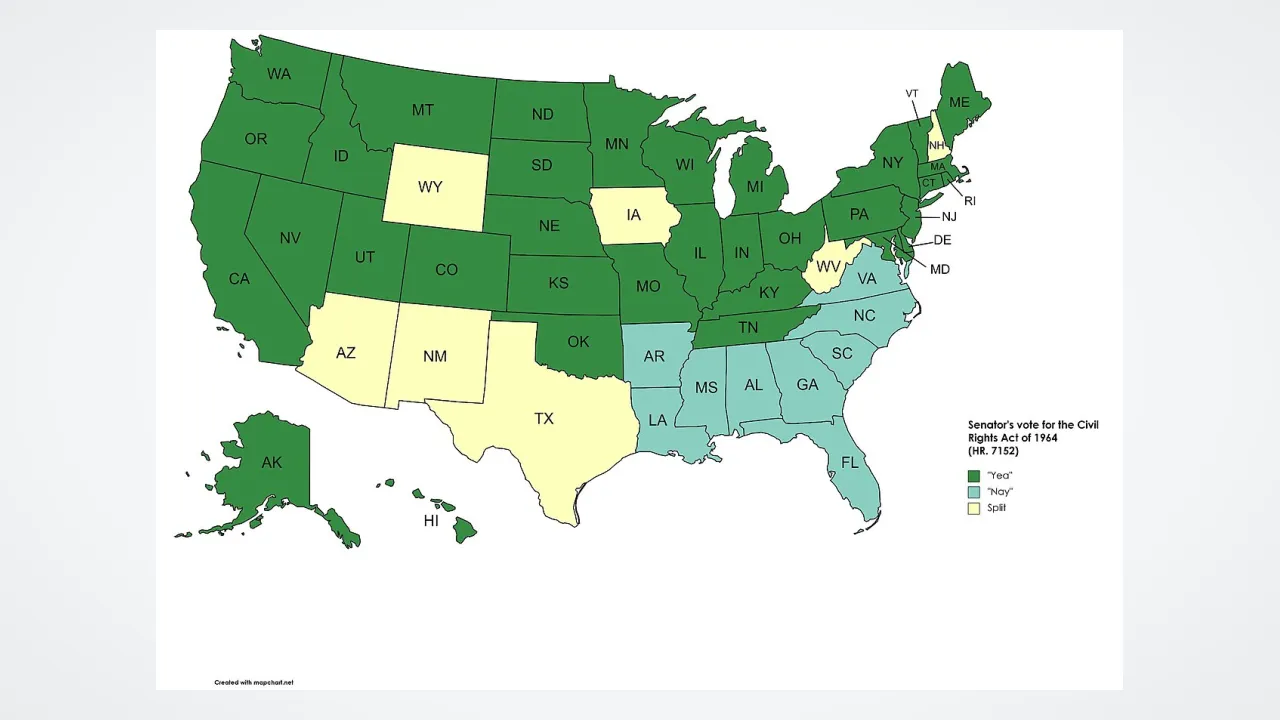
Passed 290–130 by the House of Representatives in February 1964—where Northern Virginia's Howard W. Smith and Representative Martha Griffiths debated adding 'sex' to employment protections, backed passionately by legal scholar Pauli Murray's arguments—the bill confronted a sixty-working-day Senate filibuster. Floor manager Hubert Humphrey (D-MN), Minority Leader Everett Dirksen (R-IL), Attorney General Robert F. Kennedy, and NAACP strategist Clarence Mitchell Jr. forged a bipartisan coalition, invoking cloture 71–29 on June 10 and passing the final Act on July 2, 1964.
3
Architecture of the Eleven Titles
The dismantled legal segregation across multiple arenas simultaneously: Title II barred discrimination in public accommodations affecting interstate commerce; Title III desegregated municipal parks, libraries, and courthouses; Title IV authorized federal lawsuits to desegregate public schools; Title VI withheld federal financial assistance from discriminatory institutions; and Title VII barred employment discrimination by employers and unions while establishing the Equal Employment Opportunity Commission (EEOC).
4
Avoiding the 1883 Trap Through the Commerce Clause
In 1883, the Supreme Court had struck down an earlier Reconstruction Civil Rights Act by ruling that the Fourteenth Amendment regulated only 'state action,' not private businesses. Learning from history, 1964 drafters anchored Title II directly in Article I, Section 8's Interstate Commerce Clause—a strategy vindicated five months later in unanimous 9–0 rulings in Heart of Atlanta Motel v. United States and Katzenbach v. McClung.
5
Foundation for Modern Equal Opportunity Law
Over subsequent decades, Congress modeled landmark protections—including Title IX in education (1972) and the Americans with Disabilities Act (1990)—directly on the enforcement framework of the Civil Rights Act of 1964, cementing its status as a pillar of modern American law.
1. Why did the authors of the Civil Rights Act of 1964 base Title II (public accommodations) on the Constitution's Interstate Commerce Clause in addition to the Fourteenth Amendment?
2. Which African American legal scholar wrote influential memos helping convince lawmakers to retain protection against 'sex' discrimination in Title VII?