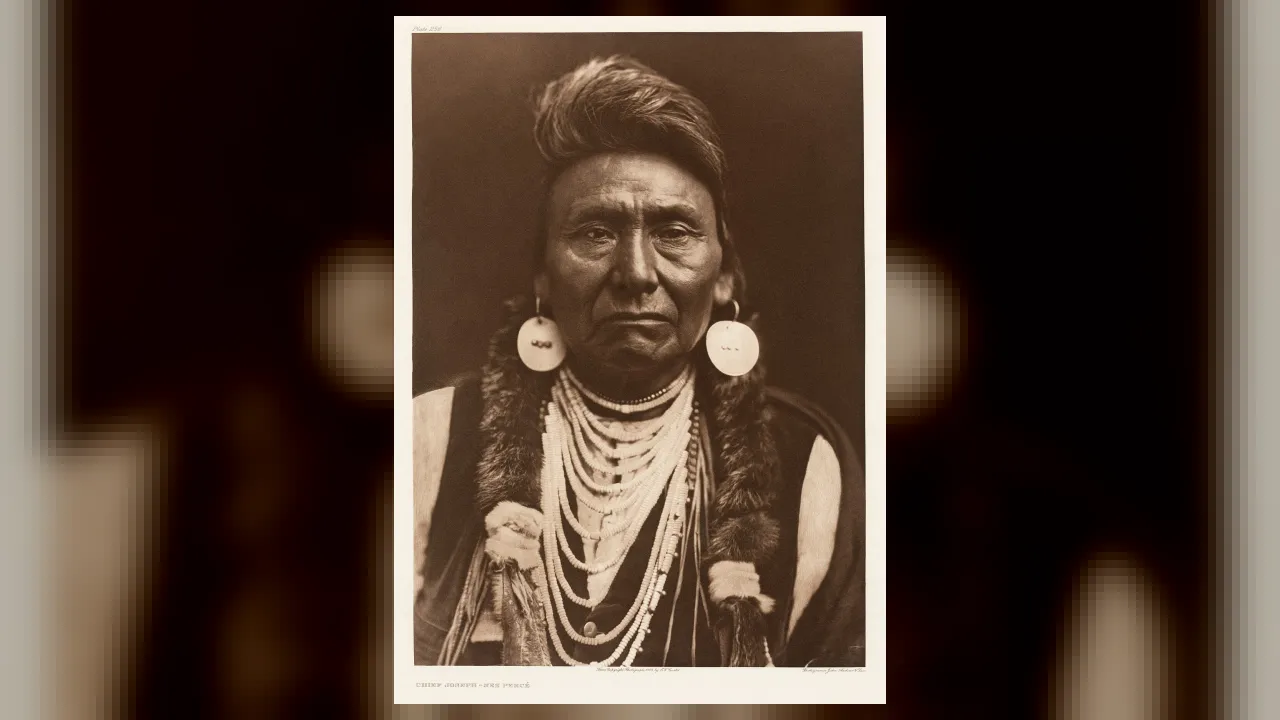
1. What does Chief Joseph's Nez Perce name mean in English?
2. What famous spotted horses were raised by the Nez Perce people?
🤯 Mind-Blowing Fact • Grade 2
More than seventy years before 1877, the Nez Perce people had kindly fed and guided Lewis and Clark's starving expedition across the Bitterroot Mountains!
✨ Word Sparks (Grade 2 Glossary)
Tap 🔊 to hear
ancestral
Belonging to a family's elders long ago
reservation
Land set aside by government for tribes
compassion
Deep care for people who are hurting
🪝
How did Chief Joseph protect hundreds of families across more than a thousand miles of rugged mountains?
1
The Beautiful Wallowa Valley
Picture sparkling blue water surrounded by tall snowy peaks in northeastern Oregon! That homeland belonged to the Wallowa band of the Nez Perce, or Nimiipuu, who had welcomed explorers Meriwether Lewis and William Clark in peace decades earlier. When Chief Joseph became leader in 1871, he promised his father never to sell their valley.
2
Across Four States
In 1877, the U.S. government ordered the Wallowa Nez Perce onto a much smaller in Idaho. Hoping to reach safety in Canada, Joseph helped care for families, children, and horse herds across a 1,170-mile trek through Oregon, Idaho, Wyoming, and Montana.
3
Words Remembered Forever
Just forty miles from Canada in freezing October snow, Chief Joseph chose peace to save his freezing families, speaking words of still studied across America today.
1. Which famous American explorers had the Nez Perce kindly helped decades before Chief Joseph's time?
2. About how far did Chief Joseph and the Nez Perce families travel on their 1877 journey toward Canada?
🤯 Mind-Blowing Fact • Grade 3
In his famous 1879 speech in Washington, D.C., Chief Joseph told Congress: 'Let me be a free man—free to travel, free to stop, free to work... and I will obey every law!'
✨ Word Sparks (Grade 3 Glossary)
Tap 🔊 to hear
eloquent
Speaking with clear, moving, persuasive words
guardian
Someone who protects and cares for others
relocate
To move homes to a different place
🪝
Why did members of Congress gather in Washington, D.C., in 1879 to listen intently to a Nez Perce chief from Oregon?
1
Promise in the Land of Winding Waters
Listen to the wind sweeping through pine forests above Oregon's Wallowa Lake, where herds of spotted Appaloosa horses graze in summer meadows. Born there in 1840, Hin-mah-too-yah-lat-kekt—known as Young Joseph—succeeded his father, Old Joseph, in 1871. Although an 1855 treaty had recognized Nez Perce ownership of the Wallowa Valley, gold discoveries brought settlers, and a disputed 1863 treaty shrunk tribal lands.
2
Guardian of Families on the 1877 Trek
When U.S. officials ordered Joseph's band to within thirty days in spring 1877, Joseph reluctantly moved to avoid bloodshed, until clashes broke out along the Salmon River. Over the next three and a half months, while warrior chiefs like Looking Glass led defenses, Chief Joseph served as civil —guiding roughly 750 men, women, elders, and children across 1,170 miles of rugged mountains, including Yellowstone.
3
Bear Paw Mountains Speech
Surrounded in a fierce October blizzard in Montana's Bear Paw Mountains just forty miles south of Canada, Joseph ended the conflict to save starving children, concluding softly, 'From where the sun now stands, I will fight no more forever.'
4
Appeal for Equal Law in 1879
Traveling to Washington, D.C., in January 1879, Chief Joseph addressed diplomats, cabinet officials, and congressmen at Lincoln Hall, asking simply for equal freedom under one fair law for all Americans.
1. What main role did Chief Joseph play during the 1,170-mile journey of 1877?
2. How close were Chief Joseph and his people to the Canadian border when winter snow trapped them in Montana?
🤯 Mind-Blowing Fact • Grade 4
Today, the 1,170-mile route traveled by Chief Joseph and the Nimiipuu families is preserved by the National Park Service as the Nez Perce National Historical Trail across four states!
✨ Word Sparks (Grade 4 Glossary)
Tap 🔊 to hear
cede
To formally give up land by treaty
tactician
A leader skilled at planning careful movements
besieged
Surrounded closely with supplies cut off
🪝
How did Chief Joseph's 1879 speech in Washington, D.C., echo the exact ideals of the Declaration of Independence?
1
Nimiipuu Heritage and Broken Treaties
Stand inside packed Lincoln Hall in Washington, D.C., on January 14, 1879, where U.S. senators, cabinet secretaries, and President Rutherford B. Hayes's officials listen in hushed respect to Chief Joseph of the Nimiipuu (Nez Perce). Born in 1840 in Oregon's Wallowa Valley, Hin-mah-too-yah-lat-kekt grew up among a nation renowned for peaceful diplomacy since rescuing the Lewis and Clark Expedition in 1805. Though the 1855 Treaty of Walla Walla guaranteed the Wallowa homeland, an 1863 agreement—never signed by Joseph's father or the Wallowa band—ceded ninety percent of Nez Perce territory.
2
The 1,170-Mile Retreat Across the Rockies
Seeking to prevent war when General Oliver O. Howard demanded removal to Idaho's Lapwai Reservation in May 1877, Joseph began gathering thousands of horses across swollen rivers. After outraged young warriors sparked fighting, five non-treaty Nez Perce bands united. Across 108 days and 1,170 miles spanning Oregon, Idaho, Wyoming's Yellowstone Park, and Montana, military Looking Glass and Ollokot held off 2,000 U.S. soldiers while Joseph safeguarded hundreds of elders, mothers, and children.
3
'I Will Fight No More Forever'
in subzero snow at Bear Paw Battlefield in northern Montana on October 5, 1877—forty miles from Canada—and with his brother Ollokot and Looking Glass fallen, Joseph handed his rifle to Colonel Nelson Miles and General Howard, delivering one of the most moving humanitarian speeches in American history so his freezing children might live.
4
Championing Equal Rights Under Law
Sent first to Kansas and Indian Territory instead of Idaho as promised, Joseph traveled repeatedly to Washington, D.C. Appealing directly to American constitutional conscience, he urged Congress to treat Native Americans under equal law with all other citizens, eventually winning permission in 1885 for his people to return to the Pacific Northwest.
1. Why did Chief Joseph and his father reject the 1863 treaty reducing Nez Perce lands?
2. What argument did Chief Joseph bring before Congress and cabinet officials at Lincoln Hall in 1879?
🤯 Mind-Blowing Fact • Grade 5
During the 1877 campaign through Montana's Bitterroot Valley, Chief Joseph and Nez Perce leaders insisted on paying local townspeople fair prices in cash and horses for flour, sugar, and supplies!
✨ Word Sparks (Grade 5 Glossary)
Tap 🔊 to hear
sovereignty
A nation's rightful authority to govern itself
ultimatum
A final demand backed by strict deadline
natural rights
Freedoms belonging to every human at birth
🪝
How did a peace-minded civil chief become an enduring American voice for equal protection under law?
1
Sovereignty in the Wallowa Valley and the 1863 Treaty Dispute
Contemplate the glacial waters of Wallowa Lake in northeastern Oregon, framed by nine-thousand-foot granite peaks where Nimiipuu (Nez Perce) families harvested salmon and bred celebrated Appaloosa herds for centuries. Born there in spring 1840, Hin-mah-too-yah-lat-kekt ('Thunder Rolling Down the Mountain') watched his father, Tuekakas (Old Joseph), sign the 1855 Walla Walla Treaty with Territorial Governor Isaac Stevens, explicitly reserving 7.5 million acres—including the Wallowa Valley—to the Nez Perce Nation. Following an 1860 gold rush, federal commissioners negotiated the 1863 'steal treaty' reducing the reservation by ninety percent; Tuekakas and four other band leaders refused to sign, maintaining legal title to Wallowa.
2
Civil Leadership Across the 1,170-Mile Campaign of 1877
Inheriting civil chieftainship in 1871, Young Joseph counseled diplomatic restraint even when General Oliver Otis Howard issued a thirty-day in May 1877 to cross the flooded Snake River to Idaho's Lapwai Reservation. When unauthorized raids by grieving young men ignited the Nez Perce War in June, roughly 750 Nimiipuu—only 200 of them warriors—embarked on an extraordinary 1,170-mile strategic retreat across Lolo Pass, the Bitterroots, Yellowstone, and northern Montana. While Ollokot, Looking Glass, and White Bird directed rear-guard tactics that baffled multiple U.S. Army columns across eighteen engagements, Joseph served as camp chief, organizing horse herds, tending the wounded, and insisting that peaceful Montana settlers and trading posts remain unharmed.
3
Humanitarian Surrender at Bear Paw Battlefield
Intercepted by Colonel Nelson A. Miles's cavalry during a blinding blizzard in Montana's Bear Paw Mountains forty miles south of Sitting Bull's refuge in Saskatchewan, Joseph stood amid freezing rifle pits after five days of siege. With Looking Glass and his younger brother Ollokot killed, Joseph rode forward on October 5, 1877. Recorded by Lieutenant Charles Erskine Scott Wood, his words—'Hear me, my chiefs! I am tired; my heart is sick and sad. From where the sun now stands, I will fight no more forever'—prioritized the survival of Nimiipuu children and elders over futile resistance.
4
Constitutional Diplomacy in Washington, D.C.
When War Department authorities overruled Miles's pledge to return the Nez Perce to Idaho and instead exiled them to malaria-ridden camps in Kansas and Indian Territory, Joseph waged a relentless campaign of public persuasion. Addressing senators, diplomats, and journalists at Lincoln Hall in Washington on January 14, 1879—published nationwide in the North American Review—he framed Indigenous rights directly in the language of and constitutional equality: 'Whenever the white man treats the Indian as they treat each other, then we will have no more wars. We shall all be alike—brothers of one father and one mother, with one sky above us and one country around us, and one government for all.'
5
Return to the Northwest and Historical Legacy
Public sympathy awakened by Joseph's advocacy persuaded Congress in 1885 to return surviving Nez Perce families to the Pacific Northwest—half to Idaho and Joseph's band to the Colville Reservation at Nespelem, Washington, where he lived until 1904, visiting his beloved Wallowa Valley peacefully before his passing.