1. About how big was the space rock before it entered Earth's sky over Chelyabinsk?
2. Where did divers find the biggest surviving piece of the Chelyabinsk Meteor?
🤯 Mind-Blowing Fact • Grade 2
When scientists placed the giant 1,250-pound Lake Chebarkul meteorite onto a heavy scale to weigh it, the rock was so heavy it actually broke the scale!
✨ Word Sparks (Grade 2 Glossary)
Tap 🔊 to hear
glare
Dazzling bright light that hides faint objects
pressure
Strong pushing force against a surface
thunderclap
Loud booming sound wave moving through air
🪝
Why did the giant boom from the Chelyabinsk Meteor arrive two whole minutes AFTER its bright flash?
1
Sneaking Out of the Sunrise
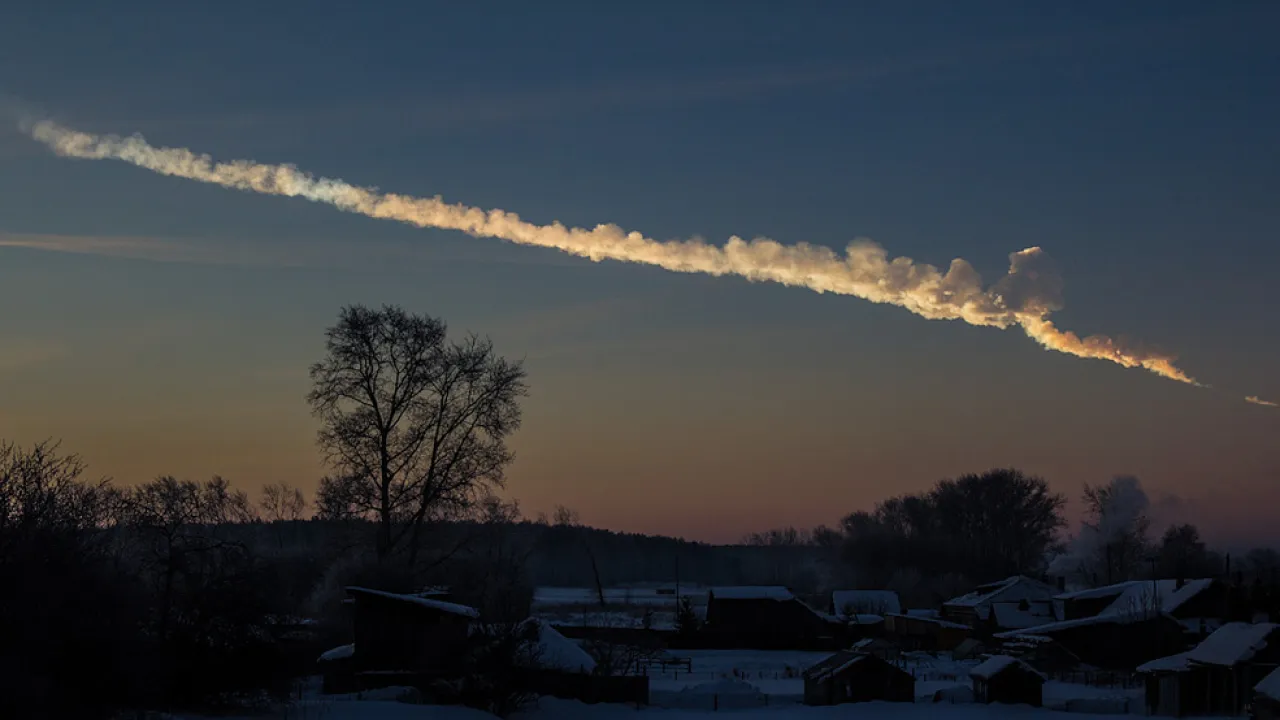
Just after sunrise on February 15, 2013, a 65-foot stony asteroid skimmed into Earth's atmosphere at 42,000 miles per hour! Why hadn't any night telescopes spotted it coming? It approached right out of the daytime of the rising Sun!
2
Light Races Faster Than Sound
Nineteen miles overhead, air squeezed the rock until it burst into dust and pebbles, shining thirty times brighter than the Sun! Because light travels almost instantly while sound creeps much slower, the loud boom took more than two minutes to reach the ground.
3
Treasure in Lake Chebarkul
Fishermen soon found a round hole in frozen Lake Chebarkul, where divers hoisted up a 1,250-pound stony meteorite!
1. Why couldn't night-sky telescopes see the Chelyabinsk asteroid approaching Earth beforehand?
2. Why did people see the bright flash two minutes before hearing the loud sonic boom?
🤯 Mind-Blowing Fact • Grade 3
Infrasound sensors built in Antarctica—nearly ten thousand miles away—picked up low-pitched sound waves from the Chelyabinsk airburst after they rippled twice around the entire planet!
✨ Word Sparks (Grade 3 Glossary)
Tap 🔊 to hear
superbolide
An extraordinarily bright meteor airburst high overhead
triangulate
Pinpoint exact location using views from several spots
infrasound
Deep sound waves too low for human ears
🪝
How did ordinary car dashboard cameras help astronomers trace a meteor's path all the way back to the Asteroid Belt?
1
Earth's Atmosphere Acts as a Shield
Imagine a 12,000-ton boulder racing twelve miles per second into Earth's blanket of air! On February 15, 2013, Earth's thick atmosphere protected the ground below by squeezing the Chelyabinsk space rock until it shattered 18.5 miles high in an event astronomers call a airburst.
2
Hundreds of Dashcam Angles
Across snowy Chelyabinsk, hundreds of commuter cars happened to have dashboard video cameras running! By measuring shadows cast by streetlights and buildings in dozens of videos from different towns, scientists triangulated the meteor's exact 18-degree entry angle and speed.
3
Rewinding Its Orbit
Rewinding that exact path backward through space traced the rock to the Flora family in the inner Main Asteroid Belt between Mars and Jupiter!
4
Dark Shock Veins Inside
Sliced fragments of the stony LL5 chondrite collected on snowbanks revealed dark melted 'shock veins' from an ancient asteroid crash billions of years before it ever met Earth!
1. How did astronomers calculate the Chelyabinsk Meteor's original orbit in space so accurately?
2. How did Earth's atmosphere protect the ground from a giant crater impact?
🤯 Mind-Blowing Fact • Grade 4
On the exact same day—February 15, 2013—an unrelated 100-foot asteroid named 2012 DA14 safely zipped past Earth inside satellite orbits on a completely different path, a pure once-in-a-million cosmic coincidence!
✨ Word Sparks (Grade 4 Glossary)
Tap 🔊 to hear
ram pressure
Intense compression of air ahead of fast objects
chondrite
Common stony meteorite containing tiny mineral spheres
jadeite
High-pressure mineral formed during asteroid collisions
🪝
Why did ancient cracks inside the Chelyabinsk asteroid make it burst miles higher in the air than a solid boulder?
1
Ram Pressure vs. Fractured Stone
People often say meteors glow from air friction, yet the main culprit is actually : air molecules in front of a 42,000-mph asteroid cannot get out of the way fast enough, compressing into white-hot plasma hotter than the Sun's surface! As the 65-foot Chelyabinsk asteroid dove down to 18.5 miles altitude, ram pressure topped millions of pounds per square foot, bursting the rock along ancient pre-existing cracks.
2
Why Shallow Entry Helped
Entering at a grazing 18-degree slant rather than plunging straight down forced the bolide to plow through hundreds of miles of upper air before breaking up. That long, shallow path spread its 500-kiloton energy release high in the stratosphere instead of focusing it directly onto the ground!
3
Jadeite Clues to a Prehistoric Crash
Microscopic inspection of Lake Chebarkul's 570-kilogram LL5 ordinary uncovered needle-like crystals of inside dark glassy veins. Radiometric clocks showed a violent collision in the Asteroid Belt cracked and weakened the parent rock hundreds of millions of years ago!
4
Closing the Daytime Blind Spot
Because Chelyabinsk snuck out of the Sun's daytime glare—the largest recorded atmospheric entry since Siberia's 1908 Tunguska airburst—NASA designed the upcoming NEO Surveyor infrared space telescope to spot sunward asteroids weeks or years ahead!
1. What actually heats the air in front of a hyper-speed meteor to glowing plasma temperatures?
2. How did entering Earth's atmosphere at a shallow 18-degree angle reduce effects on the ground?
🤯 Mind-Blowing Fact • Grade 5
NASA's Suomi NPP weather satellite tracked the Chelyabinsk dust plume wrapping into a continuous belt all the way around Earth's Northern Hemisphere stratosphere within just four days!
✨ Word Sparks (Grade 5 Glossary)
Tap 🔊 to hear
ablation
Melting and vaporizing away of outer rock layers
photogrammetry
Measuring exact 3D paths from multiple camera views
megapascal
Unit measuring millions of pascals of strong pressure
🪝
How did citizen dashcams, global infrasound arrays, and LL5 meteorite petrology make Chelyabinsk the best-documented airburst in human history?
1
Anatomy of a 500-Kiloton Superbolide
At 09:20 local time on February 15, 2013, an uncataloged 19-meter Apollo asteroid weighing roughly 12,000 metric tons pierced Earth's atmosphere above the southern Urals at 19.16 kilometers per second along an 18.3-degree grazing trajectory. Approaching within 15 degrees of the rising Sun's elongation—an optical blind spot for nocturnal ground surveys—the stony body underwent cascading fragmentation between 45 and 25 kilometers altitude, peaking at 29.7 kilometers with an optical flash thirty times brighter than the solar disk and a total kinetic energy yield equivalent to roughly 440 to 500 kilotons of TNT.
2
Citizen Photogrammetry and Infrasound Seismology
Ubiquitous Russian dashboard cameras and security feeds provided hundreds of synchronized light curves and shadow-vector recordings. By calibrating star positions on pre-dawn frames and measuring sunlit versus bolide-lit shadow azimuths across dozens of cities, dynamicists reconstructed its pre-entry Apollo orbit (1.72-AU semi-major axis, 0.57 eccentricity) to sub-degree precision, while twenty Comprehensive Nuclear-Test-Ban Treaty infrasound stations around the globe clocked sub-audible acoustic waves circling Earth multiple times—the strongest atmospheric wave ever recorded by the network until Tonga's 2022 eruption!
3
Shock Veins, Jadeite, and Cosmic-Ray Exposure
Less than 0.05 percent of the initial mass survived , led by the 570-kilogram main mass recovered beneath Lake Chebarkul's 7-meter ice hole. Petrological analysis classified the rock as an LL5 ordinary chondrite crisscrossed by black impact-melt veins rich in high-pressure jadeite. Uranium-lead dating of phosphates recorded a 4.45-billion-year primordial collision, while short cosmic-ray exposure ages (~1.2 million years) showed a recent gentle breakup near the Flora asteroid family.
4
Validating Planetary Defense Airburst Models
Crucially, the pre-cracked LL5 boulder fragmented under just 1 to 5 of aerodynamic ram pressure—far weaker than solid laboratory stone—teaching hazard modelers that decameter-scale rubble or fractured chondrites reliably airburst high in the stratosphere.
5
Space-Based Infrared Sentinels
To eliminate the daytime solar blind spot exposed in 2013, NASA's NEO Surveyor space telescope and ground twilight surveys on Vera C. Rubin Observatory are designed to catalog decameter-to-hectometer asteroids silhouetted warm in thermal infrared long before Earth encounter.