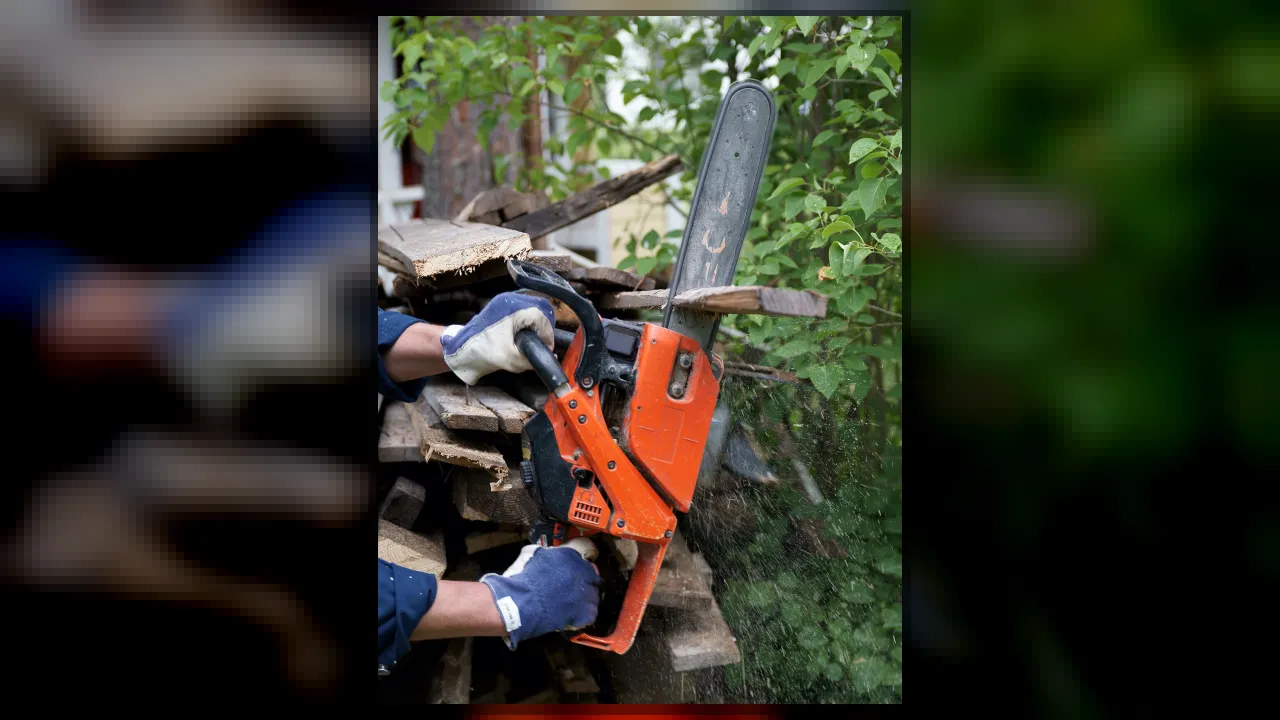
2. Which tiny forest creature inspired the shape of modern chainsaw teeth?
🤯 Mind-Blowing Fact • Grade 2
Early gas-powered forest chainsaws in the 1920s weighed over 100 pounds—as heavy as a fifth grader—and took two strong lumberjacks to carry!
✨ Word Sparks (Grade 2 Glossary)
Tap 🔊 to hear
sprocket
Toothed wheel that pulls a chain forward
lumberjack
Worker who harvests and clears forest trees
chain brake
Safety lever that stops spinning teeth fast
🪝
Would you believe the very first chainsaw was turned by hand in a doctor's room?
1
A Surprising Beginning
Picture a quiet German workshop in 1830, long before gas motors existed. Doctor Bernhard Heine built a small hand-cranked tool with a tiny linked chain so surgeons could trim damaged bone gently without jarring splinters!
2
Into the Deep Forest
Nearly a hundred years later, inventors realized a giant motorized version could help cut timber. In 1926, Andreas Stihl built an electric chainsaw, and soon gasoline saws replaced exhausting two-person crosscut hand saws.
3
Built for Speed and Safety
A wheel spins the chain around an oiled steel bar while tiny scoops shave out wood chips. Modern chainsaws include front hand guards that stop the chain in a blink if the tip bumps upward.
1. What was Bernhard Heine's 1830 hand-cranked chain tool originally built for?
2. What does a chainsaw's safety chain brake do if the bar kicks upward?
🤯 Mind-Blowing Fact • Grade 3
Firefighters carry special rescue chainsaws tipped with ultra-hard tungsten-carbide teeth that can slice straight through shingled roofs and nails during emergencies!
✨ Word Sparks (Grade 3 Glossary)
Tap 🔊 to hear
osteotome
Early hand-cranked chain tool for cutting bone
depth gauge
Small guide bump controlling each tooth's bite
arborist
Specialist trained to care for tall trees
🪝
How did watching a hungry beetle larva inside a tree stump make chainsaws cut three times faster?
1
From Surgery to Giant Timber
Whirrrr! Long before pruned high branches, German orthopedist Bernhard Heine earned fame in 1830 for his hand-cranked surgical . Almost a century passed before German engineer Andreas Stihl patented a heavy electric log-cutting chainsaw in 1926 and a gas model in 1929.
2
The Beetle-Jaw Breakthrough
Early timber chains had flat, scratchy teeth that dulled quickly and jammed in wet bark. In 1946, Oregon logger Joseph Buford Cox split open a stump and watched a timber-beetle larva slice wood fibers cleanly using curved left-and-right mandibles!
3
Cutters, Rakers, and Oil
Cox copied nature by inventing curved 'chipper' teeth that alternate left and right along the chain. Ahead of each sharp tooth sits a tiny bump called a , which keeps the tooth from biting too deeply and stalling the engine.
4
Centrifugal Clutches at Work
How can a chainsaw idle quietly with its chain standing still? A clever centrifugal clutch stays loose at slow engine speeds, then swings outward to grip and spin the drive sprocket at 45 miles per hour when the throttle opens!
1. Why does a chainsaw chain remain motionless while the engine idles slowly?
2. What job does the small bump called a depth gauge perform in front of each cutting tooth?
🤯 Mind-Blowing Fact • Grade 4
Protective chainsaw pants worn by foresters are stuffed with thousands of tough ballistic nylon or Kevlar threads designed to pull out and jam a spinning drive sprocket to a dead stop in milliseconds!
✨ Word Sparks (Grade 4 Glossary)
Tap 🔊 to hear
kerf
Narrow slot carved out by a saw
biomimicry
Designing human inventions by copying nature's solutions
kickback
Sudden upward jolt when bar tip snags
🪝
Why can you tilt a running chainsaw upside down without spilling fuel or starving the engine?
1
High-Speed Wood Planing
Watch a forestry rescue crew clear a hurricane-toppled oak blocking an ambulance route: hundreds of steel links blur around a grooved guide bar at twenty meters per second! Rather than scraping wood into fine dust like a hand saw, modern chainsaw cutters act like miniature carpenter planes, severing side grain and lifting curled chips cleanly from the .
2
Two-Stroke Power and Diaphragm Carburetors
Forest tools must stay light enough to carry up steep hills and work sideways or upside down. Engineers solved both challenges in the 1950s by pairing compact, high-power two-stroke engines with aircraft-inspired diaphragm carburetors—flexible pump membranes driven by crankcase pressure pulses that meter fuel smoothly in any orientation, joined today by high-torque lithium-ion brushless motors.
3
Biomimicry on the Guide Bar
Building on Bernhard Heine's 1830 medical chain and Andreas Stihl and Emil Lerp's late-1920s two-person timber saws, logger Joseph Cox revolutionized chain geometry in 1947. Mimicking the Ergates spiculatus beetle larva's alternating C-shaped jaws, Cox paired left- and right-hand gouge cutters with depth gauges while automatic oil pumps lubricated the sizzling bar groove.
4
Taming Kickback Physics
If the upper tip quadrant of a spinning guide bar contacts solid wood, reactive force flings the bar violently upward toward the operator—a hazard called . Inertial chain brakes instantly clamp a steel band around the clutch drum within hundredths of a second, stopping the chain while protective Kevlar-layered chaps clog runaway teeth on contact.
1. What invention allowed 1950s one-person chainsaws to run sideways or upside down without stalling?
2. How do safety chaps worn by professional tree crews protect their legs?
🤯 Mind-Blowing Fact • Grade 5
Concrete-cutting chainsaws skip wood teeth entirely—instead, they pump cooling water down the guide bar while spinning laser-welded synthetic diamond segments straight through brick walls and steel rebar!
✨ Word Sparks (Grade 5 Glossary)
Tap 🔊 to hear
centrifugal clutch
Speed-activated coupling engaging drive sprocket under rotation
diaphragm carburetor
Membrane fuel mixer operating at any angle
angular acceleration
Rapid increase in rotational speed around pivot
🪝
How did a 19th-century orthopedic surgical instrument, World War II aircraft carburetors, and a wood-boring beetle converge into modern forestry's signature machine?
1
Unlikely Medical Origins
Few industrial machines trace a more surprising lineage than the chainsaw. Following late-18th-century jointed surgical chains by Scottish physicians John Aitken and James Jeffray, German prosthetist Bernhard Heine unveiled the osteotome in 1830—a precision hand-cranked sprocket driving miniature hooked links around a narrow steel blade to section bone cleanly without percussive shock from mallets and chisels.
2
Mechanizing Timber Harvesting
Scaling Heine's mechanism to giant conifers demanded compact prime movers. In 1926 Germany, Andreas Stihl patented a 48-kilogram electric bucking saw, followed in 1927 by Emil Lerp's gasoline Dolmar and Stihl's 1929 two-operator petrol saw. True single-operator portability arrived around 1950 when lightweight magnesium-alloy die castings met all-position Tillotson adapted from aerobatic aircraft.
3
Kinematics of the Modern Saw Chain
Accelerated by a spring-loaded to linear speeds of 18 to 28 meters per second, a saw chain weaves three specialized link types: center drive tangs riding inside an oil-bathed guide-bar rail, tie straps, and Joseph Cox's biomimetic left- and right-hand chisel cutters. Each cutter's top plate slices cross-grain wood fibers while its side plate shears vertical walls, regulated to sub-millimeter bite thickness (typically 0.65 mm) by a leading depth gauge.
4
Rotational Inertia and Safety Systems
Contacting an obstruction with the upper nose quadrant of the guide bar converts forward chain momentum into rapid upward known as rotational kickback. Modern saws pair asymmetrical reduced-radius bar noses with dual-action inertial chain brakes that arrest a 12,000-RPM clutch drum in less than 0.1 seconds, alongside anti-vibration spring mounts preventing occupational Raynaud's syndrome.
5
Electrification and Specialized Cutters
Today, quiet lithium-ion brushless chainsaws match mid-sized combustion torque for urban arboriculture, while diamond-grit hydraulic chainsaws slice reinforced concrete pipes and rescue crews breach collapsed masonry after earthquakes.