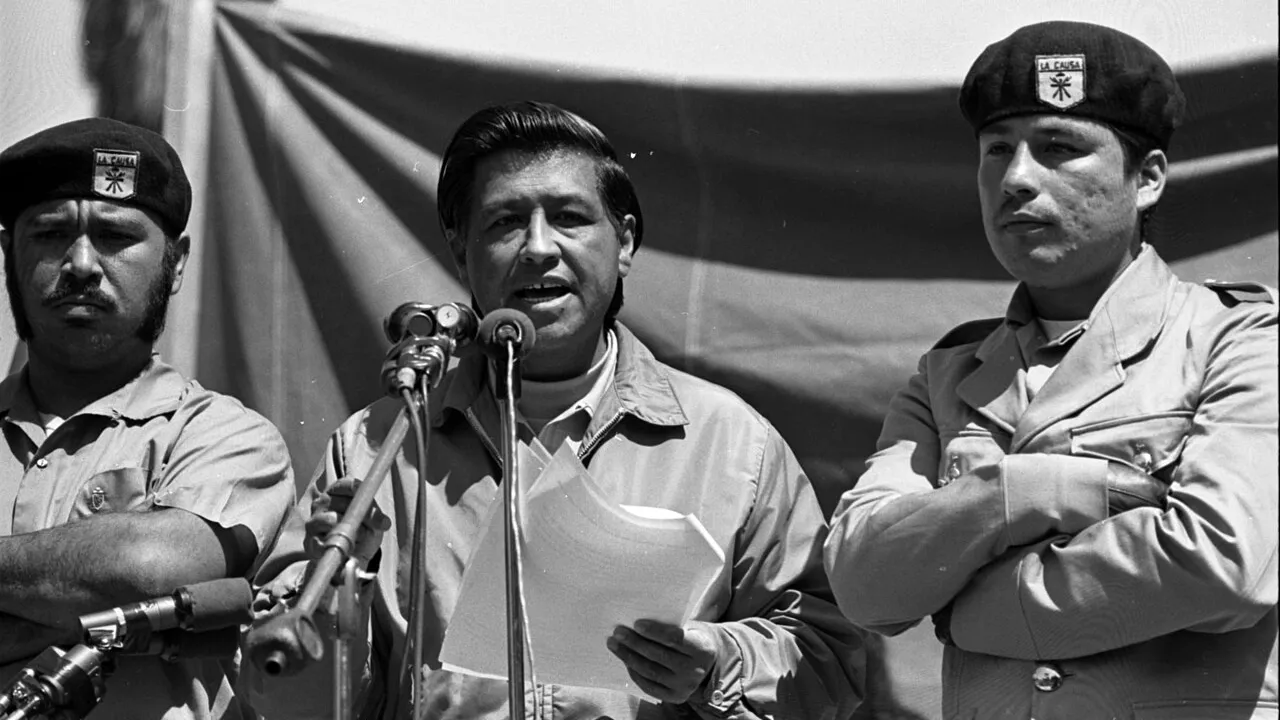
1. How did Cesar Chavez work to win fair treatment for farm workers?
2. What helpful changes did Cesar Chavez win for workers in the fields?
🤯 Mind-Blowing Fact • Grade 2
In 1994, Cesar Chavez was honored with the Presidential Medal of Freedom, the highest civilian award in the United States!
✨ Word Sparks (Grade 2 Glossary)
Tap 🔊 to hear
migrant
A worker who travels following seasonal harvests
union
Workers joining together for fair workplace rules
boycott
Refusing to buy something to encourage fairness
🪝
What does the famous Spanish phrase 'Sí, se puede' mean—and how did it inspire thousands of workers?
1
Moving From Harvest to Harvest
Picture packing everything your family owns into an old car to follow ripening crops across California! Born on a small family farm near Yuma, Arizona, Cesar Chavez saw his parents lose their land during the Great Depression. Working in fields as a child, he experienced scorching heat, aching backs, and very low wages.
2
Starting a Farm Workers Union
After serving in the U.S. Navy, Cesar teamed up with fellow organizer Dolores Huerta in 1962. Together they founded a that became the United Farm Workers, sharing the hopeful motto 'Sí, se puede'—'Yes, we can!'
3
A 300-Mile Peaceful Walk
Inspired by Mahatma Gandhi and Dr. Martin Luther King Jr., Cesar led a peaceful 340-mile march to Sacramento and a nationwide grape that won historic worker protections in 1970.
1. Who partnered with Cesar Chavez in 1962 to co-found the farm workers union?
2. What does 'Sí, se puede' mean in English?
🤯 Mind-Blowing Fact • Grade 3
Cesar Chavez's birthday, March 31, is celebrated as Cesar Chavez Day—a state holiday in several states and a national day of service!
✨ Word Sparks (Grade 3 Glossary)
Tap 🔊 to hear
nonviolence
Bringing change peacefully without hurting anyone
contract
A written agreement promising wages and safety
homestead
A family house and surrounding farm land
🪝
How did families at neighborhood grocery stores thousands of miles from California help farm workers win clean water and fair pay?
1
Lessons From Childhood Fields
Imagine bending down row after row under a blazing hundred-degree California sun to harvest lettuce, berries, and grapes. Growing up near Yuma, Arizona, Cesar Chavez loved his grandfather's until drought and the Great Depression forced the family to become migrant laborers in 1938. Switching schools more than thirty times before finishing eighth grade, Cesar still read books avidly—especially biographies of peaceful leaders.
2
Organizing Door to Door
After serving two years in the United States Navy, Chavez worked for ten years with the Community Service Organization, registering thousands of Mexican American citizens to vote. In 1962, using his own small savings in Delano, California, he and Dolores Huerta founded the National Farm Workers Association.
3
The Delano March and Grape Boycott
In 1965, Chavez joined Filipino American grape pickers led by Larry Itliong in asking vineyard owners for fair wages. To win public support peacefully, Chavez led a 340-mile march from Delano to California's state capitol in Sacramento and asked shoppers nationwide to boycott table grapes.
4
Dignity in the Fields
Millions of Americans supported the boycott! By 1970, major growers signed guaranteeing clean drinking water, rest periods, health clinics, and safer pesticide rules.
1. Which group of farm workers led by Larry Itliong joined forces with Cesar Chavez in Delano in 1965?
2. How far did Cesar Chavez and fellow farm workers march in 1966 to reach California's capitol in Sacramento?
🤯 Mind-Blowing Fact • Grade 4
In 2012, the U.S. Navy christened a massive cargo supply ship the USNS Cesar Chavez in honor of the former Navy sailor and civil rights leader!
✨ Word Sparks (Grade 4 Glossary)
Tap 🔊 to hear
coalition
Different groups uniting for a shared goal
foreclosure
Losing property when debts cannot be paid
pesticide
A chemical sprayed on crops against insects
🪝
Why did Dr. Martin Luther King Jr. send a telegram calling Cesar Chavez 'one of the heroic figures of our time'?
1
Rooted in Family and Civic Duty
Step onto a dusty country road in California's San Joaquin Valley in the spring of 1966, where a line of tired yet joyful farm workers walks northward toward Sacramento singing civic hymns. Leading the column is Cesar Estrada Chavez. Born near Yuma, Arizona, in 1927, Chavez learned compassion from his mother, Juana—who taught him never to turn away a hungry stranger—and experienced firsthand the hardships of migrant labor when Depression-era pushed his family onto California's harvest circuit.
2
Voter Registration to Labor Organizing
After serving in the U.S. Navy in the western Pacific near the end of World War II, Chavez met community organizer Fred Ross in San Jose in 1952. Working with the Community Service Organization, Chavez led voter-registration drives and citizenship classes across California towns. Convinced that agricultural workers—who had been excluded from the 1935 National Labor Relations Act—needed their own voice, he and Dolores Huerta launched the National Farm Workers Association in Delano in 1962.
3
Uniting Coalitions Through Nonviolence
When Filipino American workers in the Agricultural Workers Organizing Committee under Larry Itliong struck Delano vineyards in September 1965, Chavez's association voted unanimously to join them, merging to create the United Farm Workers (UFW). Drawing moral philosophy from St. Francis of Assisi, Mahatma Gandhi, and Dr. Martin Luther King Jr., Chavez combined a 340-mile pilgrimage to Sacramento, a twenty-five-day fast for nonviolence in 1968—praised in a personal telegram from Dr. King—and a consumer boycott supported by roughly seventeen million Americans.
4
Lasting Agricultural Protections
In 1970, grape growers signed historic union contracts establishing portable field toilets, cold drinking water, medical benefits, and restrictions on toxic , followed in 1975 by the landmark California Agricultural Labor Relations Act.
1. Why did farm workers face extra legal challenges when trying to organize before the 1960s and 1970s?
2. Approximately how many American consumers supported the nationwide grape boycott by 1970?
🤯 Mind-Blowing Fact • Grade 5
In 2012, Nuestra Señora Reina de la Paz in Keene, California—where Cesar Chavez lived and worked—was designated the César E. Chávez National Monument within the National Park System!
✨ Word Sparks (Grade 5 Glossary)
Tap 🔊 to hear
solidarity
Strong unity among people sharing common goals
collective bargaining
Workers negotiating wages and safety together
itinerant
Traveling from place to place for work
🪝
How did Cesar Chavez weave multi-ethnic solidarity, consumer boycotts, and strict Gandhian nonviolence into a turning point in American civil rights?
1
Depression Displacement and Itinerant Schooling
Stand beside Forty Acres—the sun-baked headquarters built by volunteer hands outside Delano, California—where Filipino, Mexican American, student, and religious volunteers gather in February 1968 to reaffirm their commitment to nonviolent change. Cesar Estrada Chavez, born in 1927 on his grandfather's North Gila Valley homestead near Yuma, Arizona, understood rural vulnerability intimately. After drought and tax foreclosure cost the family farm in 1938, the Chavezes joined 300,000 migrant laborers harvesting California's Imperial, Salinas, and San Joaquin Valleys. Attending thirty-seven segregated or transient schools before leaving formal classrooms after eighth grade to support his injured father, Chavez educated himself through public libraries, studying labor history, papal social encyclicals, and Mahatma Gandhi's satyagraha campaigns.
2
Grassroots Civic Training and Founding the Union
Following two years of U.S. Navy service (1946–1948), Chavez settled in San Jose's Sal Si Puedes ('Get Out If You Can') neighborhood, where organizer Fred Ross recruited him into the Community Service Organization in 1952. Over a decade, Chavez registered tens of thousands of new voters and rose to national director. When the organization declined to focus directly on rural laborers—who remained excluded from collective-bargaining protections under the 1935 National Labor Relations Act—Chavez resigned on his thirty-fifth birthday in March 1962, moving to Delano to co-found the National Farm Workers Association alongside Dolores Huerta and Gilbert Padilla.
3
Multi-Ethnic Unity and the Delano Grape Strike
On September 8, 1965, predominantly Filipino American vineyard workers in the Agricultural Workers Organizing Committee, led by Larry Itliong and Philip Vera Cruz, struck Delano table-grape growers over sub-minimum wages. Rejecting centuries-old divisions used to pit ethnic groups against one another, Chavez's membership voted on September 16 to join the strike, forging the United Farm Workers (UFW). In March–April 1966, Chavez led a 340-mile peregrinación (pilgrimage) to Sacramento, winning the movement's first major contract with Schenley Industries.
4
Consumer Boycotts, Fasts, and Statutory Reform
Deploying innovative logistics—sending volunteer organizers to major North American cities—Chavez transformed a local labor dispute into an international moral appeal, persuading roughly seventeen million consumers to boycott non-union table grapes. When tensions flared in 1968, he undertook a twenty-five-day water-only fast, earning a telegram from Dr. Martin Luther King Jr. hailing him as 'a living example of the Gandhian tradition.' By July 1970, Delano growers signed contracts covering 10,000 workers with health clinics, rest breaks, cold drinking water, and bans on DDT and other hazardous pesticides, paving the way for the 1975 California Agricultural Labor Relations Act.
5
National Memorial and Civic Legacy
Posthumously awarded the Presidential Medal of Freedom in 1994, Chavez is commemorated today at the César E. Chávez National Monument in Keene, California, where his life reminds citizens that 'true wealth is not measured in money or status or power. It is measured in the legacy we leave behind for those we love and those we inspire.'