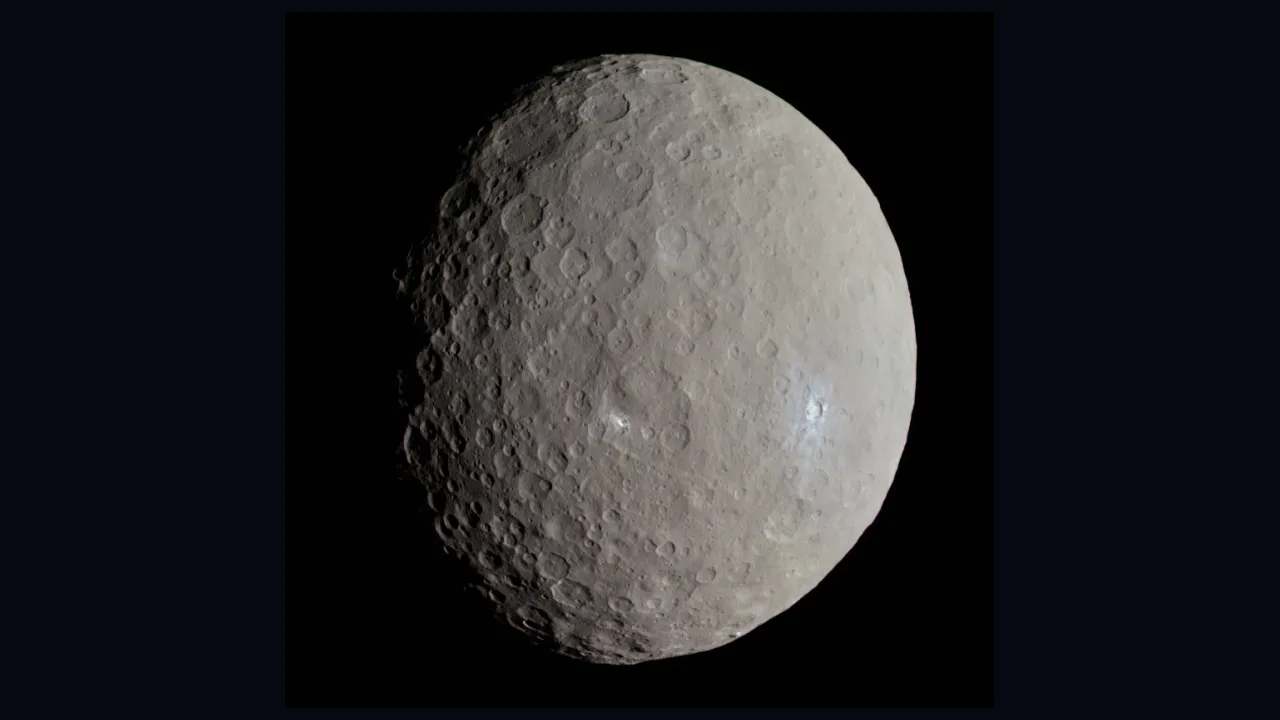
1. Where in the Solar System does dwarf planet Ceres orbit?
2. What makes the bright white spots inside Ceres's Occator Crater shine?
🤯 Mind-Blowing Fact • Grade 2
NASA's Dawn probe made history in 2015 by becoming the very first spacecraft ever to enter orbit around a dwarf planet!
✨ Word Sparks (Grade 2 Glossary)
Tap 🔊 to hear
Orbiter
A spacecraft that circles a world many times.
Brine
Extra-salty liquid water that resists freezing solid.
Mass
Total amount of stuff packed inside an object.
🪝
Why did Ceres change labels from planet to asteroid to dwarf planet?
1
Three Titles in History
When Italian astronomer Giuseppe Piazzi spotted Ceres on January 1, 1801, textbooks proudly listed it as the eighth planet! Decades later, telescopes found thousands of smaller neighbors in the same belt, so scientists called Ceres Asteroid Number One. Finally, in 2006, round Ceres teamed up with Pluto as an official dwarf planet!
2
Width of Texas
Measuring 584 miles across, Ceres is about as wide as the state of Texas and packs one-third of all the in the entire Asteroid Belt!
3
Visited by Dawn
NASA's Dawn spacecraft orbited Ceres for three years, mapping a lonely three-mile-tall ice volcano named Ahuna Mons!
1. How much of the entire Asteroid Belt's mass is packed inside Ceres alone?
2. Which NASA spacecraft orbited Ceres starting in 2015?
🤯 Mind-Blowing Fact • Grade 3
The bright salt domes inside Occator Crater contain sodium carbonate—the largest deposit of that baking-soda mineral ever found outside Earth!
✨ Word Sparks (Grade 3 Glossary)
Tap 🔊 to hear
Faculae
Dazzling bright mineral spots inside dark craters.
Sodium carbonate
White salty mineral related to household baking soda.
Mantle
Thick middle layer beneath a world's outer crust.
🪝
How can a lonely volcano ooze freezing salty mud instead of fiery red lava?
1
More Water Than You'd Guess
Unlike dry, stony asteroids nearby, Ceres is at least one-quarter water by weight! Beneath a dark, dusty clay crust lies a thick of muddy ice—meaning tiny Ceres actually holds plenty of frozen and salty water.
2
Baking-Soda Bright Spots
As NASA's Dawn spacecraft approached 57-mile-wide Occator Crater, over 130 bright patches called gleamed inside! Spectrometers proved those spots are —a cousin of household baking soda! An asteroid crash cracked the crust and let fizzy underground brine bubble to the surface.
3
Ahuna Mons, the Mud Volcano
Rising two and a half miles above cratered plains stands pyramid-shaped Ahuna Mons. Instead of melted rock, this young cryovolcano squeezed up thick domes of salty mud and ice!
4
Puffs of Water Vapor
Space telescopes even spotted thin puffs of water vapor rising off Ceres when its orbit swings closest to the Sun!
1. What kind of material erupted to build Ceres's 2.5-mile-tall mountain Ahuna Mons?
2. What familiar Earth mineral makes Occator Crater's bright faculae sparkle?
🤯 Mind-Blowing Fact • Grade 4
Dawn discovered tiny crystals of wet sea salt called hydrohalite inside Occator Crater that dry out quickly in space—proving salty water seeped up onto Ceres practically yesterday in geologic time!
✨ Word Sparks (Grade 4 Glossary)
Tap 🔊 to hear
Hydrohalite
Water-rich sea salt proving very recent brine seepage.
Phyllosilicate
Sheet-like clay mineral formed when rock meets water.
Did Ceres actually grow out past Jupiter before giant planets kicked it into the Asteroid Belt?
1
Clues of an Outer-System Immigrant
Orbiting 2.77 astronomical units from the Sun every 4.6 Earth years, Ceres looks oddly out of place beside bone-dry rocky asteroids like Vesta! Dawn's infrared spectrometer detected abundant ammoniated —ammonia-rich clays—across Ceres's dark surface. Because ammonia ice only froze in the frigid outer Solar System beyond Jupiter, planetary dynamicists think Ceres formed near the giant planets before gravitational scattering tossed it inward into the Asteroid Belt!
2
A Relict Ocean World
During Dawn's extended 2018 mission, the probe swooped just twenty-two miles above Occator Crater! High-resolution gravity and spectral data revealed —hydrated sea salt that dehydrates within centuries on an airless surface—proving a pocket of liquid brine still sloshes twenty-five miles underground today!
3
Why Hasn't Ceres's Crust Kept Huge Craters?
Curiously, Ceres has zero impact basins wider than 175 miles, even though asteroids hammered its neighborhood for four billion years. Warm, soft ice and salt inside its outer crust slowly crept and relaxed over geologic eons, smoothing giant ancient crater rims flat!
4
Organic Carbon Around Ernutet
Around northern Ernutet Crater, Dawn mapped sprawling thousand-square-kilometer patches of organic carbon molecules—combining underground liquid brines, clay minerals, carbonate salts, and rich carbon chemistry on one nearby dwarf planet!
1. What surface clue suggests Ceres originally formed out beyond Jupiter before migrating into the Asteroid Belt?
2. Why did finding hydrated salt (hydrohalite) at Occator Crater excite astrobiologists?
🤯 Mind-Blowing Fact • Grade 5
To find Ceres again after it disappeared behind the Sun's glare in 1801, 24-year-old mathematician Carl Friedrich Gauss invented the 'least-squares' math method still used in GPS navigation and data science today!
✨ Word Sparks (Grade 5 Glossary)
Tap 🔊 to hear
Effervesce
To fizz and bubble as dissolved gas escapes.
Chondritic
Made of ancient primitive stony meteorite minerals.
Escape velocity
Minimum speed needed to break free of gravity.
🪝
How did celestial hunting for a 'missing planet' unveil an astrobiologically rich relict ocean world?
1
Titius-Bode Hunt and Piazzi's Discovery
At the dawn of the nineteenth century, European astronomers organized the 'Celestial Police' to hunt for a missing planet predicted at 2.8 astronomical units between Mars and Jupiter. Before their search invitations even arrived in Sicily, Giuseppe Piazzi serendipitously spotted Ceres from Palermo Observatory on January 1, 1801—and young mathematician Carl Friedrich Gauss invented least-squares orbit determination to recover it after it slipped behind solar glare!
2
Clathrate Crust Strength and Muddy Differentiation
Spanning 964 by 964 by 892 kilometers with a mean bulk density of 2.162 grams per cubic centimeter, Ceres differentiated early into a hydrated -silicate core overlain by a 40-kilometer crust surprisingly twenty times stronger than pure water ice! Dawn gravity and topography data revealed that Ceres's crust is a rigid matrix of rock, salts, phyllosilicates, and methane-or-carbon-dioxide clathrate hydrates floating atop a denser, briny mud-rich mantle.
3
Impact Heat Plus Deep Brine Percolation at Occator
When a bolide excavated 92-kilometer Occator Crater roughly twenty-two million years ago, impact melt created a temporary warm chamber. Fractures reaching 40 kilometers down tapped a pre-existing regional brine reservoir, allowing dissolved carbon dioxide gas to upward like uncorked soda—depositing the central Cerealia Facula salt dome and outlying Vinalia Faculae!
4
Solar Energetic Particle Darkening and Organics
Around Ernutet Crater, Dawn's Visible and Infrared Mapping Spectrometer identified concentrated aliphatic hydrocarbons spanning 1,000 square kilometers. Laboratory radiation tests in 2023–2024 suggest cosmic rays degrade exposed organics within millions of years, implying an abundant internal organic supply mixed within Ceres's clay crust.
5
Accessible Sample-Return Frontier
Because Ceres orbits just 2.77 AU away with gentle (0.51 km/s), planetary decadal studies rank a Cerealia Facula sample-return lander among humanity's most achievable missions to test ocean-world habitability directly in Earth laboratories!