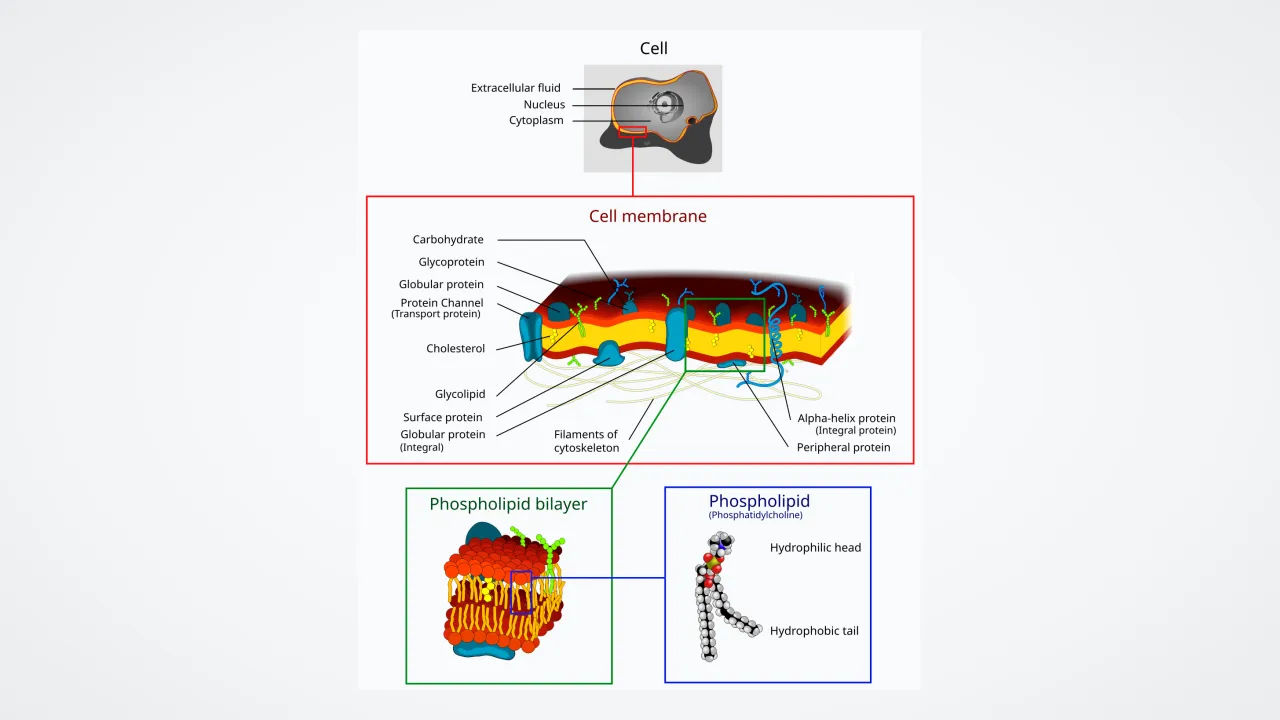
2. Is a human cell membrane stiff like rock or bendy like a bubble?
🤯 Mind-Blowing Fact • Grade 2
If a tiny microscopic needle pokes through a living cell membrane and pulls out, the oily layer flows right back together and seals itself automatically!
✨ Word Sparks (Grade 2 Glossary)
Tap 🔊 to hear
Bilayer
Double layer of molecules arranged back-to-back
Nutrient
Helpful food bit cells use to thrive
Glucose
Simple sugar fuel carried in your blood
🪝
How can a wrapper thinner than a soap bubble tell delicious sugar apart from unwanted waste?
1
A Two-Layer Sandwich
Zoom in with a super-strong microscope on the edge of any human cell! You will discover two neat rows of tiny fat-and-phosphate molecules lined up back-to-back like a double-decker sandwich.
2
Water-Loving Heads, Oil-Loving Tails
Each molecule has a round head that loves water and two wiggly tails that shy away from water. Because watery fluid sits both inside and outside your cells, the heads face outward while the oily tails hide safely in the middle!
3
Protein Tunnels and Tags
Floating inside that oily layer sit special protein tunnels and ID tags. Tunnels welcome helpful like inside while escorting waste right out.
Allowing certain molecules through while blocking others
Diffusion
Natural spreading from crowded to open spaces
🪝
Why do scientists describe your cell membrane as a 'fluid mosaic'—like colorful boats drifting on a tiny lake?
1
Meet the Phospholipid Bilayer
Biologists call the cell membrane—or plasma membrane—, meaning picky about visitors! Its foundation is a bilayer: billions of lollipop-shaped molecules whose hydrophilic (water-loving) heads face watery cytoplasm inside and body fluid outside, while hydrophobic (water-fearing) tails lock out stray dissolved ions.
2
Boats on a Microscopic Sea
Those aren't glued still—they glide sideways past one another millions of times per second! Embedded among them float cholesterol stabilizers, protein doorways, and sugar-tipped antennas, creating a shifting pattern scientists call the fluid mosaic model.
3
Free Rides vs. Ticketed Rides
Tiny nonpolar gases like oxygen and carbon dioxide slip straight across the bilayer for free in a process called . Larger travelers like glucose or charged sodium ions ride custom channel proteins or energy-powered pumps.
4
Antennas for Cell Teamwork
Carbohydrate chains sticking off the outer surface form ID badges called glycoproteins, helping T-cells recognize friendly body cells at a glance!
1. Which tiny molecules can slip straight across the phospholipid bilayer without needing a protein doorway?
2. Why is the cell membrane called a 'fluid mosaic'?
🤯 Mind-Blowing Fact • Grade 4
Roughly one-third of all the energy your resting body burns every day goes just to running tiny sodium-potassium pumps inside your cell membranes!
✨ Word Sparks (Grade 4 Glossary)
Tap 🔊 to hear
Aquaporin
High-speed membrane channel built solely for water
Active Transport
Using ATP energy to pump molecules uphill
Exocytosis
Fusing inner bubbles with membrane to export cargo
🪝
How does cholesterol—a molecule people often think is bad—actually keep your trillions of cell membranes from freezing or melting?
1
Cholesterol: The Fluidity Buffer
Tucked snugly between wiggly phospholipid tails inside animal cell membranes sit flat, four-ringed cholesterol molecules. Cholesterol acts as a brilliant temperature stabilizer: when your skin warms up during summer sports, cholesterol restrains phospholipids so the membrane doesn't turn too runny; when winter air chills your fingers, cholesterol prevents tails from packing stiffly together!
2
Passive Transport, Osmosis, and Aquaporins
Cells constantly balance traffic without wasting energy whenever possible. In passive transport, molecules flow down their concentration gradient from crowded areas to less crowded ones. Because water molecules are polar, they cross slowly through oily tails alone—so membranes install specialized hourglass-shaped water expressways called that funnel billions of water molecules per second during osmosis!
3
Active Pumps and Bubble Mail
Sometimes cells must push cargo uphill against the crowd. Active-transport proteins like the sodium-potassium pump spend ATP cellular energy to maintain electrical charges needed by every nerve and muscle! For oversize packages, the flexible membrane pinches inward to swallow droplets (endocytosis) or fuses internal bubbles outward to ship hormones ().
4
The Glycocalyx Sugar Coat
Branching carbohydrate chains along the outer leaflet weave a protective fuzzy coat called the glycocalyx, which determines A-B-O blood types, cushions passing cells, and guides developing embryonic cells into organized organs.
1. What helpful role does cholesterol play inside animal cell membranes?
2. What are the specialized membrane channels that let billions of water molecules zip into cells every second called?
🤯 Mind-Blowing Fact • Grade 5
In 1925, Evert Gorter and François Grendel floated extracted red-blood-cell fats on a tray of water, saw they covered exactly twice the cells' surface area, and deduced the phospholipid bilayer decades before anyone could photograph it!
✨ Word Sparks (Grade 5 Glossary)
Tap 🔊 to hear
Amphipathic
Having both water-loving and oil-loving molecular ends
Membrane Potential
Tiny electrical voltage maintained across cell membranes
Endocytosis
Folding membrane inward to bring cargo inside
🪝
How did two Dutch doctors measuring a single drop of red blood cells in 1925 prove that every cell membrane is exactly two molecules thick?
1
Gorter, Grendel, and Singer-Nicolson
Long before electron microscopes could resolve a seven-nanometer plasmalemma, Dutch scientists Evert Gorter and François Grendel performed an ingenious 1925 experiment. Extracting lipids from a counted sample of red blood cells—which conveniently lack nuclei or internal organelles—they spread those lipids as a single-molecule film across water and measured its area: it covered almost exactly twice the surface area of the intact cells, proving the plasma membrane is a lipid bilayer! In 1972, S. Jonathan Singer and Garth Nicolson completed our modern picture with the fluid mosaic model.
2
Amphipathic Asymmetry and Lipid Rafts
Each phospholipid pairs a polar phosphate-alcohol head with two hydrocarbon fatty-acid chains—typically one straight saturated tail and one kinked cis-unsaturated tail that preserves lateral fluidity. Enzymes called flippases maintain striking asymmetry between the two leaflets: phosphatidylcholine and sphingomyelin enrich the extracellular face, whereas negatively charged phosphatidylserine stays strictly inside unless a retiring cell flips it outward as an 'eat-me' signal for macrophages!
3
Electrochemical Gradients and Membrane Potential
Integral transmembrane proteins—spanning the hydrophobic core via alpha-helices—turn an insulating lipid barrier into a bioelectric battery. The electrogenic Na+/K+-ATPase exports three sodium ions for every two potassium ions imported per ATP hydrolyzed, establishing a resting voltage of roughly -70 millivolts across neurons that powers every thought, heartbeat, and secondary nutrient symporter.
4
Nobel-Prize Channels and Vesicular Trafficking
Peter Agre and Roderick MacKinnon shared the 2003 Nobel Prize in Chemistry for revealing at atomic resolution how aquaporins pass three billion water molecules per second while blocking protons, and how potassium channels select K+ ions over smaller Na+ ions. Meanwhile, clathrin-coated and SNARE-mediated exocytosis remodel membrane patches continuously.
5
Signal Transduction Without Crossing the Threshold
Peripheral and receptor tyrosine kinase proteins—alongside G-protein-coupled receptors—allow water-soluble hormones like epinephrine or growth hormone to dock outside the cell yet trigger amplifying enzyme cascades throughout the cytoplasm within milliseconds.