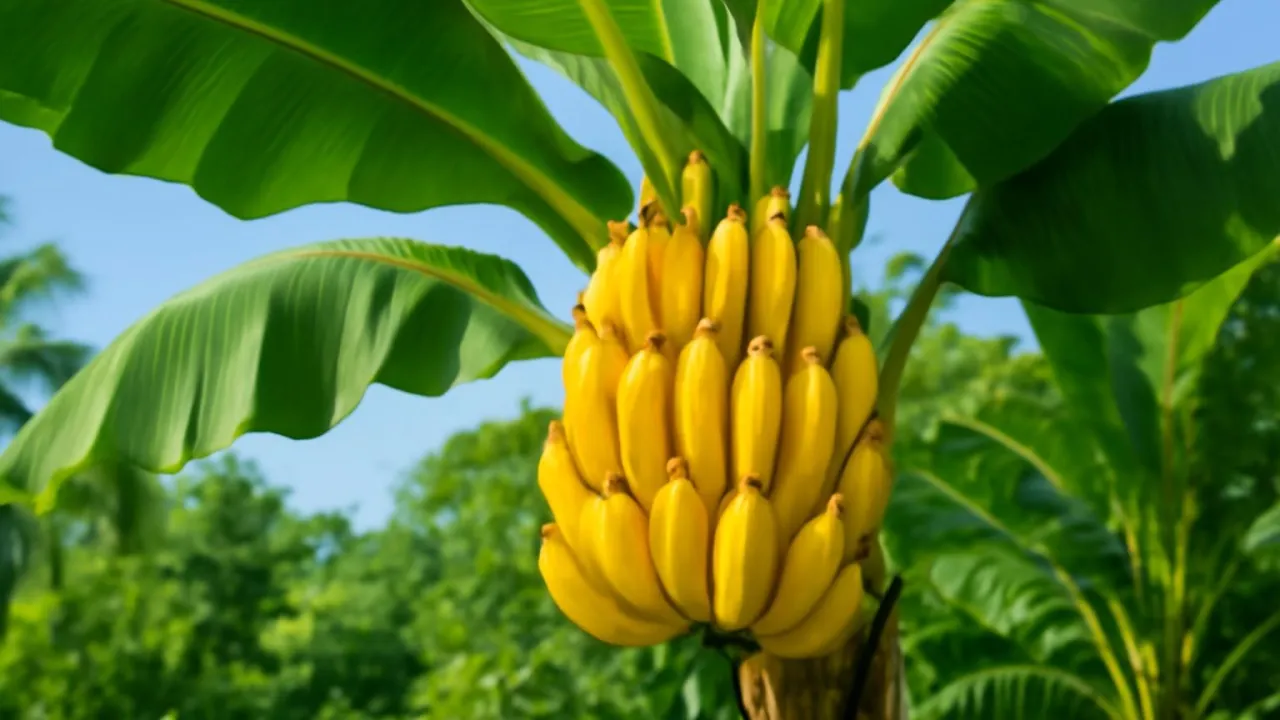
A single banana plant can grow over 100 bananas at once!
✨ Word Sparks (Grade 2 Glossary)
Tap 🔊 to hear
hand
A group of bananas together
ripen
To become ready to eat
vitamin
A nutrient that helps you grow healthy
🪝
Did you know bananas grow pointing up, not down?
1
Banana Plants Everywhere
Bananas grow in hot, rainy places called the tropics. The Cavendish banana is the kind most people eat. Each plant has huge green leaves and grows a bunch of bananas. The bananas start out green and turn yellow as they .
2
How Bananas Grow
Bananas do not grow on trees, but on tall plants. The bananas grow in big groups called , and each hand has many bananas. The fruit grows upward, reaching for the sun. Inside, bananas are soft and have no hard seeds.
3
Bananas in Your Lunch
Bananas are a favorite snack for kids and adults. They are easy to peel and eat anywhere. Bananas give your body energy and important . People use bananas in cereal, smoothies, and even baking.
Cavendish bananas are actually berries, not vegetables!
✨ Word Sparks (Grade 3 Glossary)
Tap 🔊 to hear
nutrient
Something in food that helps you grow
stem
The part of a plant that holds it up
potassium
A mineral that helps your muscles work
🪝
What if your favorite fruit never had seeds inside?
1
Bananas: Not Really a Tree
Cavendish bananas grow on giant plants that look like trees, but they are not real trees. The plant’s trunk is made from tightly wrapped leaves, not wood. Each plant grows one huge flower, which turns into a bunch of bananas. These banana bunches can weigh as much as a small child.
2
Seedless Wonders
Most fruits have seeds, but Cavendish bananas are special because they are seedless. Instead of seeds, they have tiny black specks that cannot grow new plants. Farmers grow new banana plants by cutting and planting pieces of the old plant’s . This way, bananas can keep growing without seeds.
3
Bananas and the World
Bananas need lots of sun, rain, and warm temperatures, so they grow in tropical countries. The Cavendish is the world’s most popular banana and is shipped to stores everywhere. Bananas are a major food for millions of people and are used in many recipes. Their soft flesh gives energy and important like .
4
Super Survival Skills
Banana plants have huge leaves that catch sunlight and help the plant make food. Their thick store water, helping them survive dry days. Bananas grow in bunches high above the ground, safe from many animals. Their bright yellow color tells people and animals when they are ripe and ready to eat.
1. How do farmers grow new Cavendish banana plants?
2. Why do banana plants have big leaves?
🤯 Mind-Blowing Fact • Grade 4
Every Cavendish banana you eat is almost a genetic twin to every other one!
✨ Word Sparks (Grade 4 Glossary)
Tap 🔊 to hear
clone
A copy made from one plant
export
To send goods to another country
fiber
A part of food that helps you digest
🪝
Imagine a fruit so popular it’s eaten in over 100 countries every day!
1
The Banana’s Global Journey
Cavendish bananas are grown in tropical regions like Central America, Africa, and Southeast Asia, where the climate is hot and rainy. These bananas are shipped all around the world, making them the most commonly eaten fruit in many countries. Their ability to travel long distances without spoiling quickly makes them perfect for . This global journey supports millions of farmers and workers in banana-producing countries.
2
Seedless and Special
Unlike most fruits, Cavendish bananas do not have real seeds, only tiny black dots that cannot grow. Instead, farmers use a method called cloning, where new plants are grown from cuttings of the old plant’s underground stem. This makes every Cavendish banana nearly identical, which is great for selling but risky if a disease spreads. Without genetic variety, one sickness could harm many banana crops at once.
3
Ecosystem Impacts
Banana plants provide food and shelter for insects, birds, and small animals in tropical ecosystems. However, large banana farms sometimes replace rainforests, which can harm native plants and animals. Farmers use fertilizers and pesticides to protect banana crops, but these chemicals can affect the soil and water. Sustainable farming tries to balance growing bananas with protecting the environment.
4
Bananas in Our Lives
Bananas are packed with nutrients like potassium, vitamin B6, and , which help our bodies stay healthy. People eat bananas raw, blend them into smoothies, or bake them into breads and cakes. Their soft texture and sweet taste make them a favorite snack for all ages. Even banana peels are useful—they can be composted to help gardens grow.
1. Why can a single disease threaten many Cavendish bananas?
2. What is one way banana farming can affect the environment?
🤯 Mind-Blowing Fact • Grade 5
Bananas are technically giant herbs, not trees, and each Cavendish banana is a nearly perfect clone!
✨ Word Sparks (Grade 5 Glossary)
Tap 🔊 to hear
parthenocarpic
A fruit that grows without seeds forming
pseudostem
A fake trunk made of leaf bases
biodiversity
The variety of living things in nature
🪝
Could the world’s favorite banana vanish because of its own genetic sameness?
1
A Fruit With a Scientific Story
The Cavendish banana, classified as Musa acuminata (Cavendish Group), dominates the global banana market, accounting for over 47% of worldwide production. Unlike wild bananas, which contain large, hard seeds, Cavendish bananas are —meaning they develop fruit without fertilization and contain only tiny, sterile black specks. Botanically, the banana is considered a berry, even though most people think of it as a fruit or vegetable. The Cavendish replaced the Gros Michel banana in the 1950s after disease wiped out most commercial crops. Today, bananas are cultivated in over 130 countries, making them one of the world’s top staple foods.
2
How Cavendish Bananas Grow and Multiply
Cavendish banana plants are herbaceous perennials, not trees, reaching heights of 10–15 feet (3–4.5 meters). Their 'trunk' is actually a made of tightly packed leaf bases, supporting massive leaves up to 9 feet long. The plant produces a single inflorescence, or flower cluster, which develops into a bunch containing 6–9 'hands' of bananas, each hand holding 10–20 individual fruits. Because Cavendish bananas are sterile, farmers propagate them by dividing underground stems called rhizomes or by planting tissue-cultured plantlets. This asexual reproduction ensures uniformity but also means all plants share nearly identical DNA.
3
Ecosystem and Human Impact
Large-scale Cavendish banana farming can lead to significant environmental changes, including deforestation, soil erosion, and loss of native . The use of synthetic fertilizers and pesticides protects crops from pests and diseases but can contaminate local water sources and harm non-target species. However, banana plants also provide shade, shelter, and food for various animals and insects in tropical ecosystems. Sustainable farming practices, such as integrated pest management and organic cultivation, aim to reduce negative impacts while maintaining high yields.
4
Nutrition and Global Importance
A medium Cavendish banana weighs about 4 ounces (120 grams) and provides roughly 105 calories, 27 grams of carbohydrates, and 422 milligrams of potassium. Bananas are rich in vitamin B6, vitamin C, and dietary fiber, supporting heart health and digestion. Their soft texture and natural sweetness make them ideal for infants, athletes, and people of all ages. In many countries, bananas are a dietary staple, providing essential nutrients and calories to millions of people every day. Even banana peels are used as animal feed or composted to enrich soil.
5
The Threat of Panama Disease
The Cavendish banana faces a major threat from Panama disease, caused by the soil fungus Fusarium oxysporum f. sp. cubense Tropical Race 4 (TR4). Because all Cavendish bananas are genetically similar, this disease can spread rapidly and devastate entire plantations. Scientists are working to develop resistant banana varieties using genetic engineering and traditional breeding. If TR4 spreads to more regions, it could dramatically reduce banana supplies and affect food security worldwide. Protecting banana diversity and supporting sustainable farming are crucial for the future of this beloved fruit.