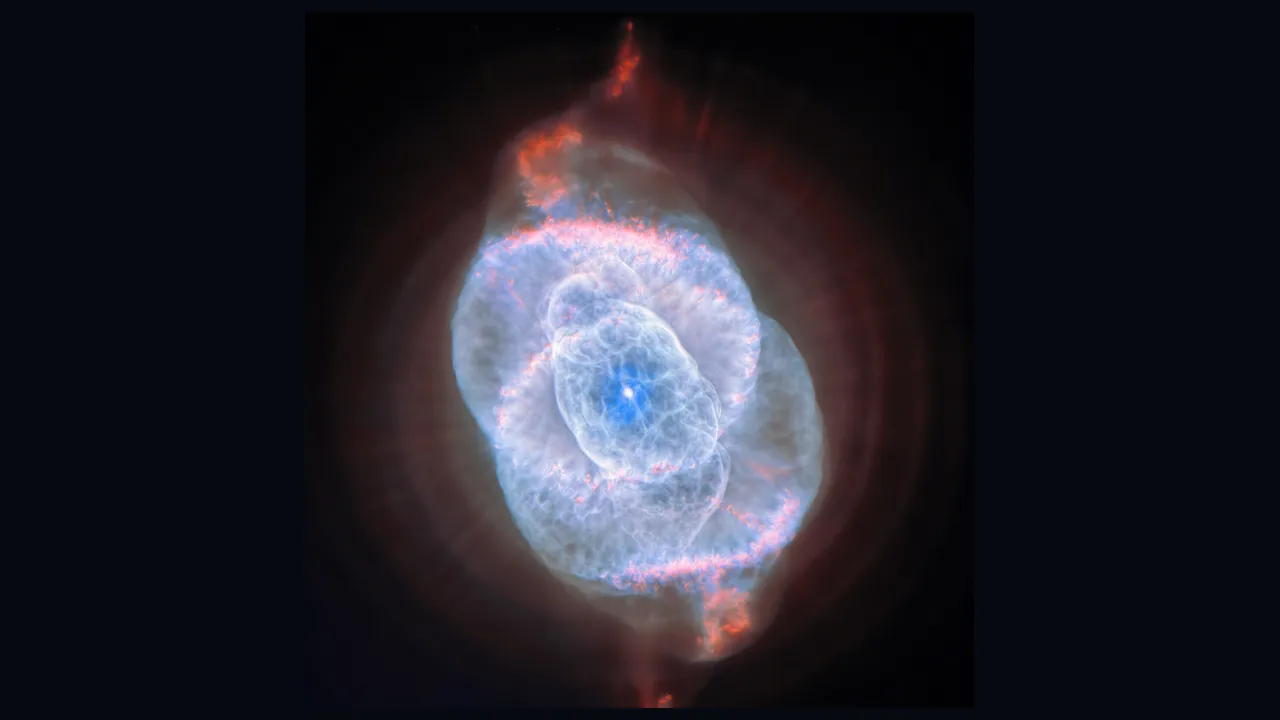
1. How many round dust shells wrap around the Cat's Eye Nebula like layers of an onion?
2. In which dragon constellation does the Cat's Eye Nebula shine?
🤯 Mind-Blowing Fact • Grade 2
When William Huggins split the Cat's Eye Nebula's light through his prism in 1864, instead of a full star rainbow he saw a single bright green line—unlocking modern astrophysics!
✨ Word Sparks (Grade 2 Glossary)
Tap 🔊 to hear
prism
Glass wedge splitting light into colors
bull's-eye
Target pattern of nested round rings
lace
Delicate crisscrossing web of fine threads
🪝
How did looking at the Cat's Eye Nebula in 1864 solve one of astronomy's biggest riddles?
1
Solving the Fuzzy-Cloud Mystery
For hundreds of years, nobody knew if fuzzy clouds in space were made of gas or just millions of tiny faraway stars blurred together. On August 29, 1864, astronomer William Huggins aimed a tool at the Cat's Eye Nebula—and proved for the very first time that nebulae are glowing clouds of hot gas!
2
Fancier Than Any Doughnut
Sitting 3,300 light-years away in Draco, the Cat's Eye Nebula has one of the twistiest, prettiest shapes ever photographed by the Hubble Space Telescope. Interlocking bubbles, bright knots, and twin fountains cross like .
3
Clockwork Hiccups
Around the twisty middle float eleven dust rings, puffed out like clockwork every 1,500 years!
1. What huge discovery did William Huggins make using the Cat's Eye Nebula in 1864?
2. About how often did the dying star puff out each of its eleven bull's-eye dust shells?
🤯 Mind-Blowing Fact • Grade 3
Beyond the eleven bull's-eye shells and bright inner eye, an even older ghostly halo of gas stretches more than five light-years across Draco!
✨ Word Sparks (Grade 3 Glossary)
Tap 🔊 to hear
ecliptic pole
Sky point straight above planets' orbits
spectroscope
Tool separating light to identify gases
shockwave
Compressed blast wave from fast collision
🪝
Why is the Cat's Eye Nebula twisted into knots, bubbles, and jets instead of one simple ring?
1
Right at the Sky's Top Pivot
Discovered by William Herschel in 1786, NGC 6543—the Cat's Eye Nebula—sits 3,300 light-years away in Draco. Curiously, it shines almost directly at the North , straight 'up' perpendicular to the flat disk where Earth and the planets orbit our Sun!
2
Eleven Shells Before the Finale
Long before weaving its bright inner eye, the aging red giant star pulsed every 1,500 years over the last 20,000 years. Each pulse launched an expanding sphere of dust that looks like a bright ring around its edge—stacking eleven bull's-eye shells!
3
Million-Mile-Per-Hour Winds
Roughly a thousand years ago, the exposed central star heated to 80,000 kelvins and unleashed a stellar wind screaming at four million miles per hour! That fast wind plowed into older gas, inflating hot X-ray bubbles spotted by NASA's Chandra telescope.
4
Wobbling Twin Jets
Twin narrow jets also sprayed outward like wobbling garden hoses, hinting that an unseen partner star tugs on the dying core.
1. What special sky landmark sits almost right beside the Cat's Eye Nebula in Draco?
2. Why do astronomers suspect an unseen companion star orbits inside the Cat's Eye Nebula?
🤯 Mind-Blowing Fact • Grade 4
Every single second, the tiny central star of the Cat's Eye Nebula blasts away twenty trillion tons of hot gas—more than three times the mass of Mount Everest per second!
✨ Word Sparks (Grade 4 Glossary)
Tap 🔊 to hear
emission line
Single bright color band from hot gas
precessing jet
Narrow gas beam wobbling in circles
halo
Faint outer cloud surrounding bright core
🪝
How did Hubble, Chandra, and 3D computer reconstructions untangle the most intricate planetary nebula in the sky?
1
Birthplace of Astronomical Spectroscopy
Night after night before August 1864, astronomers argued fiercely: were all nebulae simply distant star clusters too faint to resolve into dots, or did true luminous fluids float between the stars? When British pioneer William Huggins pointed his spectroscope at NGC 6543 in Draco, its single emerald-green oxygen settled the debate in seconds—giving birth to modern astrophysics!
2
Layered History of Mass Loss
Deep exposures by Hubble's Advanced Camera for Surveys revealed why the Cat's Eye Nebula fascinates theorists. Surrounding the bright 0.2-light-year inner core sit eleven sharp, concentric dust shells spanning over half a light-year, encircled even farther out by a ragged five-light-year ejected 50,000 to 90,000 years ago.
3
X-Ray Cavities and Fast Winds
At the center blazes an 80,000-kelvin Wolf-Rayet-type planetary nebula nucleus losing twenty trillion tons of gas every second in a 1,900-kilometer-per-second gale! NASA's Chandra X-ray Observatory mapped multimillion-degree plasma trapped inside the inner eye, inflating curved bubbles like a cosmic hot-air balloon.
4
3D Morpho-Kinematic Modeling
In 2022, astronomers combined Hubble Space Telescope imagery with ground-based Doppler spectrographs in Mexico to construct the first full 3D anatomical model of NGC 6543—revealing symmetrical warped rings painted on opposite ends of the nebula by a wobbling binary jet that switched off only centuries ago!
1. What inflates the bright inner bubbles of the Cat's Eye Nebula from the inside?
2. What did the 2022 3D kinematic model of the Cat's Eye Nebula reveal about its symmetrical outer rings inside the core?
🤯 Mind-Blowing Fact • Grade 5
Because NGC 6543 sits only four arcminutes from the exact North Ecliptic Pole, continuous-viewing space telescopes like TESS and JWST can monitor its sky zone year-round without our Sun ever blocking the view!
✨ Word Sparks (Grade 5 Glossary)
Tap 🔊 to hear
cadence
Regular repeating rhythm or time interval
tomography
Building 3D models from sliced measurements
point-symmetry
Matching features mirrored across a center
🪝
Why do eleven clockwork shells around NGC 6543 still puzzle stellar theorists 160 years after Huggins's prism breakthrough?
1
August 29, 1864: Light Decoded
Cataloged by German-British astronomer William Herschel in February 1786 near the North Ecliptic Pole in Draco (roughly 1,000 parsecs / 3,300 light-years away per Gaia astrometry), NGC 6543—the Cat's Eye Nebula—transformed humanity's grasp of deep space on August 29, 1864. Peering through his visual prism spectroscope in London, William Huggins exclaimed, 'No spectrum such as I expected! A single bright line only!' That 500.7-nanometer forbidden doubly ionized oxygen ([O III]) line proved luminous gaseous nebulae exist independently of unresolved star clusters.
2
Puzzle of 1,500-Year Concentric Shells
Deep Hubble Advanced Camera for Surveys exposures unveiled eleven-plus razor-sharp concentric spherical dust shells surrounding the inner core, each containing roughly one Solar System's planetary mass and ejected at ~1,500-year intervals during the final 20,000 years of asymptotic giant branch (AGB) evolution. That 1,500-year poses a classic astrophysical puzzle: internal helium-shell flashes repeat only every 10,000 to 100,000 years (too slow), whereas fundamental AGB pulsations repeat annually (too fast)—pointing toward solar-like magnetic dynamos or an eccentric wide binary companion!
3
Interacting Stellar Winds and X-Ray Plasma
Roughly a millennium ago, the exposed 0.6-solar-mass Wolf-Rayet-type planetary nebula nucleus heated to 80,000 kelvins at 10,000 solar luminosities, unleashing a 1,900-kilometer-per-second fast wind that shocked older AGB ejecta into two-million-kelvin X-ray-emitting plasma mapped cleanly by NASA's Chandra X-ray Observatory.
4
Precessing Jets and Point-Symmetry
Spatially resolved long-slit Doppler from Mexico's San Pedro Mártir Observatory combined with multi-decade Hubble expansion measurements reconstructed NGC 6543 in 3D: an inner prolate ellipsoid flanked by point-symmetric partial rings sculpted by a precessing bipolar jet.
5
Abundance Discrepancy Clues
High-resolution spectroscopy of the Cat's Eye also showcases a famous nebular mystery: faint optical recombination lines yield oxygen and neon abundances roughly three times higher than bright collisionally excited lines, pointing to cold, metal-rich plasma droplets ejected during binary star interaction.